Link Building for Startups: A Stage-by-Stage Playbook
Most link building advice assumes assets a startup doesn't have yet. Learn what actually works at DR 0, what to skip, and what your first budget buys.
- By
- Serpverse Team, SEO Experts
- Published
- Aug 9, 2026
- Read
- 12 min read
- startup link building
- link building
- startup SEO
- backlinks
 Serpverse
Open almost any link building guide and you'll find the same advice: publish original research, build a free tool, create integration pages, run a digital PR campaign. All of it works. None of it is available to a startup with eleven customers, no proprietary data, no partners, and eight months of runway.
Link building for startups is a different problem, and it isn't a smaller version of the same one. It's a sequencing problem — knowing which tactics are unlocked at your stage, which are still locked, and which are actively a waste of the only two resources you have. This guide maps the tactics to the stage.
Why Link Building for Startups Is a Different Problem
Established companies build links from a position of surplus. They have traffic to survey, customers to interview, integrations to announce, and a brand journalists recognise. Every high-leverage tactic in the standard playbook draws on one of those.
A startup has none of them yet, plus three constraints that don't apply later:
- Runway is the real deadline. SEO's payback period is measured in months. If your link building plan pays off in month fourteen and you're funded through month ten, the plan is wrong regardless of how good it is.
- Your domain has no history. Trust accrues slowly, and a brand-new domain converts links into rankings more slowly than an established one converts the same links.
- Every hour is contested. The hour you spend on outreach is an hour not spent on the product or on customers, and at this stage those usually compound faster.
That last point is the one most founders get wrong in both directions — either ignoring links entirely until they're structurally behind, or grinding outreach that a small budget could have bought outright.
Be Honest About What You Actually Have
Before choosing tactics, sort your assets into what exists today versus what you're pretending exists. The list is usually short and that's fine — it's the input to the sequence, not a judgement.
| Asset | Unlocks | Typical startup reality |
|---|---|---|
| Proprietary data | Research studies, industry benchmarks | Not until you have enough users to aggregate |
| Integrations / partners | Partner directory links, co-marketing | Not until the product has an ecosystem |
| A named audience | Surveys, community amplification | Not until you have a list worth surveying |
| Founder expertise | Guest posts, expert commentary, podcasts | Available on day one |
| A budget line | Paid placements | Available, usually small |
| A working product | Product-led content, launch coverage | Available at launch |
The two rows that are already green are the two the sequence is built on. Founder expertise and a modest budget are enough to build a real link profile — they just don't scale the way the tactics in a SaaS link building guide do. That guide is organised by business model and assumes the ecosystem assets above; this one is organised by stage and assumes you don't have them yet.
What to Skip in Your First Six Months
Skipping is the highest-leverage decision on this list, because these tactics aren't bad — they're just mispriced at your stage.
- Digital PR campaigns. Genuinely powerful, and genuinely expensive: BuzzStream's link building pricing analysis(opens in new tab) puts digital PR at roughly $1,250–$1,500 per unique link, with typical campaigns running $5,000–$10,000 to produce six or seven linking domains. That's a rational spend at Series A and a runway-shortening one before it.
- Building a free tool purely for links. A tool that earns links is a product in its own right — design, build, maintain, promote. Before product-market fit, that engineering time belongs in the actual product.
- The mass outreach grind. Cold outreach converts in the low single digits. Two hundred emails for four links is a fine trade for a dedicated outreach hire, and a terrible one for a founder.
- Chasing DR 70+ placements. They cost the most and, on a domain with no history, they're also the least likely to be granted editorially.
- Directory submission runs. The handful worth having take an afternoon. The other four hundred are a footprint, not a strategy.
A Stage-by-Stage Sequence
Stage 1 — Pre-launch to first customers
Your goal here is not rankings. It's a link profile that looks like a real company, so that later links have something to attach to.
Do the small set of things that are genuinely free and genuinely legitimate: your company's own profiles on the platforms your industry actually uses, the launch directories that carry real traffic, the podcasts and newsletters that will have a founder on. Write the two or three pieces only you can write — the technical decision you made and why, the thing you learned building the product, the number nobody else in your category publishes.
Expect a handful of links. That's the correct outcome. You're establishing that the domain exists and is associated with a real entity.
Stage 2 — Early traction
Now founder expertise becomes the engine. You have enough experience with real customers to say something specific, which is the only thing that gets a pitch accepted on merit.
This is also where a small paid budget starts beating your own time. A placement you buy costs money; a placement you earn through cold outreach costs several hours at a low conversion rate. Once your time has any real value, the arithmetic favours buying a meaningful share of your links and spending the saved hours on the pieces only a founder can produce.
Target relevance over authority. A DR 30 site your exact buyers read outperforms a DR 60 general-marketing blog, and it costs less.
Stage 3 — Post-seed and scaling
The locked assets start unlocking. You now have enough usage data to publish something original, enough partners for integration pages, and enough budget for digital PR to price sensibly. This is the point at which the standard playbook — and the tactics in the SaaS guide — becomes the right reading.
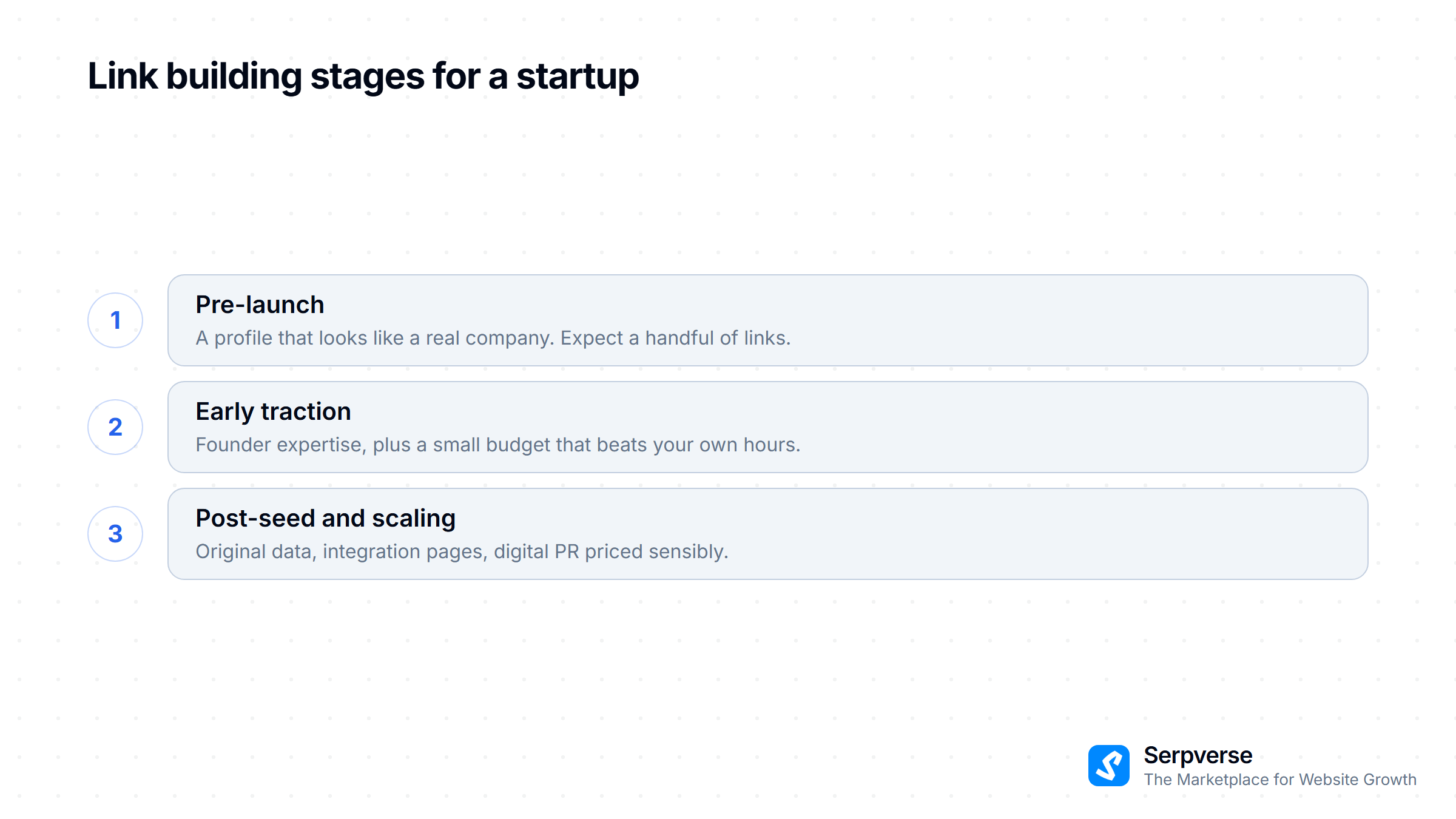
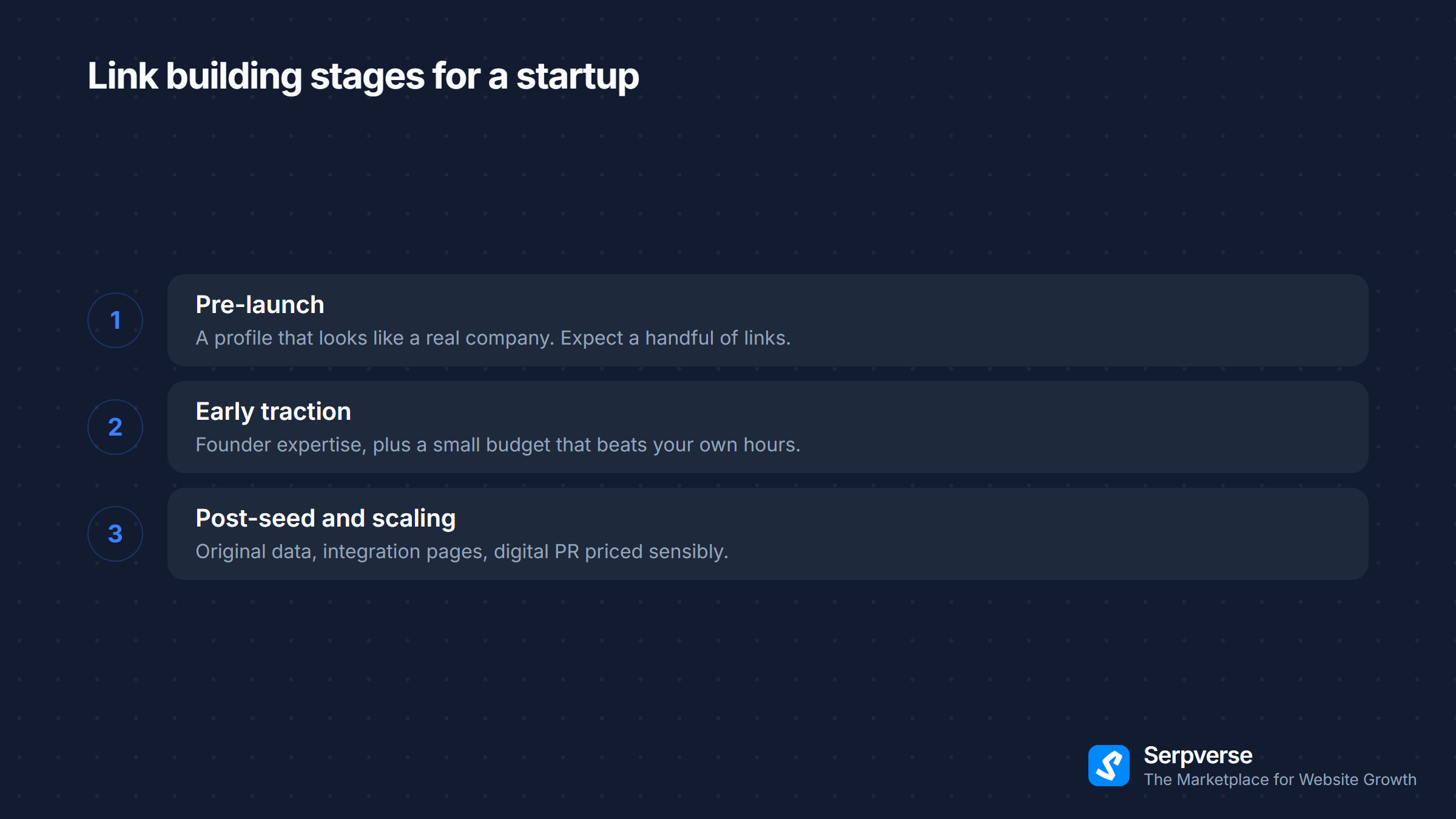
The sequence matters more than any individual tactic in it. Skipping to stage three doesn't accelerate anything; it just spends stage-three money on a domain that isn't ready to convert it.
What a Startup Link Budget Actually Buys
Founders consistently overestimate what a small budget buys, mostly because the cheapest inventory advertises hardest. Real market rates, per the same BuzzStream dataset, average $295 for a guest post bought directly from a site and $461 through a vendor.
At those rates a realistic monthly budget looks like this:
| Monthly budget | Realistic output | What it should be spent on |
|---|---|---|
| Under $500 | 1–2 mid-tier placements | Tightly relevant sites in your exact niche |
| $500–$1,500 | 3–5 placements | A mix of relevance plays and one stronger domain |
| $1,500–$4,000 | 6–12 placements | Consistent monthly cadence; begin targeting competitive terms |
The trap at the bottom of that table is assuming a small budget means buying cheaper links rather than fewer of them. It means fewer. BuzzStream's analysis found that only 1.37% of guest post sites met a basic quality bar of DR/DA above 65 with at least 10,000 monthly visits — the inventory that advertises at $30 is drawn almost entirely from the other 98.6%.
Three genuinely relevant placements a quarter will move a young domain further than thirty cheap ones, which will move it backwards. If you're calibrating what a given placement should cost, our guide to the cost of a backlink breaks the market rates down by placement type.
Guest Posts or Link Insertions When You're Starting From Zero
Both are available to buy, and they behave differently on a young domain.
A link insertion — your link added into an article that already exists and already ranks — is cheaper and faster, averaging $179 against a guest post's $295. The appeal at seed stage is obvious. The catch is that you're buying a slot in someone else's content, so you control neither the context nor how long it survives an editorial cleanup.
A guest post is a new article built around your link. It costs more and takes longer, but the page is written for your topic, the link sits in context you chose, and it reads as editorial because it is.
For a startup with a thin profile, weight toward new articles early. A young domain benefits from links that are unmistakably editorial and topically tight, and an insertion bought cheaply into an unrelated post is exactly the pattern that looks purchased. Once you have a base of relevant placements, insertions become a reasonable way to add volume. If you're new to the format, niche edits explained covers how insertions work and where the risk actually sits.
How to Measure Progress Before You Rank
The hardest part of startup link building is that the metric you care about — rankings for commercial terms — won't move for months. Watching it daily produces panic and abandoned strategies. Watch leading indicators instead:
- Referring domains, not links. Ten links from one site is one vote. Track unique domains; it's the number that reflects real profile growth.
- Relevance ratio. What share of your new domains are genuinely in your category? On a young site this predicts outcomes better than average DR does.
- Indexed and live. Check that placements are indexed and still present after 90 days. Links that quietly disappear are a cost you already paid.
- Long-tail movement first. Low-competition terms move before your money keywords do. That's the earliest honest signal the profile is working.
Set the expectation internally that meaningful ranking movement takes months, not weeks — our timeline on how long SEO takes is a useful thing to send a board member before they ask. And if you need a sense of scale for a specific target, how many backlinks you need to rank is a better planning input than a generic monthly quota.
Mistakes That Cost Startups the Most
- Buying volume because it's affordable. The cheap tier isn't a discount on the same product; it's a different, worse product with a penalty risk attached.
- Optimising for DR alone. Authority with no traffic behind it is usually inflated. Relevance and real visitors predict value far better on a young domain.
- Front-loading exact-match anchors. A new domain whose earliest links all use commercial anchor text is the clearest unnatural pattern there is.
- Stopping at three months. Links compound with a lag. Quitting just before the lag ends is the single most expensive mistake on this list.
- Ignoring disclosure rules. Google's link spam policies(opens in new tab) treat links exchanged for money as spam unless they carry
rel="sponsored"orrel="nofollow". Buying placements is not the risk; buying undisclosed followed links at scale is.
Where a Marketplace Fits
The reason paid placements suit early-stage teams is that they convert an unpredictable time cost into a fixed, known one. The reason founders are right to be wary is that most of the market is opaque — quoted per email, unvetted, and impossible to compare.
A transparent marketplace closes that gap. On Serpverse every listing shows its price, authority, traffic, and niche up front, so you can filter to the sites your buyers actually read and compare like for like. Publishers are verified before they can list, payment is held in escrow until the placement is live and you've approved it, and you get a review window to check the result.
One detail matters more at this stage than any other: you can order a placement as either a Guest Post, where you supply the article, or an Article, where the publisher writes it to your brief. A startup with no content team can build links without first hiring a writer — which, for most teams reading this, is the actual bottleneck.
Key Takeaways
- Stage, not business model, determines your tactics. The standard playbook assumes data, partners, and an audience you don't have yet.
- Skip digital PR, tool-building, and the outreach grind early. They're good tactics priced for a later stage.
- Founder expertise and a small budget are enough to build a legitimate profile — they just don't scale, and they don't need to yet.
- A small budget buys fewer links, not cheaper ones. Only 1.37% of guest post inventory clears a basic quality bar; the cheap tier is drawn from the rest.
- Weight toward new articles before insertions while your profile is thin, and toward relevance over authority throughout.
- Measure referring domains, relevance, and survival at 90 days — the rankings you care about will move last.
The startups that win at search aren't the ones that ran the biggest campaigns early. They're the ones that bought a small number of genuinely relevant links every month, from the stage they could afford it, and didn't stop.