How Many Backlinks Do You Need to Rank?
Wondering how many backlinks you need to rank? There is no fixed number. Learn the variables that decide it and how to estimate your real target.
- By
- Serpverse Team, SEO Experts
- Published
- Jun 22, 2026
- Read
- 10 min read
- backlinks
- link building
- SEO ranking
- referring domains
 Serpverse
"How many backlinks do you need to rank on page one?" is one of the most common questions in SEO, and one of the most misunderstood. People want a single number: 50 links, 100 links, 300 links. The honest answer is that no such number exists. The right amount of links is entirely relative to the keyword you are chasing, the sites you are competing against, and the authority your own domain already carries. This guide explains why, and gives you a repeatable method to estimate the target for any keyword instead of guessing.
The Short Answer: It Depends
The number of backlinks you need to rank depends on the competitiveness of the keyword and how strong the existing top-ranking pages are. For a low-competition, long-tail query, you might rank with a handful of links or none at all. For a high-value commercial term, you may need links from hundreds of unique websites. There is no fixed quota — only a target relative to what is already ranking.
That answer frustrates people who want certainty, but it is the only accurate one. Google itself is explicit on this point: in its SEO Starter Guide(opens in new tab), the company states there are "no secrets here that'll automatically rank your site first." Ranking is the output of dozens of weighted signals, and backlinks are one input among many.
So the useful question is not "how many backlinks do I need?" in the abstract. It is "how many do I need for this specific keyword, given my current site?" That question has an answer, and you can estimate it.
Why There Is No Fixed Number
Ranking is competitive and relative. You are not clearing an absolute bar set by Google — you are trying to out-signal the pages currently occupying the positions you want. Those pages move targets. The links required to outrank a thin affiliate page are trivial; the links required to outrank an established industry publication with a decade of authority are enormous.
Two factors make a universal number impossible:
- Backlinks are one ranking factor among many. Content relevance, search intent match, on-page optimisation, page experience, internal linking, and domain-level authority all contribute. A page with fewer links but a far better intent match can outrank a heavily-linked competitor.
- Link quality varies wildly. One editorial link from a trusted, topically-relevant site can outweigh dozens of low-value directory or comment links. Counting links without weighting their quality produces a meaningless number.
Anyone selling you a specific figure — "300 backlinks guarantees page one" — is selling a fiction. The variables below are what actually decide it.
The Variables That Decide How Many Backlinks You Need
Before you can estimate a target, you need to understand the levers. These four variables determine the link requirement for any given keyword.
| Variable | Effect on links needed | Why |
|---|---|---|
| Keyword difficulty / competition | Higher = more links | Competitive terms are contested by stronger pages with bigger link profiles |
| Strength of current ranking pages | Stronger competitors = more links | You must out-signal the pages already in the positions you want |
| Your existing domain authority | Higher = fewer links per page | An established, trusted domain ranks new pages on less individual link support |
| Content quality & intent match | Better content = fewer links | A superior page that nails search intent needs less link support to compete |
The interplay matters more than any single variable. A high-authority site publishing genuinely excellent content that matches intent precisely can rank competitive terms with surprisingly few page-level links — because the domain's accumulated trust and the content's quality are doing much of the work. A brand-new site chasing the same term may need a substantial link profile just to be considered. For a deeper look at how that accumulated trust is measured, see our guide on what domain authority means and how it works.
Why Referring Domains Matter More Than Raw Link Count
Here is the single most important correction to the "how many backlinks" question: the metric that correlates with rankings is not the total number of backlinks — it is the number of unique referring domains linking to you.
A referring domain is a distinct website that links to you at least once. Fifty links from one blog count as fifty backlinks but only one referring domain. Search engines treat each new domain as an independent vote of confidence, and the marginal value of repeat links from a domain you already have falls off quickly.
This is why "I have 500 backlinks" tells you almost nothing on its own. Five hundred links from twelve domains is a weak, narrow profile. Eighty links from eighty different domains is a far stronger one, despite the lower raw count. When you benchmark a keyword, count referring domains, not total links. Our deep-dive on why referring domains matter more than total backlinks covers the diminishing-returns curve in detail.
How to Estimate Your Target by Analysing the Top Results
You do not have to guess. The pages currently ranking for your keyword have already revealed the approximate link profile Google expects to see in those positions. Reverse-engineer it.
A step-by-step method
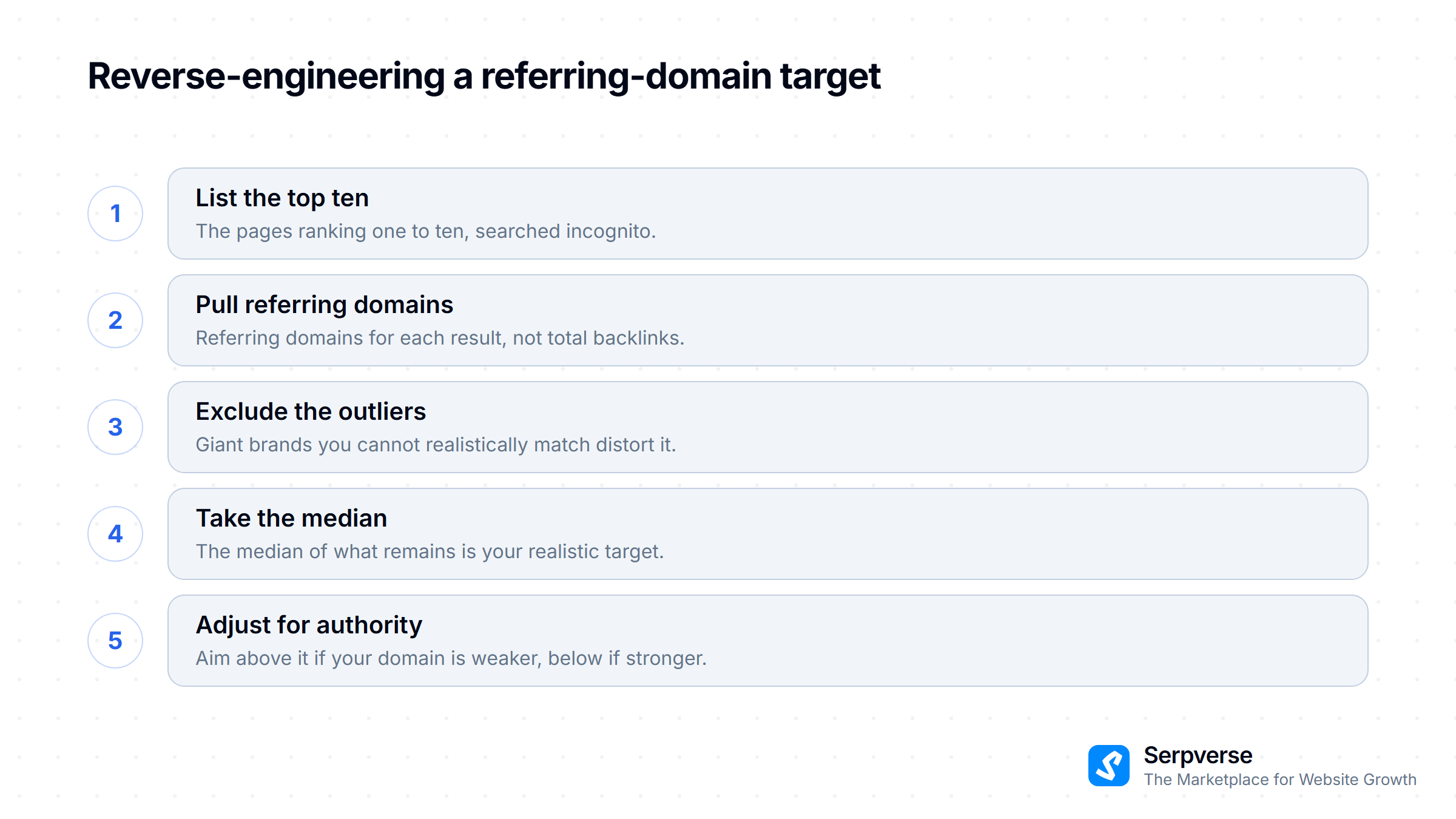
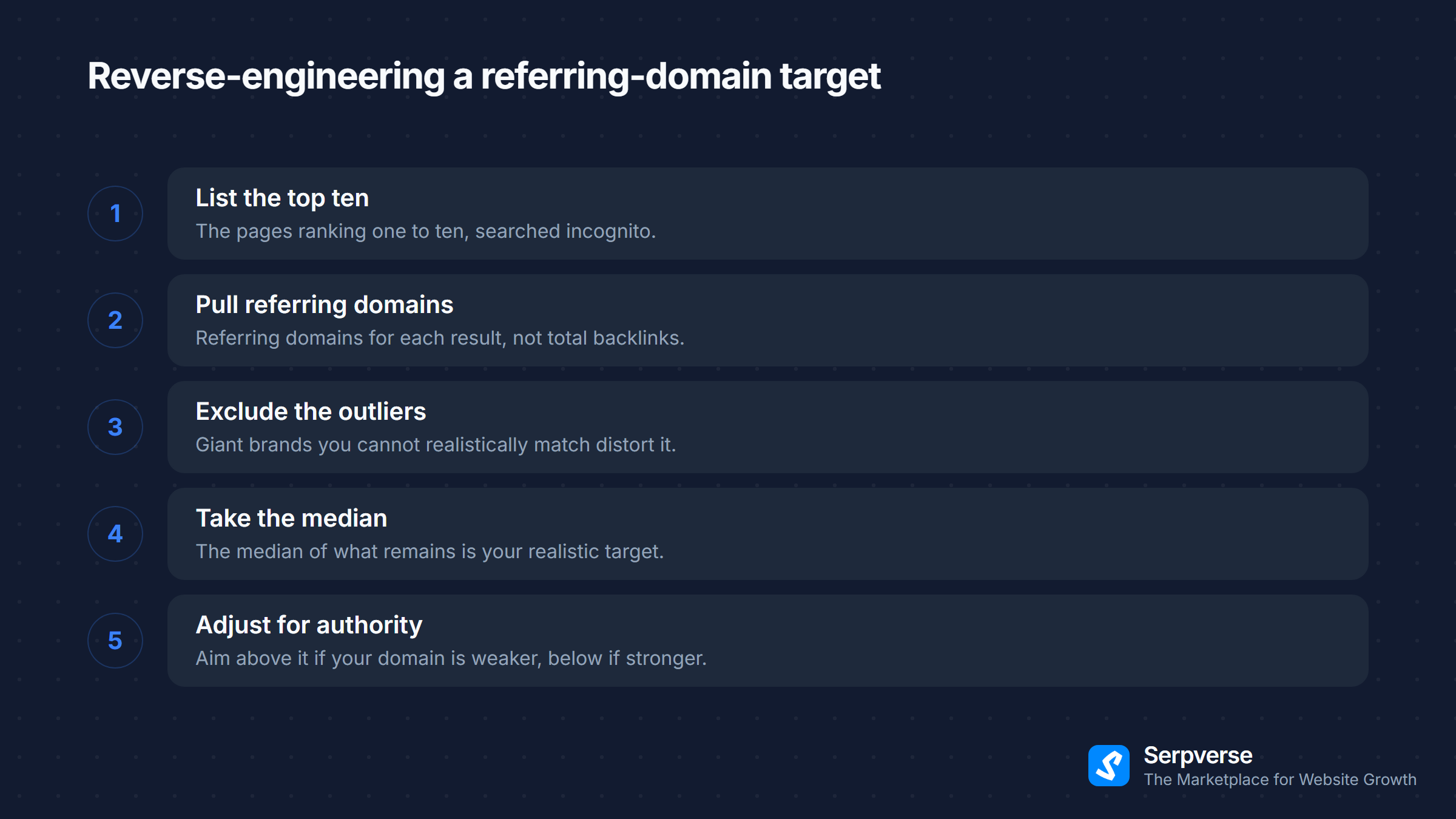
- Search your target keyword in an incognito window and list the pages ranking in positions one through ten.
- Pull the referring domain count for each using a backlink tool (Ahrefs, Semrush, Moz, or Majestic all expose this). Record referring domains, not total backlinks.
- Exclude the outliers. Drop giant brands and Wikipedia-style results that rank on domain authority you cannot realistically match — they distort the picture.
- Take the median of the remaining pages. That median is your realistic referring-domain target to compete in that set.
- Adjust for your own authority. If your domain is weaker than those competitors, aim slightly above the median. If it is stronger, you can aim at or below it.
This turns an unanswerable question into a concrete, keyword-specific estimate. Repeat it per keyword — a target that holds for one term will be wrong for another.
Look at the page level, not just the domain
A common mistake is benchmarking the competitor's whole domain instead of the specific page that ranks. Google ranks pages. A site with 10,000 site-wide referring domains might rank an article that has only fifteen links pointing directly at it. Benchmark the referring domains to the ranking URL, then supplement with the domain-level picture. A full competitor backlink analysis walks through this page-versus-domain distinction and how to run a link gap analysis to find the exact domains you are missing.
Quality Over Quantity: Why the Count Is Only Half the Story
Even a well-benchmarked number is misleading if you treat all links as equal. A handful of strong links can outperform a large pile of weak ones, so chasing a raw count can send you in the wrong direction.
Weight your benchmarking by link quality:
- Relevance. A link from a site in your niche carries more weight than one from an unrelated domain, even at a similar authority level.
- Authority. A link from a trusted, established site moves the needle more than one from a brand-new or low-trust domain.
- Placement. An editorial, in-content link beats a footer, sidebar, or author-bio link.
- Followed vs. nofollow. A followed link passes ranking signals more directly, though a natural profile contains a mix of both.
The practical implication: if the median competitor has thirty referring domains but they are high-authority, in-niche editorial links, you need thirty links of comparable calibre — not thirty links from low-value directories. Quality is what makes the count meaningful. Once you have a target number, our guide to the cost of a backlink covers what closing that gap actually costs and how to set a defensible ceiling per link.
A Caution on Link Velocity
Once you have a target, resist the urge to hit it overnight. Link velocity — the rate at which you acquire new links — is itself a signal. A profile that jumps from twenty referring domains to two hundred in a single month looks engineered, and an unnatural spike can attract scrutiny rather than rankings.
Natural link profiles grow steadily and unevenly: a few new domains most months, an occasional spike when a piece of content earns attention, and quiet stretches in between. Aim to mirror that pattern. Consistent acquisition over months outperforms a one-time burst, both for safety and for results. If you are unsure what "natural" looks like, our guide on building a natural backlink profile covers the ratios and growth patterns search engines trust.
Velocity also explains why link building is a sustained programme, not a sprint. The links you build this month rarely move rankings this month — discovery, crawling, and re-evaluation take time, which is one reason SEO results take as long as they do to materialise.
What the Data Actually Says
The strongest publicly available evidence reinforces the relative, no-fixed-number view. Ahrefs' large-scale study(opens in new tab) found a clear correlation between the number of websites linking to a page and the traffic it receives, and concluded that ranking for competitive terms without a link profile is "almost impossible." Crucially, the same research notes that low-competition topics can rank with few or no links.
That is the whole thesis in one finding: links matter, the number scales with competition, and there is no universal threshold. The data tells you more links generally help in competitive niches — it does not, and cannot, hand you a fixed quota.
Putting It Together
Stop looking for a magic number and start benchmarking. Here is the workflow in brief:
- Accept there is no universal number — the target is always relative to the keyword and the competition.
- Count referring domains, not raw backlinks — unique linking domains are what correlate with rankings.
- Benchmark the actual top results — take the median referring-domain count of the realistic competitors for each keyword.
- Adjust for your domain's authority and your content's quality — stronger on both fronts means fewer links needed.
- Weight by quality — relevant, authoritative, editorial links beat a larger count of weak ones.
- Grow at a natural velocity — steady acquisition over months, not an overnight spike.
Once you know your per-keyword target, the work shifts to acquiring those links from relevant, authoritative sites. Earning placements on quality publishers in your niche is exactly what a marketplace like Serpverse is built for — connecting you with vetted sites so each new placement adds a fresh referring domain to your profile, at a pace that looks natural rather than manufactured.
The teams that rank consistently are not the ones who guessed a number. They are the ones who measured what it actually takes for each keyword, then built toward it deliberately.