How Long Does SEO Take? A Realistic Month-by-Month Timeline
Discover how long SEO takes to show results. A month-by-month timeline covering factors that speed up or slow down rankings, traffic, and ROI.
- By
- Serpverse Team, SEO Experts
- Published
- Apr 10, 2026
- Read
- 10 min read
- SEO timeline
- SEO results
- link building
- organic traffic
- keyword rankings
 Serpverse
"How long does SEO take?" is the first question every buyer asks before investing in link building or content marketing. The honest answer is uncomfortable: it depends. But "it depends" is not useful advice, so this article gives you the specific factors, realistic timelines, and a month-by-month breakdown of what to expect from a typical SEO campaign.
Understanding these timelines upfront prevents premature abandonment of strategies that are working but have not yet matured.
Why SEO Does Not Produce Instant Results
Paid advertising delivers traffic the moment you turn it on. SEO does not work that way. Search engines need time to crawl your content, evaluate your backlinks, assess your authority, and test your pages against competitors.
Three fundamental processes create the delay:
- Crawling and indexing: Google must discover your content and add it to its index. This can take days to weeks depending on your site's crawl frequency.
- Authority evaluation: New backlinks need to be crawled, attributed, and weighted. Google does not instantly trust a link the moment it appears — how long backlinks take to work sets out that chain stage by stage.
- Ranking testing: Google often tests pages at various positions before settling on a stable ranking, a process that can take weeks per keyword.
These are not inefficiencies. They are deliberate quality mechanisms that prevent manipulation and ensure stable results.
Factors That Accelerate SEO Results
Not all sites start from the same position. These factors determine whether you see results in 3 months or 12.
Domain Age and Existing Authority
Established domains with existing backlinks and indexed content have a significant head start. A site with a Domain Authority of 40+ that publishes new content will see it rank faster than a brand-new domain, because the authority foundation is already in place.
New domains face what some SEOs call the "sandbox" period: an informal observation phase where Google is slower to rank new content from unproven sites. This is not an official Google mechanism, but the effect is widely observed.
Competition Level
The keyword landscape matters enormously. Consider two scenarios:
| Factor | Low Competition | High Competition |
|---|---|---|
| Example keyword | "best CRM for landscaping businesses" | "best CRM software" |
| Typical time to page 1 | 2-4 months | 8-14 months |
| Links needed | 5-15 quality links | 50-200+ quality links |
| Content depth required | 1,500-2,000 words | 3,000-5,000+ words |
Understanding your competitive landscape prevents setting unrealistic expectations. A competitor backlink analysis reveals exactly what you are up against.
Content Quality and Relevance
Google's helpful content system evaluates whether your content genuinely serves search intent. Pages that comprehensively answer the searcher's question rank faster because they generate positive user signals: lower bounce rates, longer dwell time, and fewer pogo-sticking returns to the SERP.
Thin, generic content stalls in positions 20-50 regardless of how many links point to it.
Link Velocity and Quality
Link velocity is the rate at which you acquire new backlinks. Consistent, gradual acquisition signals natural growth. A sudden spike of 100 links followed by silence looks artificial and may trigger scrutiny.
Quality matters more than quantity. Five links from relevant, authoritative sites in your niche will accelerate rankings faster than fifty links from unrelated, low-authority domains. For more on what makes a healthy link acquisition pattern, read about building a natural backlink profile.
Technical SEO Foundation
Technical issues create friction that slows everything else. Sites with fast load times, clean architecture, proper crawlability, and mobile optimization give search engines no reason to deprioritize their content.
Common technical blockers that delay results:
- Slow page speed (Core Web Vitals failures)
- Broken internal links and crawl errors
- Duplicate content issues
- Missing or incorrect canonical tags
- Poor mobile experience
Fix technical issues before investing heavily in content and links. Building on a broken foundation wastes both time and money.
Month-by-Month Timeline for a Typical Campaign
This timeline assumes a site with moderate existing authority (DA 20-35), targeting keywords with medium competition, and executing a consistent strategy of content creation plus link building.
Month 1: Foundation and Setup
Activities: Technical SEO audit and fixes, keyword research, content strategy development, initial content production, first link building outreach.
Expected results: No ranking changes yet. This month is about preparation. Your new content is being crawled and indexed. Your first links are being discovered by search engines.
What you should track: Pages indexed, crawl errors resolved, baseline keyword positions recorded.
Month 2: Early Signals
Activities: Continued content publication, ongoing link acquisition (5-10 links), internal linking optimization.
Expected results: Minimal visible movement. Some long-tail keywords may enter the top 100. Your domain authority may show a small uptick.
What you should track: New keywords appearing in Search Console, impressions growth (even without clicks).
Month 3: Momentum Building
Activities: Content velocity increases, link building continues (10-15 cumulative links), first content updates based on early performance data.
Expected results: Target keywords begin moving into positions 15-30. Long-tail keywords may reach page 1. Organic traffic shows a modest increase (10-20% over baseline).
What you should track: Keywords entering top 20, first referral traffic from link placements, Search Console click-through rate trends.
Month 4-5: Visible Progress
Activities: Consistent link building (20-30 cumulative links), content expansion, guest posting for both links and brand visibility.
Expected results: Primary keywords reach positions 8-15. Organic traffic increases 30-60% over baseline. Some pages begin generating meaningful traffic. DA/DR shows clear upward trend.
What you should track: Keywords on page 1, organic traffic per page, conversion data from organic visitors.
This is often the phase where patience is most tested. You can see progress, but you are not yet in the top positions where the majority of clicks happen. Understanding how search engines rank pages helps you interpret these mid-stage movements.
Month 6-8: Compounding Returns
Activities: Scaling what works, cutting what does not, advanced content strategies (topic clusters, content upgrades), continued link building at a steady pace.
Expected results: Multiple keywords reach top 5 positions. Organic traffic reaches 2-3x baseline. Referral traffic from placements becomes a consistent secondary channel. Lower-competition keywords may reach position 1.
What you should track: Revenue or conversions attributed to organic traffic, keyword position distribution (percentage in top 3, top 10, top 20), month-over-month traffic growth rate.
Month 9-12: Maturity and Scale
Activities: Expanding to new keyword clusters, building topical authority across related topics, optimizing conversion paths for organic traffic.
Expected results: Primary keywords stabilize in top 5 positions. Organic traffic reaches 3-5x baseline. New content ranks faster because of established domain authority. SEO becomes a self-reinforcing channel.
What you should track: Customer acquisition cost from organic vs. paid, lifetime value of organic traffic, new keyword opportunities unlocked by established authority.
The Compounding Nature of SEO
SEO is not linear. It compounds. This is the single most important concept for setting expectations.
In month 1, a new link marginally improves your authority. In month 8, that same link adds to a foundation of 40+ links, established content authority, and positive user signals. The marginal impact of each action grows over time.
This compounding also applies to content. New articles on a domain with established authority rank faster than the first articles did. A site that took 6 months to rank its first keyword might rank new keywords in 2-3 months a year later.
The implication: abandoning SEO at month 4 because results seem slow means forfeiting the compounding returns that were about to materialize.
Setting Expectations for Link Building Buyers
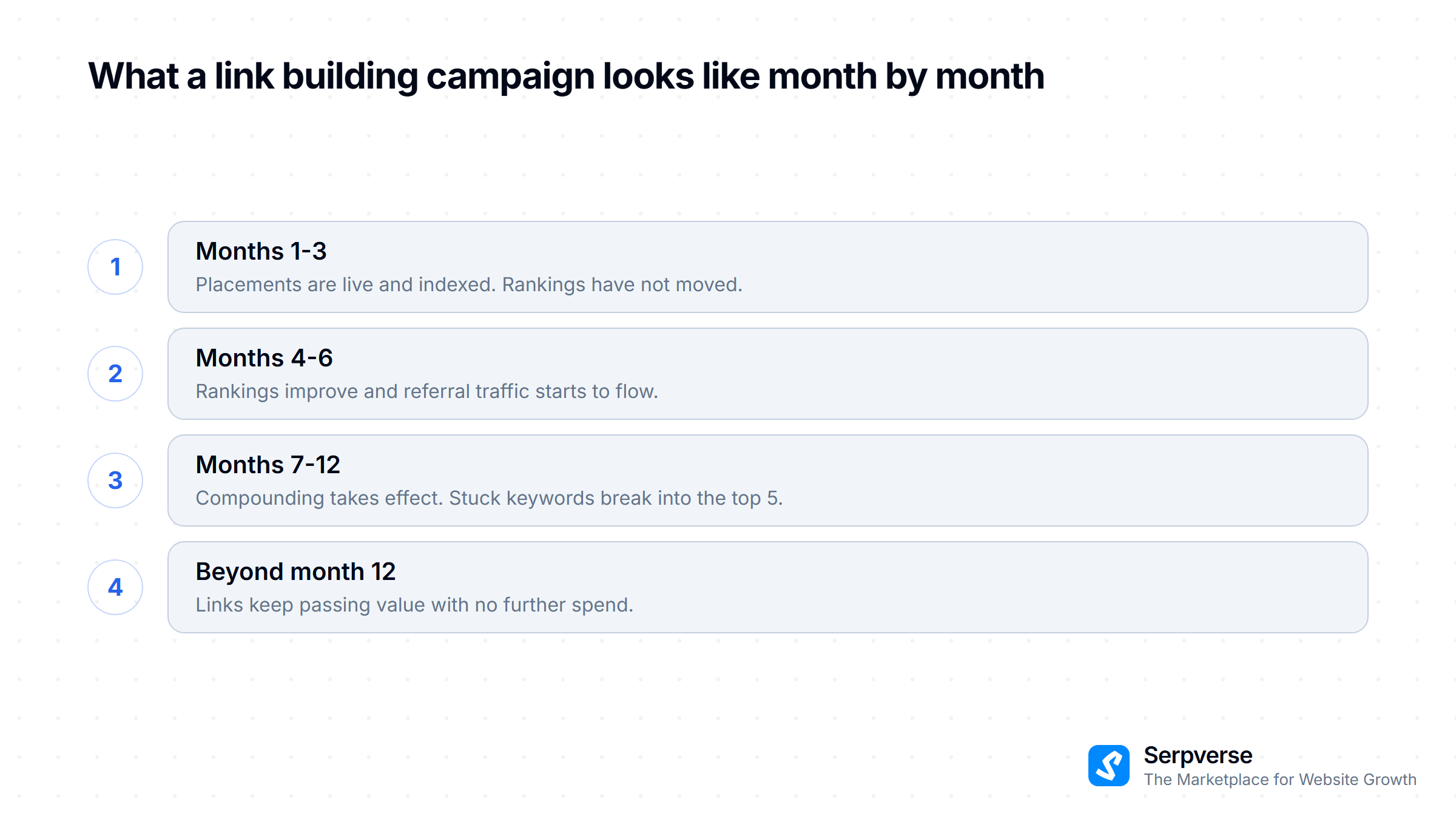
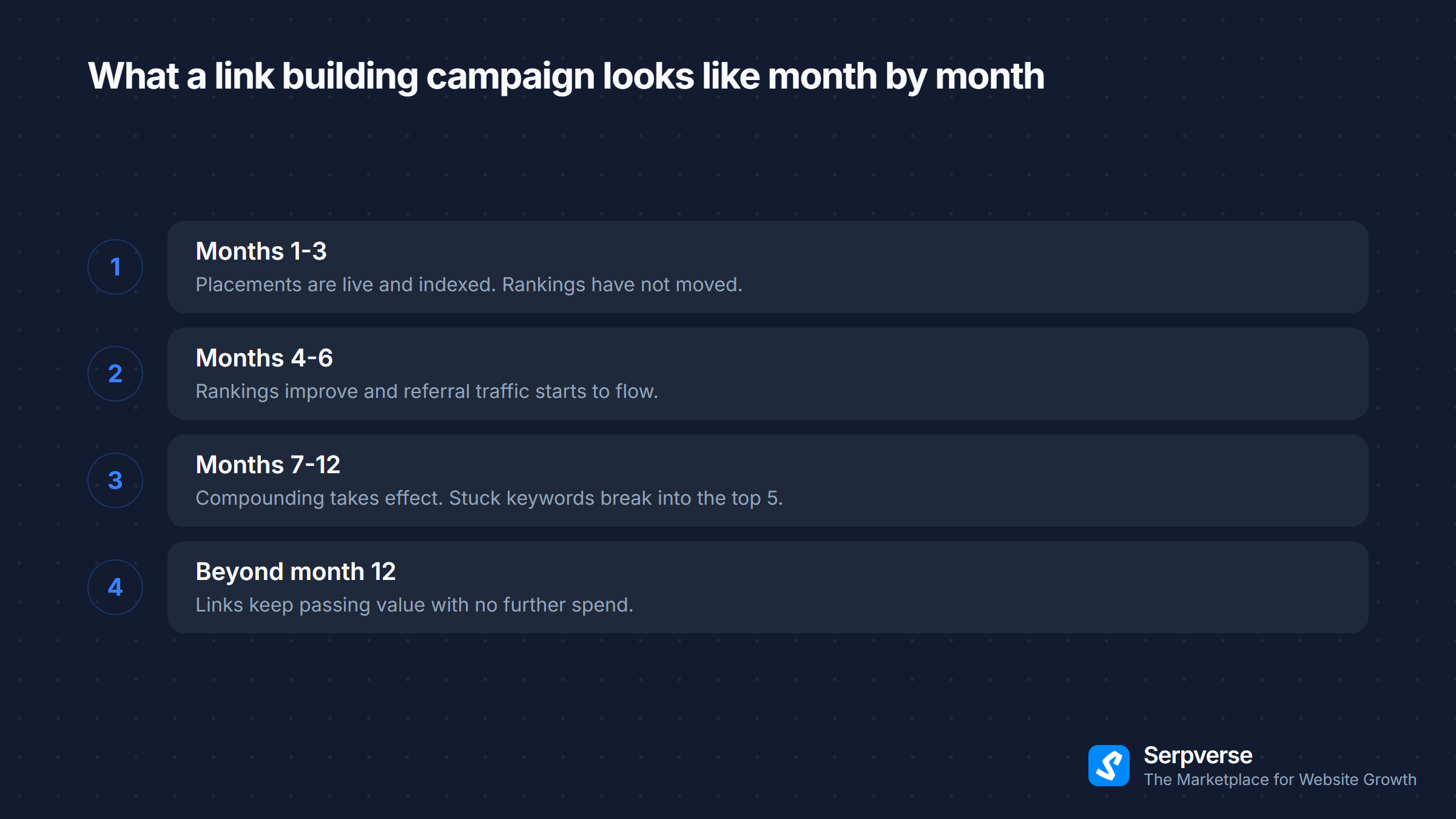
If you are investing in link building through a marketplace like Serpverse, here is what realistic expectations look like:
Months 1-3: Your placements are live, links are indexed, authority is building. You may not see dramatic ranking changes yet. This is normal.
Months 4-6: Rankings improve for targeted keywords. Referral traffic from placements begins flowing. The value of your investment becomes measurable.
Months 7-12: Compounding takes effect. Keywords that seemed stuck in positions 10-15 break into the top 5. Organic traffic grows at an accelerating rate.
Beyond month 12: The links you built continue to pass value indefinitely (as long as the pages remain live). Unlike paid advertising, which stops the moment you stop paying, link building generates ongoing returns.
Why Patience Is a Strategic Advantage
Most businesses quit SEO too early. They invest for 2-3 months, see minimal results, and redirect budget to paid channels. Their competitors who stay the course inherit the search landscape.
The patience advantage is real and measurable:
- Fewer competitors survive to month 6, reducing competition
- Domain authority gains become permanent assets
- Content libraries create barrier-to-entry moats
- Organic traffic has near-zero marginal cost once established
The businesses that dominate organic search are rarely the ones with the biggest budgets. They are the ones that maintained consistent effort long enough for compounding to take effect.
For a framework on measuring whether your investment is working during the waiting period, see our guide on link building ROI. Knowing what link building involves and how the process works helps you maintain confidence during the early months when results are still building.
Accelerating Your Timeline
While patience is essential, you can take steps to compress the timeline:
- Fix technical issues first. Run through an on-page SEO checklist to catch crawl errors, missing meta tags, and slow load times before investing in links.
- Target low-competition keywords initially. Quick wins build momentum and prove the model while you work toward competitive terms.
- Publish high-quality content consistently. Google rewards fresh, comprehensive content. A steady publishing cadence keeps crawlers returning frequently.
- Build links to your best content. Concentrate link building on pages with the strongest content, not thin pages that cannot rank regardless.
- Use anchor text strategically. Relevant, varied anchor text helps search engines understand what your pages are about.
The Long Game Wins
SEO takes 4-12 months to produce significant results for most businesses. The exact timeline depends on your starting authority, competition level, content quality, and link building consistency.
The campaigns that succeed share a common pattern: consistent execution, realistic expectations, and the discipline to stay invested through the early months when results are building beneath the surface. Treat SEO as a compounding investment, not a campaign with a switch. The returns grow larger over time, and the assets you build today continue generating value for years.