How to Measure Link Building ROI (Metrics That Matter)
Learn how to measure link building ROI with metrics like DA growth, organic traffic, keyword rankings, and cost per link to prove value.
- By
- Serpverse Team, SEO Experts
- Published
- Mar 23, 2026
- Read
- 9 min read
- link building
- ROI
- SEO metrics
- backlink analysis
- organic traffic
 Serpverse
Every dollar you spend on link building should be traceable to a measurable outcome. Yet most buyers struggle to answer a simple question: is this investment paying off? Measuring link building ROI requires looking beyond vanity metrics and connecting placements to the business outcomes that actually matter.
This guide breaks down the metrics, attribution models, and reporting frameworks you need to prove (or disprove) the value of every link you acquire.
Why Link Building ROI Is Hard to Measure
Link building sits in the middle of a long chain of SEO cause and effect. You acquire a link, which passes authority, which improves rankings, which drives traffic, which generates conversions. Each step introduces variables you cannot fully control.
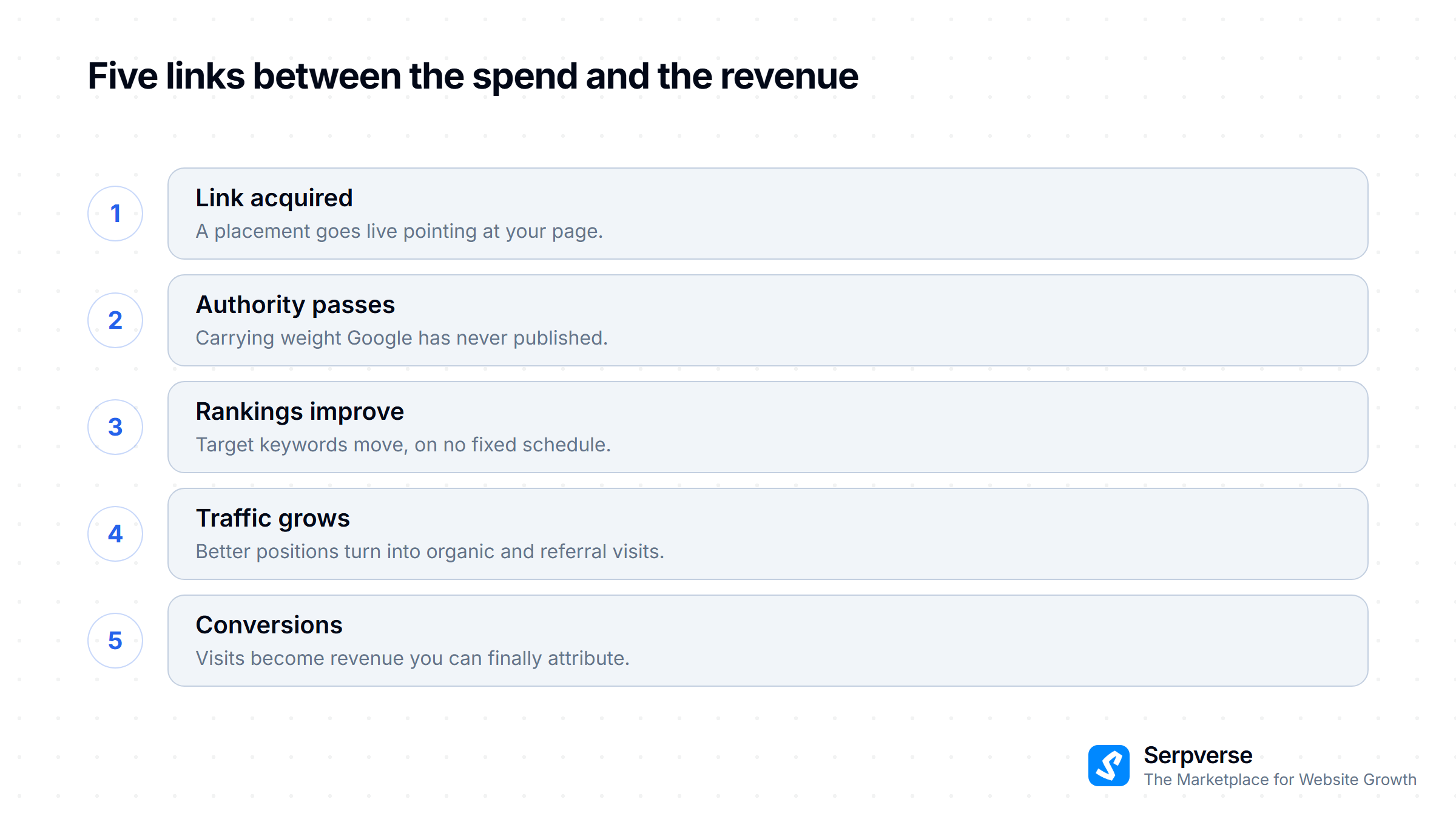
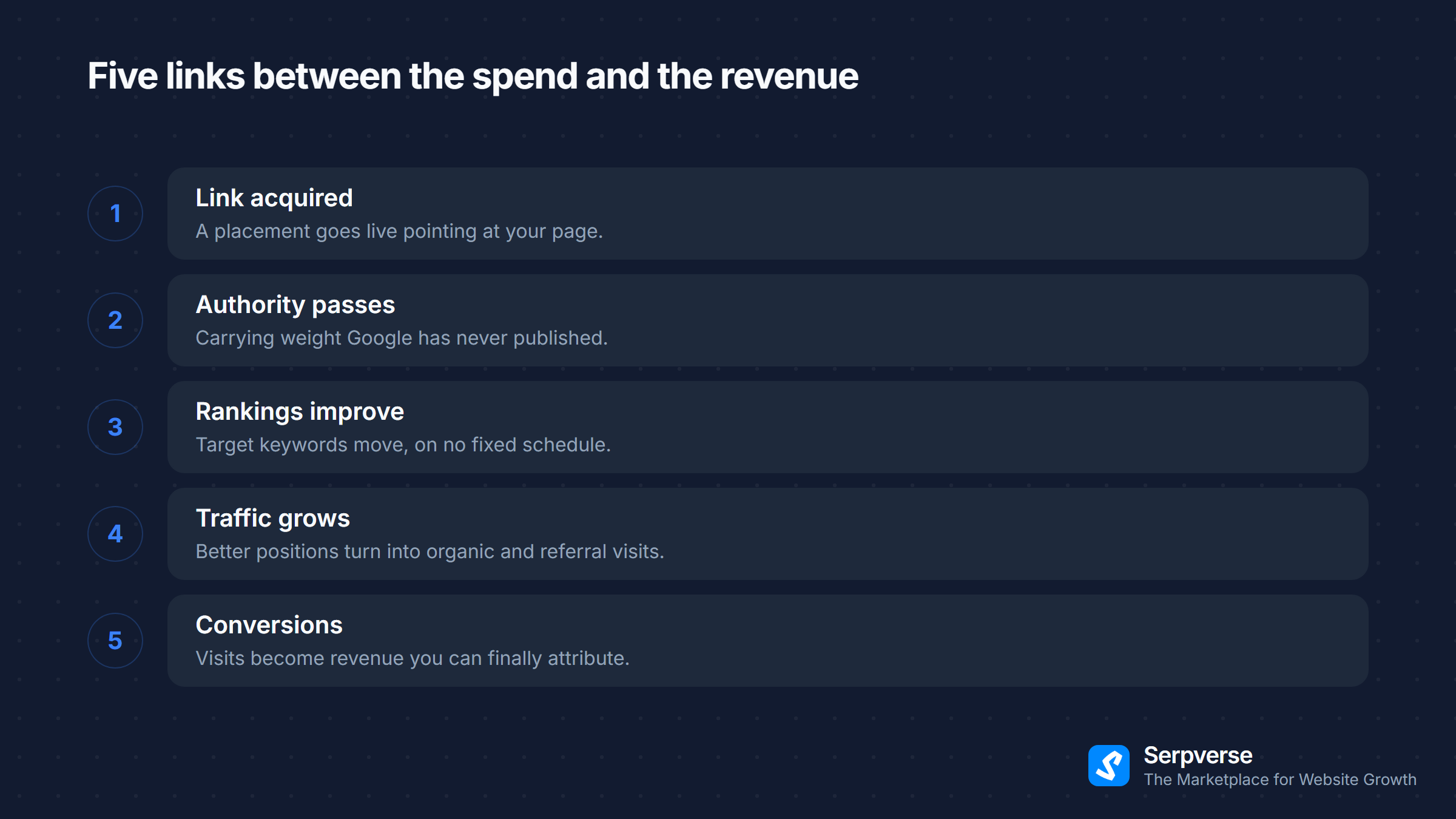
Google does not publish how much weight any single link carries. Algorithm updates can shift the landscape overnight. And the impact of a link often compounds over months rather than appearing immediately.
None of this means measurement is impossible. It means you need the right framework.
The Five Core Metrics for Link Building ROI
Track these five metrics in combination. No single metric tells the full story.
| Metric | What It Measures | Tools |
|---|---|---|
| DA/DR growth | Domain-level authority over time | Moz, Ahrefs |
| Organic traffic change | Visitors from search engines | Google Analytics, Search Console |
| Keyword ranking movement | Position changes for target terms | Ahrefs, SEMrush, Serpstat |
| Referring domains & referral traffic | Unique linking domains + direct clicks from placed links | Google Analytics, Ahrefs |
| Cost per link vs. value generated | Financial efficiency | Spreadsheet + analytics |
Tracking Domain Authority and Domain Rating Growth
Domain Authority (Moz) and Domain Rating (Ahrefs) are third-party scores that estimate a domain's backlink strength on a 0-100 scale. They are not Google metrics, but they correlate with ranking ability and serve as a useful proxy.
Record your DA/DR monthly. Plot it against your link acquisition timeline. A steady upward trend confirms that your placements are building cumulative authority.
Be cautious about chasing DA/DR as a goal in itself. A jump from 25 to 35 means nothing if it does not translate into rankings and traffic. Always pair authority metrics with performance metrics. For a deeper dive into what these scores mean, read our guide on domain authority explained.
Measuring Organic Traffic Change
Organic traffic is the most direct measure of whether your SEO efforts are working. In Google Analytics, isolate organic search traffic and segment it by the landing pages you are building links to.
Compare month-over-month and year-over-year trends. Year-over-year comparisons account for seasonality, which can distort monthly numbers significantly.
Create a cohort view: group pages by the month they first received external links, then track traffic growth for each cohort over the following 3, 6, and 12 months. This isolates the impact of link building from other SEO activities like content updates or technical fixes.
Keyword Ranking Movement
Rankings are the leading indicator of organic traffic growth. Track your target keywords weekly.
Focus on three categories:
- Target keywords: The terms you are intentionally building links to rank for
- Related keywords: Long-tail variations that benefit from the same topical authority
- Brand keywords: Monitor for stability; significant drops here signal broader issues
A useful framework is tracking the percentage of your target keywords in each position bracket: top 3, positions 4-10, positions 11-20, and 20+. Over time, link building should shift the distribution upward.
Understanding how search engines rank pages helps contextualize why certain keywords respond faster to link building than others.
Referral Traffic: The Overlooked Metric
Not every link's value comes through SEO. Links on high-traffic websites drive direct referral visitors who click through to your site. This traffic is immediate, measurable, and often high-intent.
In Google Analytics, navigate to the referral traffic report and filter for the domains where you have placed content. Track:
- Volume of referral visits per placement
- Bounce rate of referral visitors compared to other channels
- Conversion rate of referral traffic
A placement on a niche-relevant site with 50 referral visits per month that converts at 5% can be more valuable than a high-DA link that sends zero clicks.
Calculating Cost Per Link vs. Value Generated
This is where ROI becomes a concrete number. The formula is straightforward:
ROI = (Value Generated - Total Cost) / Total Cost x 100
The hard part is defining "value generated." Use one of these approaches:
Revenue attribution: If you can track conversions from organic traffic back to specific pages that received links, multiply conversions by average order value or customer lifetime value.
Traffic value method: Use Ahrefs or SEMrush "traffic value" estimates, which calculate what your organic traffic would cost if purchased via Google Ads. Compare the monthly traffic value gain to your monthly link building spend.
Cost per position improvement: Divide total link building spend by the number of target keywords that improved by at least 10 positions. Compare this cost to your PPC cost-per-click for those same terms.
Building an Attribution Model
Link building rarely works in isolation. You are probably also publishing content, optimizing on-page elements, and improving technical SEO. Attributing results purely to links requires a structured approach.
Last-Touch Attribution
Credit the most recent link acquired before a ranking improvement. Simple but ignores the cumulative effect of previous links.
Time-Decay Attribution
Weight recent links more heavily while still crediting older ones. A link acquired last month gets more attribution than one acquired six months ago, but both receive credit.
Controlled Comparison
The most rigorous approach. Select two groups of similar pages: one group receives link building, the other does not. Compare performance over 3-6 months. The difference in organic traffic growth between the groups isolates the link building effect.
Setting Up a Reporting Framework
A monthly reporting cadence works for most link building campaigns. Weekly is too noisy; quarterly is too slow to catch problems.
Your report should include:
- Links acquired this month: Count, average DA/DR of linking domains, relevance scores
- Authority trend: DA/DR change month-over-month
- Ranking movement: Number of keywords improving, declining, stable
- Organic traffic change: Total and per-page for targeted URLs
- Referral traffic: Volume and engagement from placement domains
- Cost metrics: Cost per link, cost per ranking improvement, estimated traffic value gained
- Cumulative ROI: Running total of investment vs. estimated value returned
Automate data collection where possible. Google Search Console API, Ahrefs API, and Google Analytics API can feed into a dashboard that updates automatically.
What Good Link Building ROI Looks Like
Benchmarks vary by industry, but here are general guideposts:
| Timeframe | Expected Outcome |
|---|---|
| Month 1-2 | Links indexed, minimal ranking movement |
| Month 3-4 | Target keywords begin moving into top 20 |
| Month 5-6 | Organic traffic to linked pages increases 20-50% |
| Month 9-12 | Campaign reaches positive ROI for competitive terms |
For less competitive niches, the timeline compresses. For highly competitive keywords, extend each phase by 1-2 months.
A backlink profile audit at the 6-month mark helps identify which link types are driving the most value, so you can double down on what works.
Common ROI Measurement Mistakes
Measuring too early. Links need time to be crawled, indexed, and factored into rankings. Declaring failure at 30 days is premature.
Ignoring link quality. Ten cheap, irrelevant links will show poor ROI. Five relevant, authoritative placements will outperform them every time. Quality matters more than quantity for both rankings and measurement clarity, so learn to evaluate link quality before you buy rather than after.
Not isolating variables. If you simultaneously launch a link building campaign, redesign your site, and overhaul your content, you cannot attribute results to any single effort. Stagger initiatives or use controlled comparisons.
Forgetting about compounding. SEO compounds. The links you build this quarter improve your authority, which makes future content rank faster, which earns more organic links. Linear ROI calculations undervalue this compounding effect.
How to Report ROI to Stakeholders
Stakeholders care about business impact, not SEO jargon. Translate your metrics:
- Instead of "DA increased from 32 to 38," say "Our website's search engine authority grew 19%, positioning us to compete for higher-value keywords."
- Instead of "We acquired 15 links," say "We earned 15 editorial placements on industry-relevant websites, driving 340 referral visits and contributing to a 28% increase in organic traffic to our target pages."
- Instead of "Average cost per link was $180," say "Our cost to acquire each high-quality placement was $180, generating an estimated $2,400 in equivalent advertising value over 12 months."
Frame everything in terms of investment and return. Link building is not a cost center; it is an investment in compounding organic visibility.
Optimizing ROI Over Time
After 3-6 months of data, you have enough information to optimize. Audit your placements and ask:
- Which linking domains correlated with the biggest ranking improvements?
- Which content formats earned the most referral traffic?
- Are links from certain categories or niches outperforming others?
Shift your budget toward the link types, niches, and content that earns backlinks most effectively. Cut placements that show no measurable impact after 6 months.
Marketplaces like Serpverse give you transparency into publisher metrics before you buy, letting you make data-driven placement decisions from the start rather than learning through trial and error.
Key Takeaways
Link building ROI is measurable when you track the right metrics, use a consistent attribution model, and give campaigns enough time to mature. Build your reporting framework early, automate data collection, and report in business terms.
The buyers who treat link building as a measurable investment channel, not a checkbox SEO task, are the ones who consistently scale their organic growth.