White Hat vs Black Hat Link Building: A Clear Guide
Understand white hat link building versus black hat tactics. Learn which strategies are safe, which trigger penalties, and how to recover.
- By
- Serpverse Team, SEO Experts
- Published
- Mar 18, 2026
- Read
- 10 min read
- white hat SEO
- black hat SEO
- link building tactics
- Google penalties
- penalty recovery
 Serpverse
The line between ethical and manipulative link building is not always obvious, but Google's penalties for crossing it are severe. White hat link building focuses on earning links through genuine value. Black hat link building attempts to game the algorithm through deception. Understanding both sides protects your site and informs smarter strategy decisions.
Defining White Hat Link Building
White hat link building follows Google's Webmaster Guidelines and focuses on acquiring links through methods that would exist even if search engines did not. The core principle: if a link would still make sense and provide value in a world without Google rankings, it is white hat.
White hat tactics share common characteristics:
- Links are earned through content quality, relationships, or genuine utility
- The linking site editorially chooses to include the link
- No deception is involved regarding the nature of the link
- The link provides value to the reader of the linking page
- The practice is sustainable and scales through quality, not automation
Defining Black Hat Link Building
Black hat link building attempts to manipulate search rankings through artificial link signals. These tactics exploit algorithmic weaknesses rather than earning genuine endorsements.
Black hat tactics share these characteristics:
- Links exist solely to influence rankings, not to serve users
- The link placement involves deception, automation, or payment without disclosure
- The practice violates Google's guidelines explicitly
- Results are typically short-lived and carry significant risk
- Scale comes from automation or networks rather than quality
White Hat Tactics That Work
Guest Posting on Relevant Sites
Contributing high-quality articles to established publications in your niche earns editorial backlinks while demonstrating expertise. The key distinction between white hat and manipulative guest posting is quality and relevance.
White hat guest posting means writing original, valuable content for sites with real audiences and editorial standards. The link is a natural byproduct of contributing genuine expertise. Learn more about writing guest posts that publishers accept.
Content Marketing and Digital PR
Creating content that journalists, bloggers, and industry professionals want to reference is the most sustainable link building approach. This includes:
- Original research and surveys that produce citable statistics
- Comprehensive guides that become definitive references
- Data visualization that media outlets embed and credit
- Expert commentary on trending industry topics
For a deeper look at this strategy, see our guide on content that earns backlinks.
Resource Page Link Building
Identifying resource pages, tool roundups, and curated lists in your niche, then requesting inclusion of your genuinely useful content. This works because you are helping a curator improve their page for their audience.
Broken Link Building
Finding broken outbound links on relevant sites and suggesting your content as a replacement. This provides value to the webmaster (fixing a broken link) while earning a backlink. See our broken link building guide for a step-by-step process.
Digital PR and HARO
Responding to journalist queries through Help a Reporter Out (HARO), Connectively, or direct media outreach. When publications quote you as a source, they typically link to your site.
Relationship-Based Links
Building genuine professional relationships in your industry leads to natural link opportunities: co-authored content, podcast appearances, conference collaborations, and mutual recommendations.
Black Hat Tactics to Avoid
Private Blog Networks (PBNs)
PBNs are networks of websites created or acquired solely to link to a target site. They simulate editorial links but lack real audiences, original content, or legitimate purpose. Our guide to spotting a PBN covers the signals that give one away before you buy.
How they work: An operator buys expired domains with existing authority, sets up minimal websites, and places links to their money site across the network.
Why they fail: Google has invested heavily in PBN detection. Shared hosting footprints, thin content patterns, unnatural link graphs, and registration data all expose these networks. When Google identifies a PBN, every site in the network and every site it links to faces penalties.
Link Farms and Link Exchanges
Link farms are networks of sites that exist solely to exchange links among members. Organized link exchange schemes (you link to me, I link to you, across dozens of sites) create detectable reciprocal patterns.
Google's algorithms specifically identify and devalue link exchange patterns. The 2022 SpamBrain update significantly improved Google's ability to detect both link farms and sophisticated link exchange schemes.
Paid Links Without Disclosure
Buying links that pass PageRank without using rel="sponsored" or rel="nofollow" violates Google's guidelines. This includes:
- Paying for dofollow links in articles without disclosure
- Exchanging products or services for links without appropriate rel attributes
- Paying for links embedded in widgets, themes, or plugins distributed across multiple sites
The distinction matters: paying for exposure on a relevant site is legitimate marketing. Paying specifically for dofollow links to manipulate rankings without disclosing the commercial relationship is black hat.
Comment and Forum Spam
Automated or manual posting of links in blog comments, forum threads, and community boards solely for link building purposes. Modern CMS platforms and forums nofollow these links by default, making the tactic both risky and ineffective.
Link Injection and Hacking
Exploiting security vulnerabilities to inject links into legitimate websites. This includes hacking WordPress sites to add hidden links, exploiting open redirects, or inserting links through compromised admin accounts.
This is not just a Google guidelines violation. It is a criminal act in most jurisdictions.
Cloaking and Sneaky Redirects
Showing search engines different content (with links) than what users see. This includes hiding links with CSS (display:none, matching text color to background), using JavaScript redirects to funnel link equity, or serving different pages to Googlebot versus human visitors.
Automated Link Building Tools
Software that automatically creates profiles, posts comments, submits to directories, or spins and distributes articles across hundreds of sites. The links produced are low quality, easily detected, and carry penalty risk.
The Gray Area: Tactics That Require Judgment
Some link building practices fall between clearly white hat and clearly black hat:
| Tactic | Consideration |
|---|---|
| Niche edits (adding links to existing content) | White hat if the content genuinely benefits from the addition. Black hat if the link is forced into irrelevant context. |
| Scholarship link building | Once white hat, now widely abused. Google devalues .edu links from scholarship pages with no genuine program. |
| Sponsored content with followed links | Acceptable if disclosed and tagged with rel="sponsored". Violations occur when sponsored links are disguised as editorial. |
| Directory submissions | White hat for legitimate, curated directories. Black hat for mass submissions to hundreds of low-quality directories. |
| Infographic distribution | White hat when offering genuine value to publishers. Black hat when distributing thin infographics solely as link vehicles. |
The test for gray area tactics: would you be comfortable explaining your link building strategy to a Google Search Quality team member? If the answer is no, reconsider the approach.
Google Penalty Types
Google enforces link quality through two mechanisms:
Algorithmic Penalties
These are automatic ranking adjustments applied by Google's algorithms (primarily Penguin, now integrated into the core algorithm). Characteristics:
- No notification in Google Search Console
- Gradual or sudden ranking drops for affected pages or the entire site
- Recovery requires cleaning up the link profile and waiting for algorithmic reassessment
- Can affect specific pages, sections, or the entire domain
Manual Actions
These are penalties applied by human reviewers at Google. Characteristics:
- Notification appears in Google Search Console under "Manual Actions"
- Clear description of the violation (e.g., "Unnatural links to your site")
- Recovery requires submitting a reconsideration request after cleanup
- Can be partial (affecting specific pages) or site-wide
| Penalty Aspect | Algorithmic | Manual Action |
|---|---|---|
| Notification | None | GSC notification |
| Cause | Pattern detection by algorithm | Human reviewer flag |
| Recovery path | Clean up + wait for recrawl | Clean up + reconsideration request |
| Typical timeline | Weeks to months | 2-4 weeks after request submission |
| Severity | Varies from minor demotion to deindex | Clearly stated in notification |
Recovering From Link Penalties
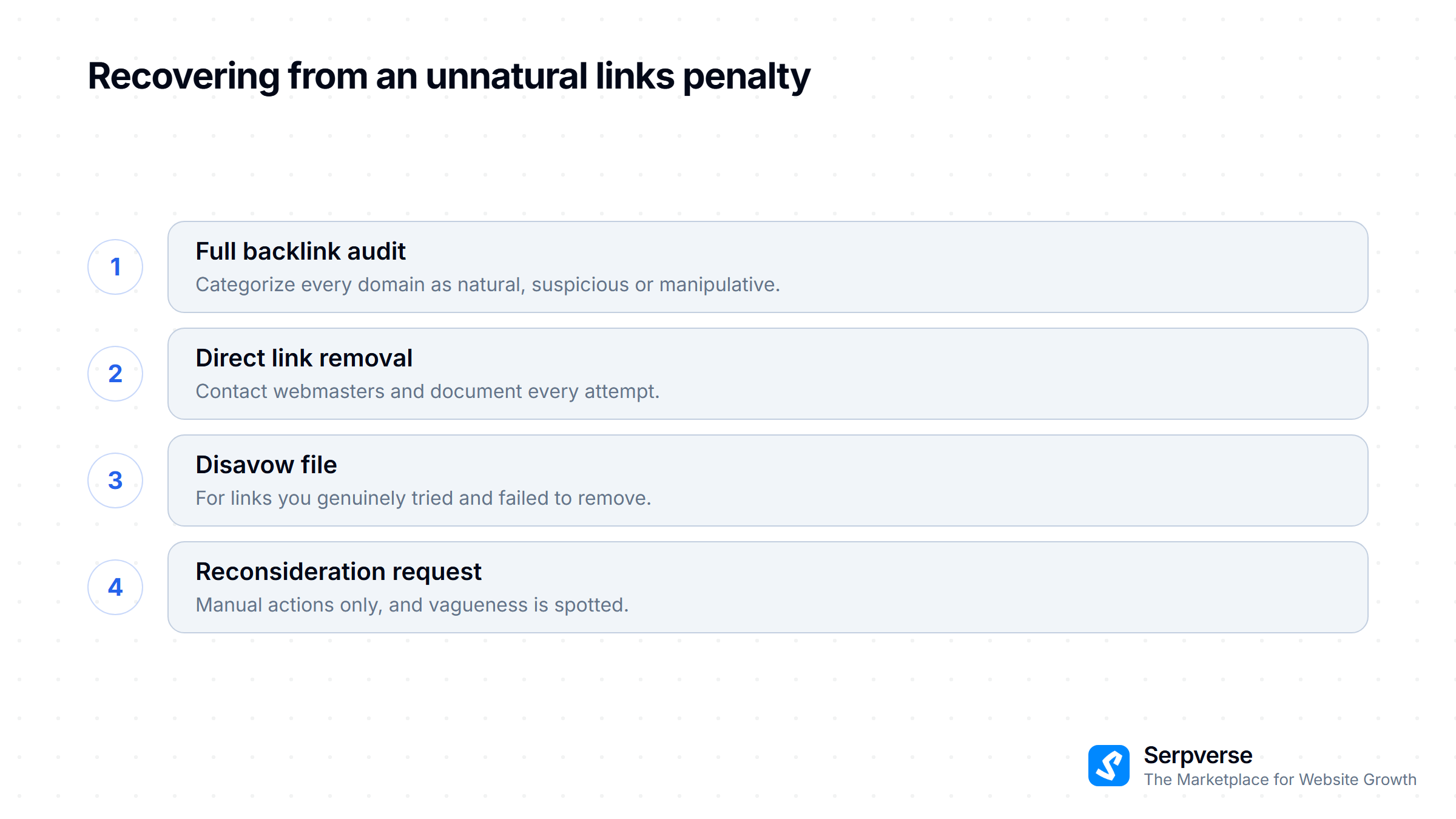
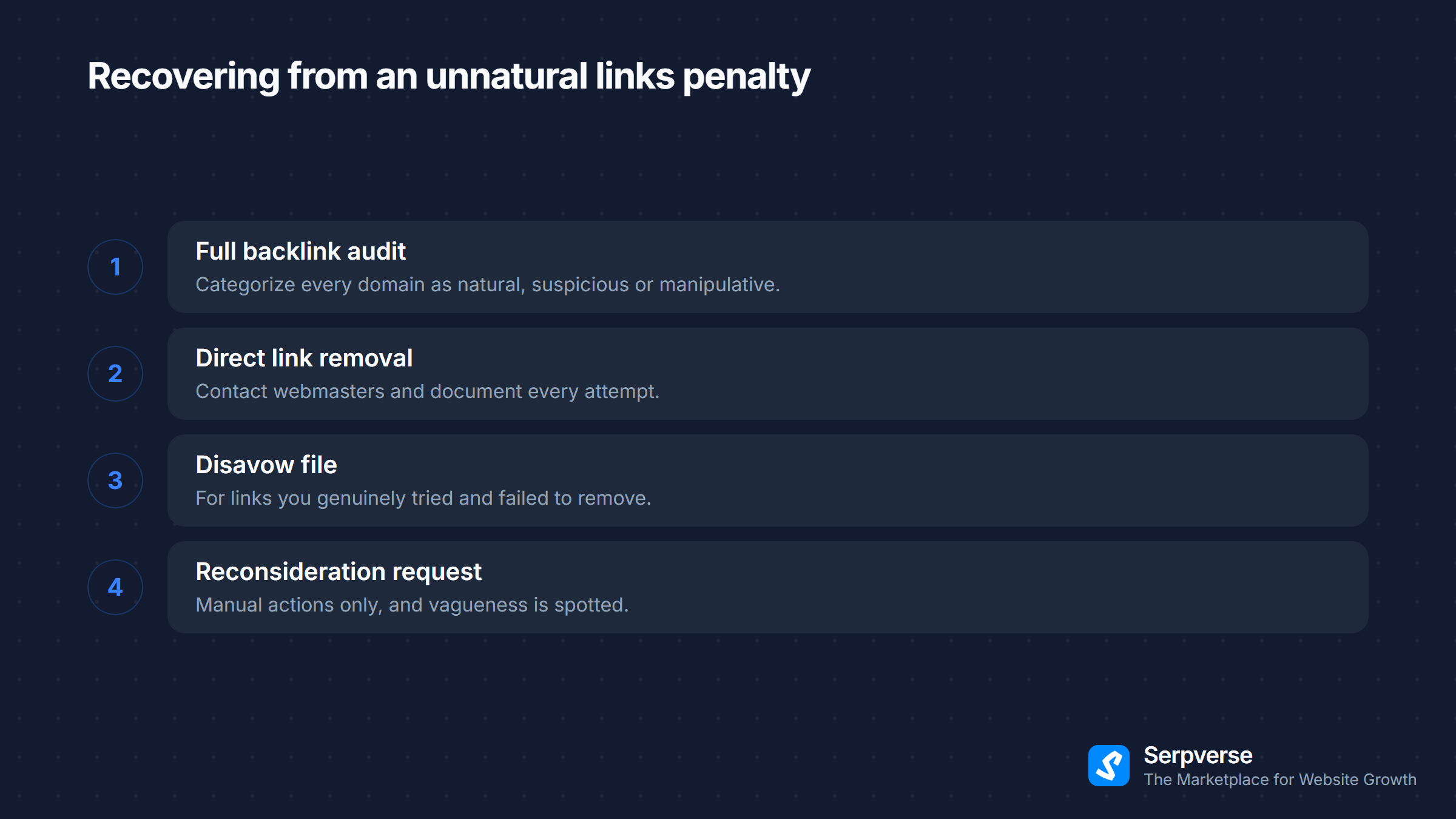
If your site has been penalized for unnatural links, recovery is possible but requires systematic effort:
Step 1: Full Backlink Audit
Export your complete backlink profile and audit every link. Categorize each linking domain as natural, suspicious, or clearly manipulative.
Step 2: Direct Link Removal
Contact webmasters of sites hosting your manipulative links and request removal. Document every outreach attempt with dates and responses. Google expects to see genuine removal effort.
Step 3: Disavow File Submission
For links you cannot remove, submit a disavow file through Google Search Console — our free disavow file generator builds one from a pasted list in the format Google documents. Include only links you have genuinely attempted to remove and that are clearly unnatural. Do not disavow legitimate links.
Step 4: Reconsideration Request (Manual Actions Only)
Submit a detailed reconsideration request explaining:
- What happened (acknowledge the violation)
- What you did to fix it (removal efforts, disavow file)
- What you will do differently going forward (policy changes)
Be transparent. Google's reviewers process thousands of these requests and can identify vague or dishonest submissions.
Step 5: Rebuild With Clean Tactics
After penalty recovery, rebuild your link profile using exclusively white hat methods. The sites that recover strongest are those that commit to sustainable practices and invest in content quality and E-E-A-T signals.
Why White Hat Wins Long Term
The economics of black hat link building are deceptive. The upfront cost appears lower, but the total cost of ownership includes:
- Ongoing maintenance to replace detected and devalued links
- Revenue loss during penalty periods
- Recovery costs (audit tools, outreach, consultant fees)
- Opportunity cost of rankings lost during recovery
- Brand reputation damage if penalties become public knowledge
White hat link building costs more upfront per link but compounds in value. An editorial link from a respected publication continues to pass authority for years. A PBN link may be devalued within months.
Building a Sustainable Link Strategy
A sustainable link building program combines multiple white hat channels:
- Content creation that attracts organic editorial links
- Guest posting on relevant, quality publications through platforms like Serpverse that verify publishers against quality guidelines
- Digital PR that earns media coverage and citations
- Community participation that builds relationships and natural mentions
- Technical excellence (fast site, great UX, useful tools) that makes your site worth linking to
Understanding how search engines rank pages reinforces why quality signals matter more than quantity. Every algorithmic update pushes further in the direction of rewarding genuine authority and penalizing manipulation.
The choice between white hat and black hat link building is ultimately a choice between building a durable asset and renting temporary rankings. Invest in the approach that compounds.