How Search Engines Rank Pages: A Beginner's Guide
Learn how Google crawls, indexes, and ranks web pages. Understand the major ranking factors and how they work together to determine search results.
- By
- Serpverse Team, SEO Experts
- Published
- Jan 25, 2026
- Read
- 17 min read
- search engines
- Google ranking
- SEO basics
- crawling indexing
 Serpverse
How Does Google Decide What Ranks Where?
Every time you type a query into Google, the search engine sifts through hundreds of billions of indexed pages and returns a ranked list of results in roughly 0.5 seconds. The process behind this feels like magic, but it follows a structured, three-stage pipeline: crawl, index, rank.
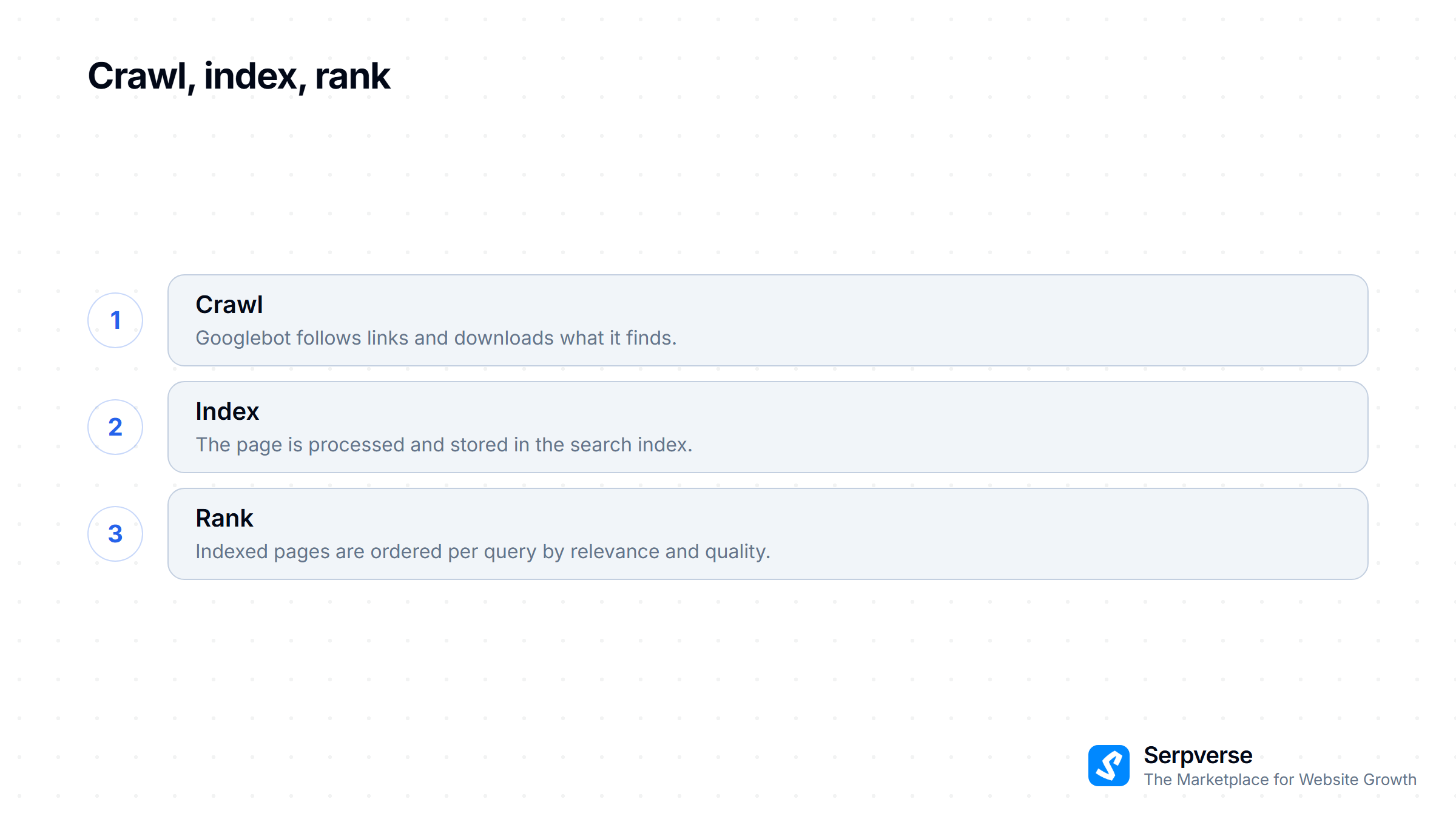
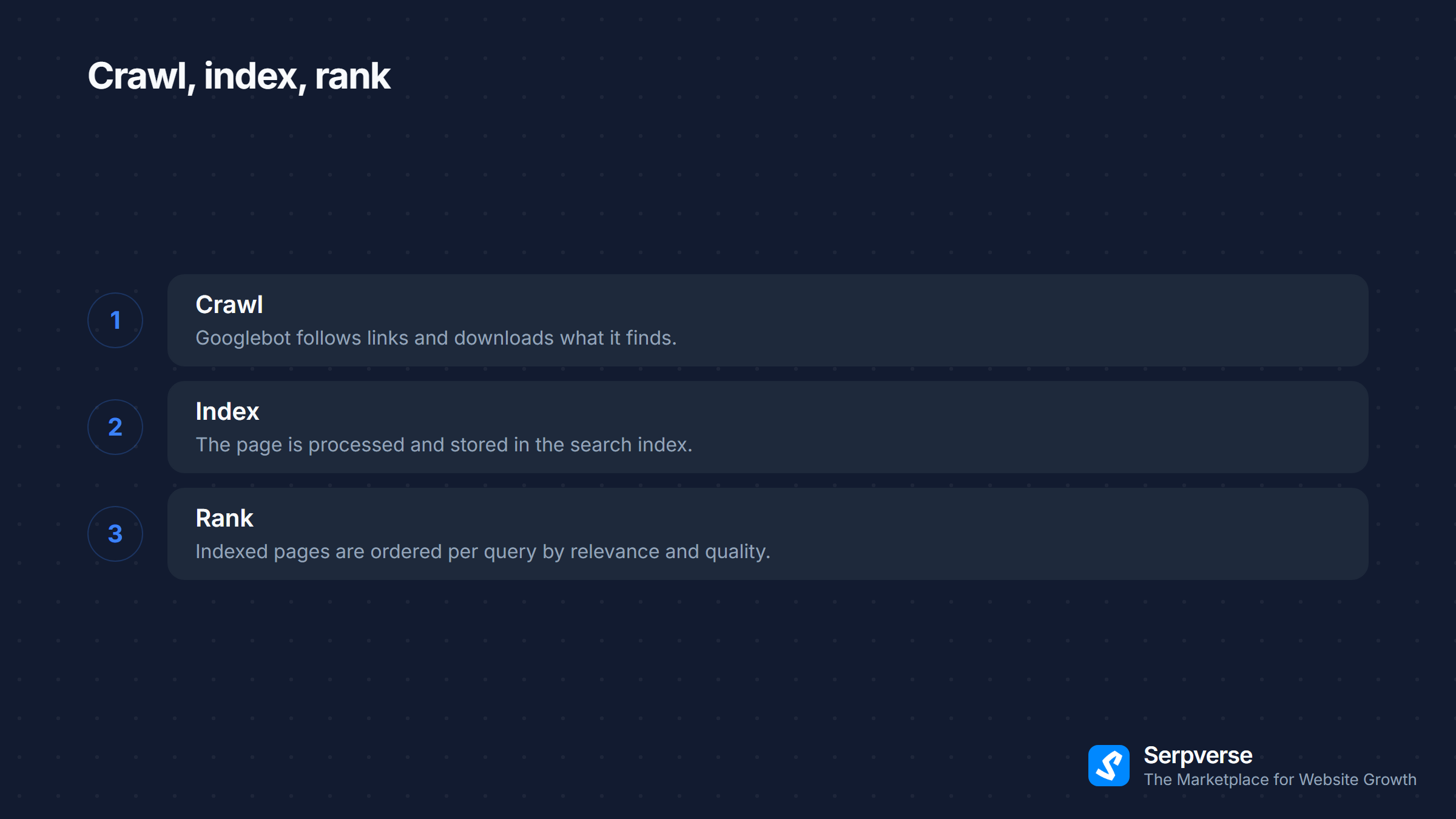
Understanding this pipeline is the foundation of every SEO strategy. Once you know how pages enter Google's system and how they're evaluated, every tactical decision — from content creation to link building to technical optimization — makes more sense.
This guide walks through the entire process, explains the major ranking factor categories, and shows how they interact so you can make informed decisions about where to invest your SEO effort.
Stage 1: Crawling — How Google Discovers Pages
Before Google can rank a page, it has to find it. That's the job of Googlebot, Google's web crawler — a fleet of automated programs that follow links across the internet, visiting pages and downloading their content.
How Crawling Works
Googlebot starts with a massive list of known URLs from previous crawls and sitemaps submitted through Google Search Console(opens in new tab). It visits each URL, reads the page content, and extracts every link on that page. Those links become new URLs to crawl, creating a cascading discovery process that branches across the entire web.
Think of it as a spider (the original term) following threads in a web. Each page leads to new pages, which lead to more pages, building an ever-expanding map of the internet.
What Determines How Often Your Site Gets Crawled?
Not every site gets crawled with the same frequency. Google allocates crawl budget based on two factors:
- Crawl rate limit — How fast Google can crawl without overloading your server. If your site is slow or returns errors, Google backs off.
- Crawl demand — How popular and frequently updated your pages are. A major news site gets crawled every few minutes; a small static blog might get crawled once a week.
How to Help Google Crawl Your Site Effectively
Several technical factors influence whether Googlebot can discover and access your pages:
- XML Sitemap — A structured file listing all the URLs you want indexed. Submit it through Google Search Console so Googlebot doesn't have to discover every page through links alone.
- Internal linking — Pages that aren't linked from anywhere on your site (orphan pages) are invisible to crawlers. Every important page should be reachable within 3 clicks from your homepage.
- Robots.txt — This file tells crawlers which parts of your site they can and can't access. A misconfigured robots.txt can accidentally block important pages from being crawled.
- Site speed — If your server responds slowly, Googlebot can crawl fewer pages per visit. Fast servers get more thorough crawls.
Stage 2: Indexing — How Google Understands and Stores Pages
After crawling a page, Google processes its content and stores it in the search index — a massive database of all the pages Google knows about and considers potentially useful for search queries.
What Happens During Indexing?
When Google processes a crawled page, it:
- Parses the HTML — Reads the page's content, headings, meta tags, images, and structured data
- Renders JavaScript — Executes client-side JavaScript to see the page as a user would (this is why JavaScript-heavy sites need special SEO attention)
- Analyzes content — Identifies the page's topic, entities mentioned, and the relationships between concepts using natural language processing
- Evaluates quality signals — Assesses content depth, originality, and whether the page provides genuine value
- Stores the result — Adds the processed page to the index with all its associated signals and metadata
Why Some Pages Don't Get Indexed
Not every crawled page ends up in the index. Google may decline to index a page if:
- The content is thin or duplicate — Pages with very little unique content or that substantially duplicate content found elsewhere on the web
- The page has a
noindextag — A meta robots tag explicitly telling Google not to index the page - The page returns errors — 4xx or 5xx HTTP status codes signal that the page isn't serving content properly
- Canonical tags point elsewhere — If the page declares a different URL as the canonical version, Google may index the canonical instead
- The content is low quality — Pages that exist solely for SEO manipulation, contain auto-generated content with no value, or are stuffed with keywords
Stage 3: Ranking — How Google Orders Search Results
This is where the real complexity lives. When a user enters a query, Google's ranking systems evaluate every indexed page that could potentially answer that query and order them by relevance and quality. Google's algorithm uses hundreds of individual signals, but they cluster into several major categories.
The Five Pillars of Google's Ranking Algorithm
While Google's exact algorithm is proprietary and constantly evolving, the major ranking factors are well-understood through Google's own documentation, patents, confirmed statements, and extensive industry testing. They fall into five broad categories.
1. Content Relevance and Quality
At its core, Google is trying to match the user's query with the most relevant, highest-quality answer. Content signals determine how well your page satisfies that goal.
What Google evaluates:
- Keyword and topic alignment — Does your page's content match the intent behind the search query? Google doesn't just match exact keywords anymore — it understands synonyms, related concepts, and the broader topic using systems like BERT and MUM.
- Content depth and comprehensiveness — Does the page thoroughly cover the topic, or does it skim the surface? Pages that answer the primary question and anticipate follow-up questions tend to rank higher.
- Content freshness — For queries where recency matters (news, technology, statistics), recently published or updated content gets a ranking boost. For evergreen topics, freshness matters less.
- Originality — Does the page offer unique insights, original research, or a perspective not found elsewhere? Google's Helpful Content System specifically targets content that rehashes what already exists without adding value.
- E-E-A-T signals — Experience, Expertise, Authoritativeness, and Trustworthiness. Google's quality raters look for evidence that content creators have genuine expertise and first-hand experience with the topic. Learn how to strengthen your E-E-A-T signals across your content.
What this means for you: Create content that genuinely answers the searcher's question better than anything else on page one. Depth, accuracy, and original insight beat keyword density every time.
2. Backlinks and Off-Page Authority
Backlinks — links from other websites pointing to yours — are Google's way of measuring how much the rest of the internet trusts and endorses your content. This has been a core ranking signal since Google's founding and remains one of the most influential factors.
What Google evaluates:
- Number of unique referring domains — How many different websites link to the page. More diverse endorsements signal broader authority.
- Quality of linking sites — A link from a well-known, trusted publication carries more weight than a link from a brand-new blog with no history.
- Relevance of linking sites — A link from a site in your industry is more meaningful than one from an unrelated niche. Google uses topical relevance to understand context.
- Anchor text — The clickable text of the link provides context about what the linked page is about. Natural, varied anchor text is a positive signal; over-optimized exact-match anchors can be a spam signal.
- Link freshness — Continuously earning new links signals that your content remains relevant and valuable. A page that earned all its links three years ago and none since may gradually lose ranking ground.
What this means for you: Invest in earning backlinks from authoritative, relevant websites. Guest posting through platforms like Serpverse is one of the most accessible ways to build quality backlinks consistently, especially for newer sites that haven't yet earned significant editorial attention.
3. Technical SEO and Page Experience
Your content might be excellent and your backlink profile strong, but if Google can't properly access, render, and deliver your pages to users, none of that matters. Technical SEO ensures the foundation is solid.
What Google evaluates:
- Core Web Vitals — Google's specific page experience metrics:
- LCP (Largest Contentful Paint) — How quickly the main content loads. Target: under 2.5 seconds.
- CLS (Cumulative Layout Shift) — How much the page layout shifts while loading. Target: under 0.1.
- INP (Interaction to Next Paint) — How quickly the page responds to user interactions. Target: under 200ms.
- Mobile-friendliness — Google uses mobile-first indexing, meaning it primarily evaluates the mobile version of your page. If your site doesn't work well on mobile, your rankings suffer across all devices.
- HTTPS — Google has confirmed that HTTPS is a ranking signal. Sites without SSL certificates are at a disadvantage and display browser warnings that destroy user trust.
- Page speed — Beyond Core Web Vitals, overall load time affects both rankings and user behavior. Faster pages have lower bounce rates and higher engagement.
- Crawlability — Clean URL structures, proper internal linking, functional sitemaps, and correct robots.txt configuration all ensure Google can efficiently discover and process your pages.
- Structured data — Schema markup (JSON-LD) helps Google understand your content's structure and can enable rich results like FAQ snippets, review stars, and how-to steps in search results.
What this means for you: Run a technical audit of your site quarterly. Use Google's PageSpeed Insights for Core Web Vitals, Google Search Console for crawl and indexing issues, and a tool like Screaming Frog for comprehensive technical analysis.
4. User Experience and Engagement Signals
Google pays close attention to how users interact with search results. While Google has been careful about confirming specific engagement metrics as ranking factors, the evidence strongly suggests they matter.
What Google likely evaluates:
- Click-through rate (CTR) — The percentage of searchers who click your result vs. others. A compelling title and meta description improve CTR, which can create a positive ranking feedback loop.
- Dwell time — How long a user stays on your page before returning to search results. Longer dwell time suggests the page satisfied the user's query.
- Pogo-sticking — When a user clicks your result, immediately returns to the SERP, and clicks a different result. This negative signal suggests your page didn't meet expectations.
- Bounce rate (in context) — A high bounce rate isn't always bad — if someone finds their answer immediately and leaves satisfied, that's a success. But bouncing back to search results to try other pages is a negative signal.
What this means for you: Write titles and meta descriptions that accurately represent your content and compel clicks — our on-page SEO checklist covers title tags, meta descriptions, and other page-level optimizations in detail. Structure your content so users find their answer quickly (answer the question early, then provide depth). Use clear formatting — headings, bullet points, tables — so content is easy to scan.
5. Search Intent and Context
The same keywords can have completely different meanings depending on context. Google has become remarkably sophisticated at understanding what a searcher actually wants — and ranking pages that match that intent, not just the words.
The four types of search intent:
| Intent Type | What the User Wants | Example Query | Expected Result Type |
|---|---|---|---|
| Informational | Learn something | "what is domain authority" | Educational article or guide |
| Navigational | Find a specific site/page | "Moz domain authority checker" | The specific tool or page |
| Commercial | Research before buying | "best guest post marketplaces" | Comparison articles, reviews |
| Transactional | Complete an action | "buy guest posts" | Product/service pages, marketplaces |
How Google matches intent:
Google doesn't just analyze your query's words — it considers:
- Query history — What type of results users typically engage with for similar queries
- SERP analysis — If the top 10 results for a keyword are all how-to guides, Google has determined the intent is informational. A product page won't rank there regardless of its quality.
- Location and device — "Pizza near me" on a mobile phone vs. a desktop computer may trigger different results. Local intent is especially device-sensitive.
- Freshness needs — Queries like "election results" clearly need current data; queries like "how to tie a tie" don't.
What this means for you: Before creating content for a target keyword, analyze the current SERP. Look at what type of content ranks (guides, lists, tools, product pages) and match your format accordingly. Don't write a 3,000-word educational guide targeting a keyword where Google clearly favors product comparison pages.
How These Factors Work Together
No single factor determines rankings in isolation. Google's algorithm is a weighted, interconnected system where factors reinforce or offset each other:
- Content + backlinks — Outstanding content with no backlinks struggles to rank for competitive keywords. A weak page with strong backlinks might rank initially but will lose ground as engagement signals disappoint. The strongest pages excel at both.
- Technical SEO + content — A technically perfect site with thin content won't rank. A content-rich site with severe technical issues (slow, broken, uncrawlable) leaves value on the table. Both foundations must be solid.
- Authority + relevance — A high-authority site in the wrong niche won't rank well for keywords outside its topical focus. A perfectly relevant niche site with no authority will lose to competitors who have both. Topical authority — being deeply established in a specific subject area — is the intersection of these two signals.
- Intent match + quality — The best content in the world won't rank if it doesn't match the search intent. A perfectly optimized product page won't rank for informational queries. Always align your content format with what Google's SERP already tells you the intent is.
A Practical SEO Strategy Based on How Ranking Works
Now that you understand the pipeline, here's how to translate it into action:
For New Sites (DA Under 20)
- Fix the technical foundation first — Ensure your site is fast, mobile-friendly, HTTPS, and crawlable. Submit a sitemap to Search Console. This is table stakes.
- Target long-tail, low-competition keywords — You won't outrank established sites for broad terms yet. Keyword research helps you find specific queries where the existing results are weak so you can create content that's clearly better.
- Start building backlinks early — Don't wait until you have "enough content." Each quality backlink accelerates everything else. Guest posting on niche-relevant publications is one of the fastest paths for new sites.
- Publish consistently — Google rewards sites that demonstrate ongoing investment. A consistent publishing cadence (weekly or biweekly) builds topical authority faster than sporadic bursts.
For Growing Sites (DA 20–50)
- Build topic clusters — Group your content around core topics with a comprehensive pillar page supported by detailed supporting articles. This builds topical authority, which Google increasingly rewards.
- Accelerate link building — At this stage, you've proven your content quality. Invest more in earning backlinks from higher-authority publishers to close the gap with competitors.
- Optimize existing content — Audit your current pages. Which are ranking on page 2–3? These are your biggest opportunities — they've already passed Google's quality bar but need a boost (better content, more internal links, a few external backlinks) to reach page one.
- Diversify traffic sources — Build email lists, social presence, and brand recognition. Google rewards sites with direct and branded traffic — it signals that real people seek out your content specifically.
For Established Sites (DA 50+)
- Defend your rankings — Monitor competitors' link building and content moves. Keep your top-performing content fresh with regular updates and new data.
- Target higher-competition keywords — Your authority now lets you compete for broader, more valuable terms. Create comprehensive, definitive content for these targets.
- Build brand authority — Invest in digital PR, industry events, original research, and thought leadership. At this level, brand signals and entity recognition become significant differentiators.
- Maintain technical excellence — At high DA, technical debt becomes a competitive liability. Invest in performance, accessibility, and user experience optimization.
What Google Has Confirmed vs. What's Speculation
Not every ranking factor you read about online is actually confirmed by Google. Here's a quick reality check:
Confirmed by Google:
- Content quality and relevance
- Backlinks (quantity and quality)
- Mobile-friendliness
- Page speed and Core Web Vitals
- HTTPS
- Structured data (for rich results, not direct rankings)
- E-E-A-T (via quality rater guidelines)
Strongly supported by evidence (not officially confirmed as direct factors):
- Click-through rate from SERPs
- Dwell time and engagement
- Domain age (older domains tend to have more links, not a direct factor)
- User experience signals
Common myths (not confirmed, likely not direct factors):
- Word count as a ranking factor (longer content often ranks better because it's more comprehensive, not because Google counts words)
- Social media shares directly boosting rankings (social signals may correlate with rankings but aren't a direct cause)
- Exact-match domains giving a ranking boost (this was true years ago but has been significantly reduced)
Key Takeaways
Search engine ranking is a complex, multi-factor system, but the fundamentals are straightforward:
- Google follows a three-stage pipeline: crawl (discover pages), index (understand and store them), rank (order results by relevance and quality)
- Five pillars drive rankings: content quality, backlinks, technical SEO, user experience, and search intent alignment
- No single factor wins alone — rankings reward a balanced approach where content, authority, and technical foundations all work together
- Backlinks remain critical — They're one of the strongest ranking signals because they're hard to fake. Earning quality links through guest posting and content marketing is a proven long-term strategy.
- Match search intent first — Before optimizing for any keyword, analyze the SERP to understand what Google thinks users want. Align your content format accordingly.
- SEO compounds over time — Every quality page, every earned backlink, and every technical improvement builds on previous work. Patience and consistency outperform short-term tactics every time. See our guide on how long SEO takes for realistic timelines.
Understanding how search engines work is the first step. The next step is building the authority and content that earns rankings — and that starts with a solid link building strategy.