How Much Should You Pay for a Backlink? A Cost Guide
The cost of a backlink runs from $20 to $1,500+ by placement type. Learn real market rates — and how to calculate what a link is actually worth to you.
- By
- Serpverse Team, SEO Experts
- Published
- Aug 11, 2026
- Read
- 10 min read
- backlink cost
- cost of a backlink
- link building
- backlinks
 Serpverse
"How much should I pay for a backlink?" is two questions wearing one coat. The first is what does the market charge — a fact you can look up. The second is what is this link worth to me — a number only your own economics can produce, and the one that should actually decide whether you buy.
Most pricing guides answer the first and stop. That leaves you able to tell whether a quote is typical, but not whether it's sensible. This guide covers both: what a backlink costs by placement type, and how to work out the ceiling above which no placement is worth buying no matter how good the site is.
What Does a Backlink Cost?
The cost of a backlink typically ranges from $20 for a link insertion on a small site to over $1,500 for a placement won through digital PR, with most quality links landing between $150 and $500. The single biggest driver isn't the site — it's the type of placement you're buying, because each type carries a different amount of work and a different amount of risk for the publisher.
Here is what each format costs, drawn from BuzzStream's link building pricing analysis(opens in new tab) of a database of roughly 500,000 sites:
| Placement type | Average cost | Typical range | What you're paying for |
|---|---|---|---|
| Link insertion (niche edit) | $179 | $20–$1,500 | A link added to an article that already exists and already ranks |
| Guest post (direct from site) | $295 | $150–$10,000 | A new article built around your link |
| Guest post (via vendor) | $461 | — | The same placement, plus someone else handling the transaction |
| Digital PR | $1,250–$1,500 | Campaigns $5,000–$10,000 | An earned mention in genuine press coverage |
Two things in that table surprise people. The first is how cheap insertions are relative to guest posts — roughly 40% less on average. The second is the gap between the same guest post bought directly ($295) and through a vendor ($461), which is a 56% markup for the same link.
This article covers backlinks of every type. If you're specifically pricing guest posts and want the breakdown by domain authority tier, niche premium, and acquisition channel, our guest post cost guide goes deeper on that format alone.
Why the Same Site Charges Different Prices for Different Links
A publisher quoting $400 for a guest post and $200 for an insertion on the same domain isn't being arbitrary. The two products differ in three ways that justify the spread:
- Work. A guest post means reviewing or writing an article and publishing it. An insertion means editing one paragraph.
- Editorial cost. A new post occupies a slot in a real publishing calendar. An insertion consumes none.
- Risk. A new article can be reviewed before it goes live. An insertion modifies a page that already earns trust and traffic, which is why careful publishers price it higher than the effort alone implies, and why careless ones price it lower than they should.
Digital PR sits in a different category entirely. You aren't buying placement; you're funding the campaign that might earn it. The per-link figure is really a campaign cost divided by an uncertain number of outcomes — which is exactly why it's the most expensive line and the hardest to budget.
The Quality Tax Nobody Prices In
The averages above hide a brutal distribution. In the same dataset, only 1.37% of guest post sites met a basic quality bar — a domain rating above 65 with at least 10,000 monthly organic visits.
That single statistic reframes the whole pricing question. The cheap inventory that dominates search results for "buy backlinks" isn't a discounted version of the good inventory. It is drawn almost entirely from the 98.6% that fails the bar. You are not choosing between an expensive link and a cheap link; you are choosing between a link and something that resembles one. If you are weighing that purchase, how to buy backlinks safely covers what separates the two in practice.
How to Calculate What a Backlink Is Worth to You
Market rates tell you what's normal. They don't tell you what's justified. To get that, work backwards from the revenue the ranking would produce.
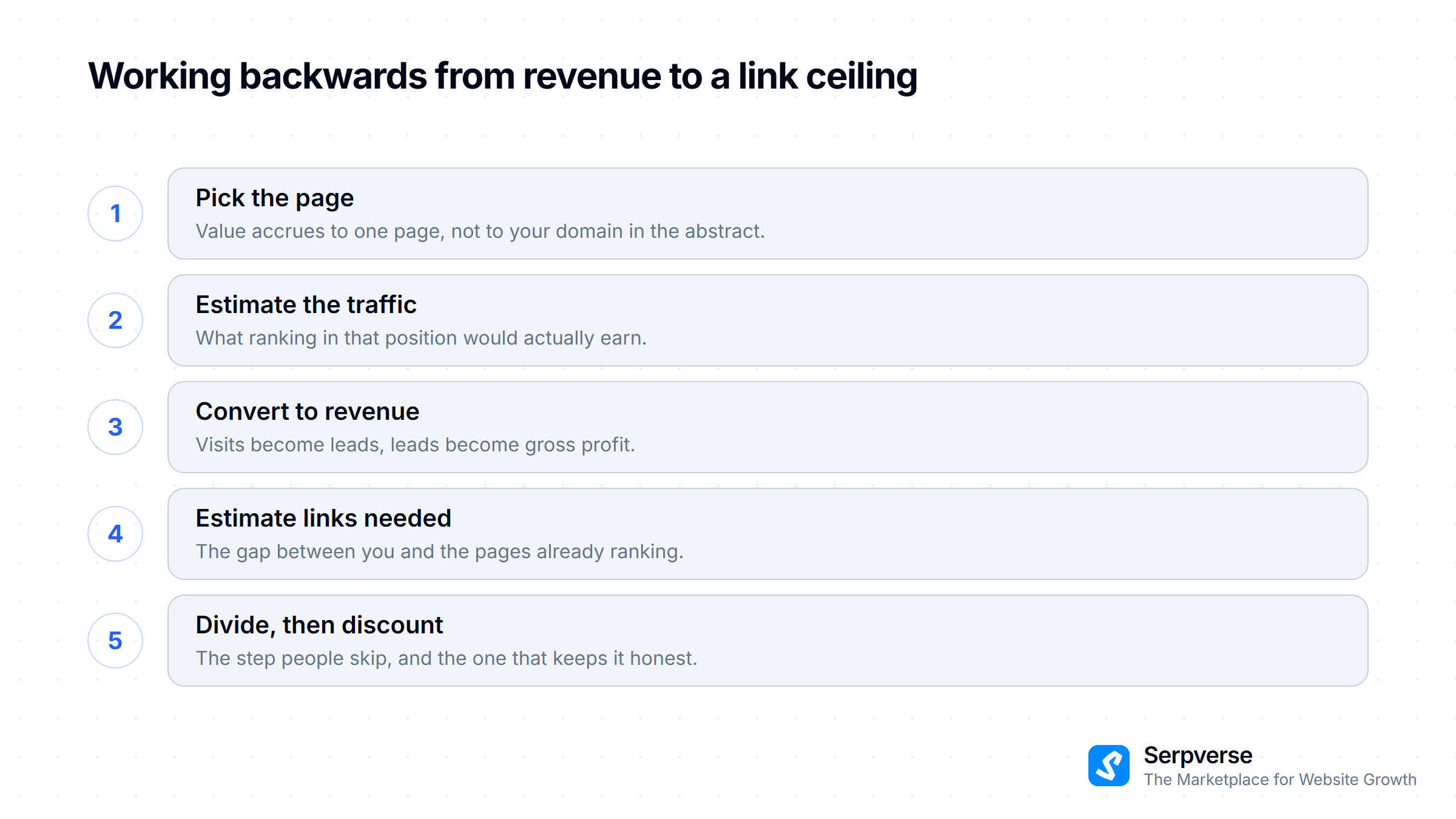
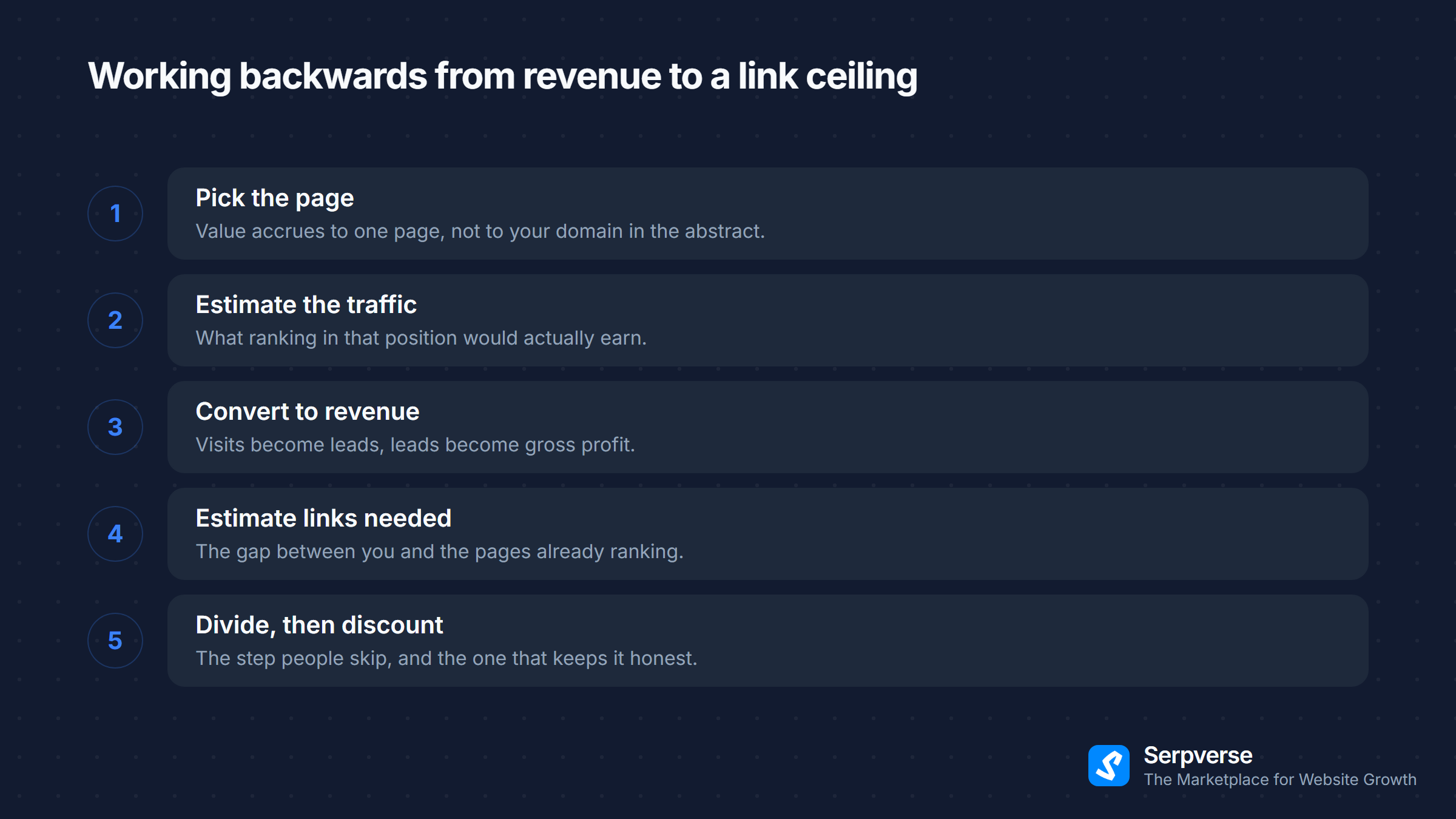
The method has five steps:
- Pick the page and the keyword it should rank for. Value accrues to a specific page, not to your domain in the abstract.
- Estimate the traffic that ranking would earn. Monthly search volume × a realistic click-through rate for your target position.
- Convert traffic to revenue. Visits × your conversion rate × gross profit per customer.
- Estimate how many links it takes. Compare your page's referring domains against the pages currently ranking. The gap is your rough link requirement.
- Divide, then discount. Annual gross profit ÷ links required, then cut it substantially, because rankings are never guaranteed.
That final discount is the step people skip, and it's the one that keeps this from being fantasy math. You are buying a probability, not an outcome.
A Worked Example
Assume a B2B service business:
- Target keyword: 1,200 searches/month
- Realistic CTR at position 3: 10% → 120 visits/month
- Conversion rate to qualified lead: 4% → 4.8 leads/month
- Lead-to-customer rate: 25% → 1.2 customers/month
- Gross profit per customer: $1,400
That's $1,680/month, or $20,160 in annual gross profit from one ranking.
Now the link requirement. If the pages ranking in the top three have 40–60 referring domains to that page and yours has 8, call it 35 links to close the gap.
$20,160 ÷ 35 = $576 per link — but only if the ranking is certain, which it isn't. Apply a 50% discount for the real probability of getting there and holding it, and your defensible ceiling is roughly $288 per link.
Against the market table above, that tells you something immediately useful: guest posts around the $295 average are rational for this business, insertions at $179 are comfortably profitable, and a $1,400 digital PR link only makes sense if it does far more than close one keyword gap.
Cost per Link Is the Wrong Metric
The number that matters is cost per result, and the two can point in opposite directions.
Ten links at $50 look cheaper than two at $250. If the ten come from sites with no traffic and no relevance, they produce no ranking movement and the true cost per result is infinite — you spent $500 for nothing. If the two are on genuinely relevant sites your buyers read, they may move the page on their own.
Three adjustments turn sticker price into real cost:
- Survival. A placement that disappears in four months cost you twice — once in cash, once in the ranking you lose when it goes. Factor in whether a site has any track record of links staying live.
- Relevance. A tightly relevant link does more work than a higher-authority irrelevant one, so a lower sticker price can buy more outcome.
- Time. A cheap link that takes six weeks of back-and-forth has a real cost your invoice doesn't show.
For the full framework on judging a placement before you pay, see our guide to evaluating link quality. And for measuring what the whole programme returned, link building ROI covers the metrics that connect links to revenue.
When Paying More Is the Cheaper Option
Counter-intuitively, the higher price is often the lower cost:
- In competitive niches, where the ranking pages all have strong profiles and weak links won't register at all.
- On a young domain, where a small number of unambiguously editorial links does more than volume, and cheap inventory actively creates a pattern that looks bought.
- When permanence matters, because the price difference between a real publication and a link shop is largely the difference between a link that stays and one that doesn't.
- When the page is worth a lot, as the worked example shows — a high ceiling means the constraint is finding good enough inventory, not affording it.
The mirror case is real too: if your ceiling comes out at $60, the honest conclusion is that paid links aren't the right channel for that page, not that you should go shopping in the cheap tier.
What You Should Never Pay For
Some things are priced low because they're worthless, and some are priced normally but shouldn't be bought at all:
- Undisclosed followed links sold at scale. Google's link spam policies(opens in new tab) are explicit that links exchanged for money are spam unless qualified with
rel="sponsored"orrel="nofollow". That's a compliance question, not a pricing one. - Per-link pricing with no visibility of the site. If you can't see the domain before paying, you're not buying a placement, you're buying a lottery ticket.
- Guaranteed rankings. Nobody can sell those. A vendor who claims to is either lying or planning something that will cost you more later.
- Sitewide or footer links. Priced as one link, valued by search engines as considerably less.
Ahrefs' write-up on buying backlinks(opens in new tab) cites a survey of 755 link builders putting the average paid link at $83 — a useful reminder that a low market average reflects what people actually buy, not what works. The bottom of any market is always the biggest part of it.
Where Transparent Pricing Changes the Math
Every calculation above assumes you can see what you're buying before you commit. In cold outreach you usually can't: prices arrive by email, vary per buyer, and can't be compared without doing the whole negotiation first.
On Serpverse, each listing shows its price, domain authority, organic traffic, and niche up front, so you can filter to what clears your ceiling and compare like for like. Publishers are verified before listing — the vetting exists precisely because of the 1.37% problem — payment is held in escrow until the placement is live and approved, and a review window gives you time to check the result before funds are released.
When the price and the metrics that justify it sit side by side, "how much should I pay" stops being a negotiation and becomes arithmetic.
Key Takeaways
- The cost of a backlink is set by placement type first: insertions average $179, guest posts $295 direct or $461 via a vendor, and digital PR $1,250–$1,500 per link.
- The vendor markup is real — 56% for the identical guest post placement.
- Only 1.37% of guest post inventory clears a basic quality bar. Cheap links aren't a discount on the good ones; they come from a different pool.
- Calculate your own ceiling from keyword value, conversion rate, gross profit, and the link gap — then discount it heavily, because rankings are a probability.
- Optimise cost per result, not cost per link. Survival, relevance, and your own time all sit outside the sticker price.
- If your ceiling comes out very low, the answer is that paid links are the wrong channel for that page — not that you should shop cheaper.