What Is a Niche Edit? Link Insertions and SEO Risk
A niche edit adds your link to an article that already exists. Learn how link insertions work, what they cost, and where the real penalty risk sits.
- By
- Serpverse Team, SEO Experts
- Published
- Aug 12, 2026
- Read
- 10 min read
- niche edit
- link insertion
- link building
- backlinks
 Serpverse
Search for "niche edit" and you'll be told it's a black-hat tactic that risks a manual penalty. Search for "link insertion" and you'll be told it's a white-hat method that doesn't contravene Google's guidelines at all.
Both pages are describing exactly the same thing. That contradiction is the most useful place to start, because it reveals what actually determines the risk — and it isn't the tactic.
What Is a Niche Edit?
A niche edit is a backlink added to an article that has already been published on someone else's website. Instead of creating new content, you (or a vendor) arrange for your link to be inserted into a relevant paragraph of an existing post — one that is already indexed, already trusted, and in the best cases already ranking and earning traffic.
The appeal is speed and inherited authority. A brand-new guest post starts from zero and has to earn its position. An established page has already done that work, so a link placed on it can begin passing value almost immediately.
Niche Edit, Link Insertion, Curated Link: One Tactic, Three Names
The vocabulary is a marketing artefact, not a technical distinction:
| Term | Who uses it | Connotation |
|---|---|---|
| Niche edit | Link vendors, SEO forums | Neutral to negative; associated with paid placement |
| Link insertion | Agencies, tool blogs | Neutral to positive; associated with outreach |
| Curated link | Vendors selling the above | Deliberately positive |
| Contextual backlink | Used loosely for both this and guest posts | Vague enough to mean anything |
Nothing changes mechanically between these labels. In every case, a link is added to a page that already existed. When a vendor offers "curated links" at a premium over "niche edits," you are being sold a synonym.
Knowing this is practically useful in one specific way: when you compare quotes, normalise the vocabulary first. Two vendors quoting wildly different prices are frequently selling the identical product under different names.
Why the Same Tactic Is Called Both White Hat and Black Hat
Here is the resolution to the contradiction: the tactic is neutral. What varies is how it's executed, and the two camps are quietly describing different executions.
The "white hat" version is outreach. You find an article that genuinely would be improved by referencing your content — it mentions a statistic you have better data on, or covers a topic where you've published the definitive guide — and you ask the editor to add it. No money changes hands. The editor agrees because the link makes their page better. This is ordinary link building, and it's unambiguously fine.
The "black hat" version is bulk paid insertion. A vendor with access to a network of sites sells slots in existing posts. The paragraph is often edited to accommodate the link rather than the link fitting the paragraph. The host pages exist to hold links. Nothing is disclosed.
Both are "adding a link to an existing article." Only one is a problem.
This distinction maps onto the broader framework in our guide to white hat vs black hat link building: the same action can sit on either side of the line depending on intent, disclosure, and whether the placement would survive a human reviewer's judgement.
How a Niche Edit Works, Step by Step
- A target page is identified — ideally one that's topically relevant to your link, indexed, and pulling real organic traffic.
- A paragraph is chosen where the link can sit as a genuine reference rather than an interruption.
- The site owner is approached, either by you directly or by a vendor with an existing relationship.
- The page is edited — sometimes just an anchor added to an existing sentence, sometimes a sentence rewritten or added to create somewhere for the link to live.
- The link goes live on a page that keeps its existing age, authority, and rankings.
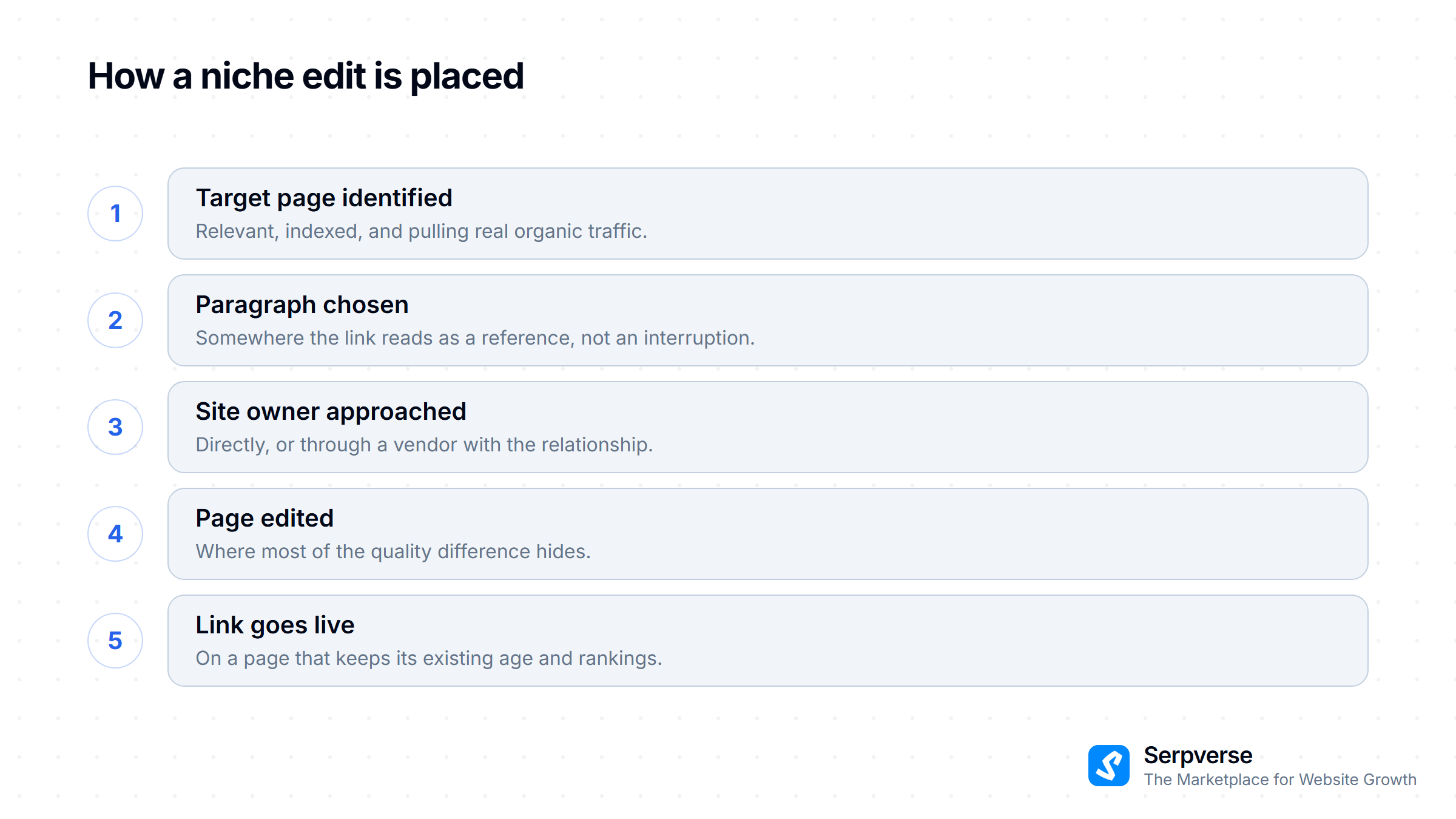
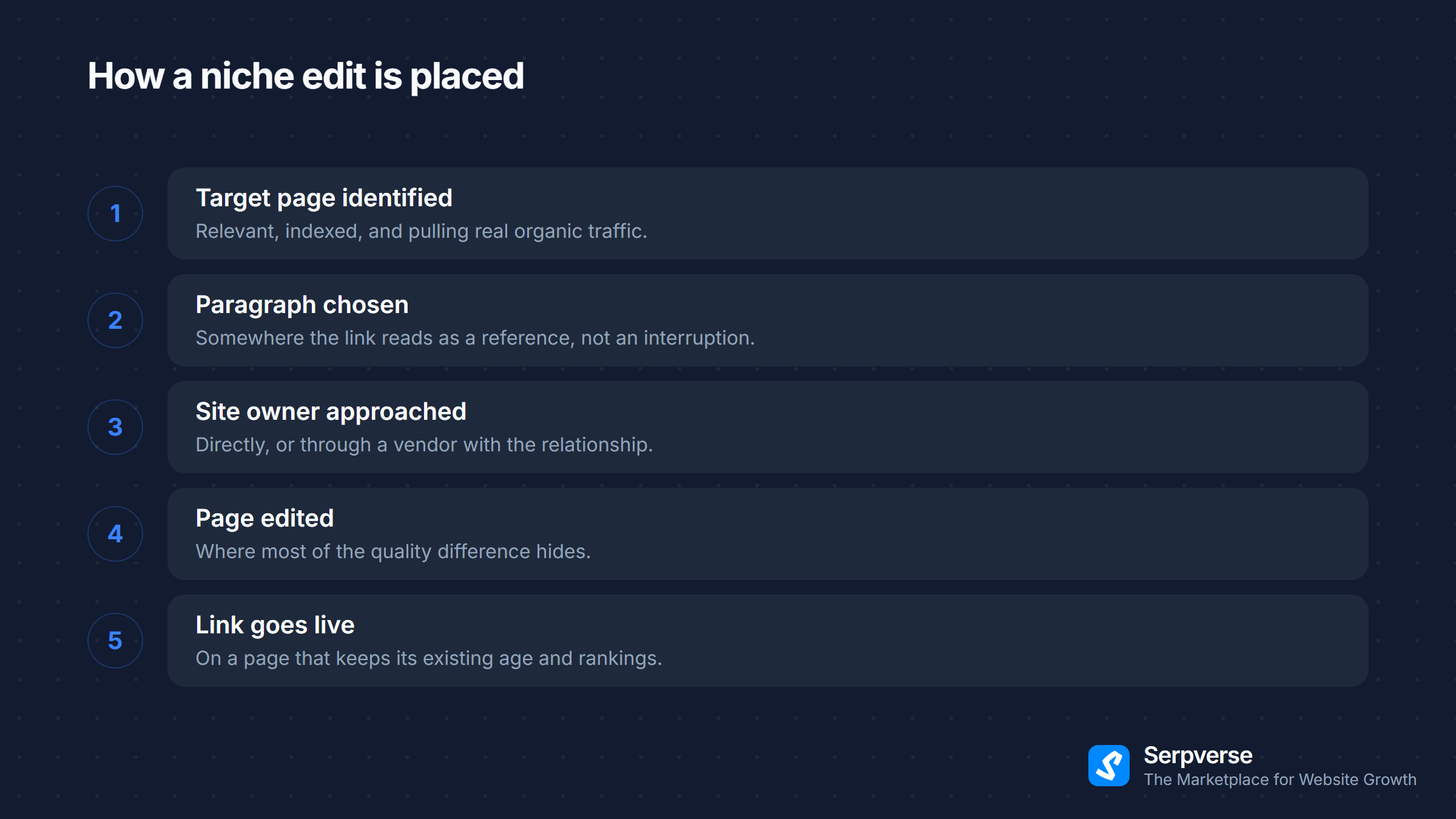
Step four is where most of the quality difference hides. A link woven into an argument the paragraph was already making is invisible to a reader. A sentence bolted on to host a commercial anchor is obvious to a reader and to a reviewer.
Niche Edits vs Guest Posts
The two formats solve overlapping problems with different trade-offs.
| Niche edit | Guest post | |
|---|---|---|
| Content required | None, or a sentence | A full article |
| Time to live | Days | Weeks |
| Typical cost | Lower | Higher |
| Page authority at placement | Inherited, immediate | Starts at zero |
| Control over context | Minimal — it's their article | Total — it's your article |
| Durability | Vulnerable to content cleanups | Tied to the page's own life |
| Reads as editorial | Depends entirely on execution | Yes, when written properly |
The honest summary: insertions buy speed and inherited authority; guest posts buy control and context. Neither is universally better, and most mature link profiles contain both. For the format comparison from the other direction, guest posting for SEO covers what a new-article placement does that an insertion can't.
The durability line deserves emphasis. Your link lives inside content someone else owns and may revise. Site redesigns, content audits, and editorial refreshes routinely strip inserted links, and you often won't notice — which is the same problem we cover in what to do when a guest post link is removed.
What Niche Edits Cost
Link insertions are consistently cheaper than guest posts, which is most of their commercial appeal. BuzzStream's link building pricing analysis(opens in new tab), drawn from a database of roughly 500,000 sites, found:
- Average link insertion cost: $179, against $295 for a guest post bought directly
- Range: $20 to $1,500
- Top-tier placements: around $780 on sites above DR 80 with 100,000+ monthly organic visits
One structural detail in that data matters more than the headline: insertions are rarely offered by the strongest sites. Only a minority of the database offered them at all. Genuine publications with real editorial standards are reluctant to sell edits into existing content, because it means altering pages they've already staked their reputation on. The sites most willing to sell insertions in bulk are, disproportionately, the sites with the least to protect.
That inverse relationship is the single most important thing to understand about this market. Our backlink cost guide sets these figures against the other placement types and covers how to work out what any link is actually worth to you.
Where the Real Risk Sits
The risk in a niche edit has nothing to do with editing an old page. It comes from four things, in descending order of severity:
- Undisclosed payment for a followed link. Google's link spam policies(opens in new tab) treat links exchanged for money as spam unless they carry
rel="sponsored"orrel="nofollow". Google's guidance on qualifying outbound links(opens in new tab) recommendssponsoredfor paid placements specifically. This applies identically to insertions and guest posts — the format is irrelevant. - Host pages that exist to sell links. A page with no organic traffic, no readership, and a paragraph that reads like a link depot is a footprint whether your link arrived last week or last year.
- Irrelevance. A link to a fintech product wedged into an article about garden furniture is conspicuous, and the older the page, the more conspicuous a fresh commercial link inside it becomes.
- Volume and pattern. A profile assembled mostly from insertions on unrelated sites, all with commercial anchors, is a recognisable shape.
Red Flags in a Niche Edit Offer
- "We have a network of sites." A network you can buy into is a private blog network. Whatever it's called, that's the highest-risk inventory in the market.
- No URL until after payment. You cannot evaluate a placement you can't see. Reputable sellers show you the exact page.
- High DR, negligible traffic. The clearest sign that authority was manufactured rather than earned.
- Bulk pricing per link. "50 niche edits for $500" prices a placement below the cost of a genuine editor's time, which tells you no genuine editor is involved.
- Any topic accepted. A site that will insert a link about anything has no subject, and therefore no relevance to lend.
- Permanence guarantees with no mechanism. A promise the seller has no way to enforce on a page they don't own.
When a Niche Edit Is the Right Choice
Insertions genuinely earn their place in a few situations:
- You need speed. A campaign with a deadline benefits from placements that go live in days on pages that already rank.
- The perfect page already exists. When an article is genuinely the right context for your link, an insertion is more natural than commissioning a new post to say the same thing.
- You're diversifying an established profile. A mature site with a base of editorial links can absorb well-chosen insertions without the pattern standing out.
- You have something worth citing. If you've published original data, outreach-based insertions are simply link building — and the cleanest version of this tactic there is.
They're the wrong choice when your domain is young and your profile is thin. At that stage, links that are unmistakably editorial do more work, and a cheap insertion into an unrelated post is the fastest way to build a profile that looks purchased — a sequencing problem our guide to link building for startups works through in detail.
For that reason, placements on Serpverse are new articles rather than insertions — either a Guest Post, where you supply the content, or an Article, where the verified publisher writes it to your brief. Every listing shows the site's authority, traffic, and price up front, publishers are vetted before they can list, and payment stays in escrow until the placement is live and you've approved it. If insertions are part of your strategy, apply the same standards you'd apply here: see the page first, check it has real traffic, and confirm the link will be relevant to the paragraph it lands in.
Key Takeaways
- A niche edit is a link added to an existing published article — the same thing as a link insertion or a curated link. The different names are marketing, not mechanics.
- The tactic is neutral. Outreach-based insertions are ordinary link building; bulk undisclosed paid insertions are link spam. Same action, opposite risk.
- Insertions average $179 against $295 for a guest post, with a $20–$1,500 range and top-tier placements around $780.
- The strongest sites rarely sell them, so cheap insertion inventory skews heavily toward sites with nothing to protect.
- Risk comes from disclosure, host quality, relevance, and pattern — never from the fact that the page already existed.
- Your link lives in content you don't control. Budget for the ones that quietly disappear in the next content audit.