Guest Post Link Removed: What to Do and How to Fix It
Guest post link removed, or quietly switched to nofollow? Here's how to confirm what actually happened, get it put back, and recover what you paid.
- By
- Serpverse Team, SEO Experts
- Published
- Aug 4, 2026
- Read
- 8 min read
- guest post link removed
- backlink removed
- nofollow
- link building
 Serpverse
You paid for a placement, the article went live, and now the link is gone. Or it's still sitting there but carrying a rel="nofollow" attribute, which for link-building purposes amounts to much the same thing.
A guest post link removed months after publication is far more common than most buyers expect, and almost nobody notices on their own. You find out during an audit, or when rankings drift and you go looking for a reason.
Most cases are fixable. Some are recoverable. This covers how to confirm what actually broke, how to get it restored, and what your options are when the publisher stops replying.
First, Work Out What Actually Broke
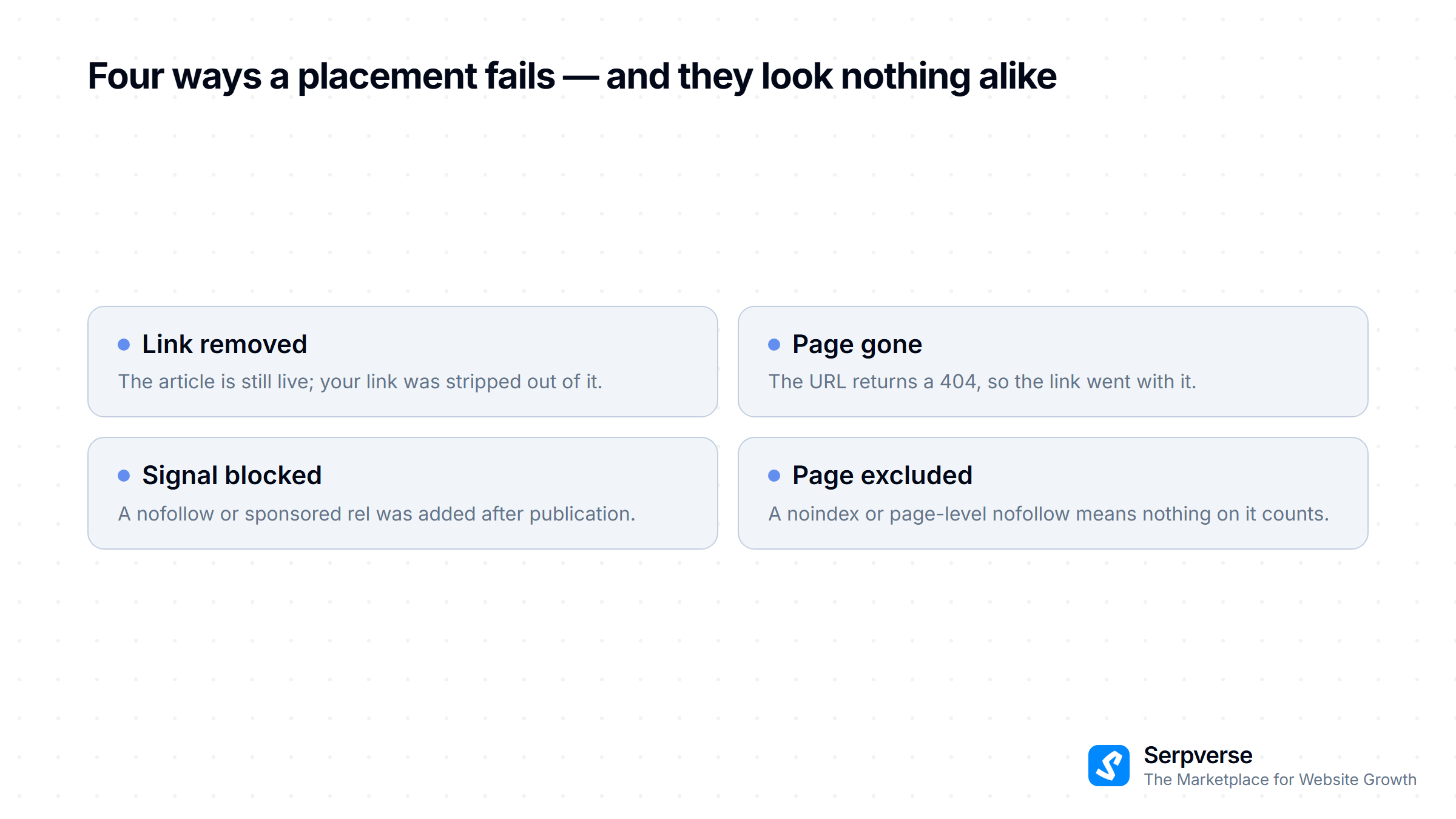
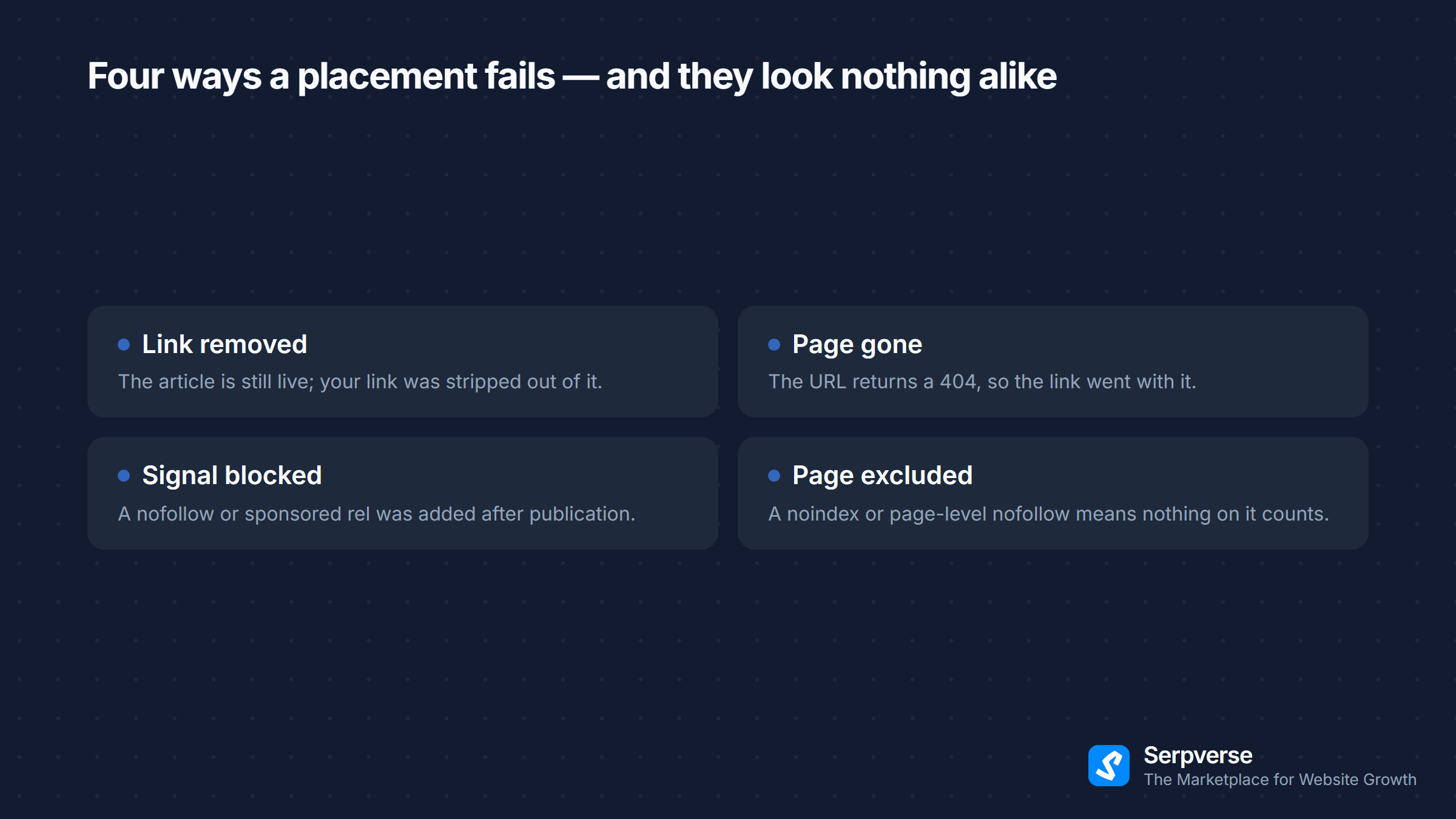
"The link was removed" is the diagnosis people jump to, and it's often wrong. Four different failures look identical from a rankings report, and they need different responses.
| What happened | What you see on the page | Effect on your SEO |
|---|---|---|
| Link removed | Article still live, your link gone | Total loss of the link |
| Switched to nofollow or sponsored | Link visible and clickable | Passes no ranking signal |
| Page deindexed | Page loads fine, absent from Google | Passes nothing — Google isn't counting it |
| Page deleted | 404, or redirected elsewhere | Total loss, sometimes silently |
The second one catches people out most. The link is right there, the anchor text is correct, and nothing looks wrong — but the publisher has added an attribute that tells Google not to pass any weight through it.
How to Check in Two Minutes
Open the article and view the page source, then search it for your domain — or paste the page and your domain into our free backlink checker, which reads the live page and reports the same thing. What you find tells you which of the four you're dealing with.
<!-- Still on the page, but it now passes nothing -->
<a href="https://yoursite.com/page" rel="sponsored nofollow">your anchor text</a>
Any of nofollow, sponsored, or ugc in that rel attribute means the link is no longer passing ranking signals. Google's guidance on qualifying outbound links(opens in new tab) sets out what each value tells crawlers, and publishers frequently add sponsored retroactively once they tighten up their policies. If you're unclear on the practical difference, we've covered dofollow versus nofollow links in more depth.
If your domain doesn't appear in the source at all, the link is genuinely gone. If the page itself won't load, check whether it 404s or redirects — a redirect to the homepage usually means a site restructure rather than a deliberate removal.
To find out when it changed, pull the page up on the Wayback Machine(opens in new tab). A snapshot from before the change is the single most useful piece of evidence you can have in the conversation that follows, and it's the difference between "I think you removed my link" and "here it is on 4 March, and here it is now."
Why Publishers Remove Guest Post Links
It's rarely malice. In rough order of how often it happens:
- The site changed hands. New owner, new editorial standards, and a purge of anything that looks paid.
- Editorial cleanup. Publishers pruning outbound links to protect their own E-E-A-T signals, especially when the linked page has gone stale.
- A CMS migration went wrong. Links stripped or mangled during a redesign, with nobody checking afterwards.
- Policy nerves. A publisher who suddenly worries about Google's spam policies(opens in new tab) and blanket-nofollows every external link.
- Deliberate churn. The slot gets resold. Cheap link vendors have no incentive to maintain a placement they've already been paid for.
That last one is the uncomfortable case, and it's concentrated at the bottom of the market. A site publishing several sponsored posts a week has a much weaker reason to keep any single one live than a site that takes a handful a year.
Ask the Publisher First
Most removals are resolved with one polite email. Lead with evidence, assume it was an accident, and make it easy to fix.
Hi [name],
We published a guest post with you on [date] — [article URL].
Our link in the third paragraph seems to have come off the page since then. Here's how it looked in [month], via the Wayback Machine: [archive URL].
Could you take a look and put it back? Happy to resend the exact anchor text and destination if that's easier.
Thanks,
[your name]
Two things make this work. You're giving them a dated snapshot rather than an accusation, and you're offering to do the work. Publishers manage a lot of content and a link stripped by a migration is genuinely news to them.
If they reply saying the removal was deliberate, ask why. A publisher tightening their policy may still agree to restore the link as dofollow for the remainder of an agreed term — especially if you can point at what was agreed when you paid.
When the Publisher Won't Respond
This is where your options narrow sharply, and where they depend almost entirely on how you bought the placement.
If you arranged the guest post directly over email with no written terms, you have very little leverage. There's no agreement stating how long the link stays up, so there's nothing to enforce. Chasing is your only real move.
If you bought through a marketplace, check whether it has any post-completion recourse at all. Many don't: once the order is marked complete and the publisher is paid, the transaction is closed and a link removed a month later is your problem.
Can You Get Your Money Back?
Honestly, it depends entirely on where you bought — and it's worth knowing the answer before you buy rather than after.
Direct deals have no mechanism. Whatever you recover comes down to the publisher's goodwill.
Marketplaces without retention terms treat the order as finished at publication. There's no obligation for the link to survive, so there's nothing to claim against.
Marketplaces that make retention an obligation are the only case where a broken placement is actionable. On Serpverse, every listing carries a placement guarantee — permanent by default, or a fixed 1–5 year term the publisher sets — and it's locked to your order at the moment you place it. Removing the link, taking the page down, or weakening it to nofollow inside that term is a breach, and you can dispute a completed order with no deadline on when.
Worth being precise about what that recovers, because "money back" oversells it. The refund is recovered from the publisher's balance, it excludes the service fee, and it can be partial if the publisher's balance is short. It's compensation for a broken placement, not a full reversal of what you paid. That's still meaningfully better than no recourse — but it isn't a guarantee that you end up whole.
How to Stop Losing Links You Paid For
You can't prevent every removal, but you can make it rare and make it recoverable.
Get the retention term in writing before you pay. "How long will this stay up?" is a fair question, and a publisher who won't answer it has told you something useful.
Monitor what you've bought. Nearly everyone discovers a removal by accident, months late. A quarterly pass over your placements — checking each is live, followed, and on an indexed page — turns a silent loss into a fixable one while the publisher still remembers you. A backlink profile audit is the natural home for that check.
Weight your buying toward sites that aren't churning placements. A site running sponsored content constantly has the weakest incentive to maintain any individual one. Fewer, better placements survive longer.
Key Takeaways
- Diagnose before you act. Removed, nofollowed, deindexed, and deleted are four different problems with four different fixes — and if the page turns out to be missing from Google's index, that one is often the publisher's to fix rather than yours.
- Check the page source, not just whether the article loads. A nofollowed link looks perfectly healthy from the outside.
- Get a Wayback snapshot before you contact anyone. Dated evidence changes the conversation entirely.
- Email first, politely. Most removals are accidental and one message fixes them.
- Your recourse was decided at purchase, not at removal. Where you buy determines whether a broken placement is a claim or a write-off.
- Monitor quarterly. A removal you catch in a month is usually recoverable; one you catch in a year usually isn't.