Why Your Backlink Isn't Indexed (and How to Fix It)
A backlink that isn't indexed passes nothing at all. Learn why Google skips them, how to check, and which fixes actually get a backlink indexed.
- By
- Serpverse Team, SEO Experts
- Published
- Aug 22, 2026
- Read
- 9 min read
- backlink not indexed
- link indexing
- google index
- link building
 Serpverse
You bought a placement, the article is live, the link is right there in the page source with no nofollow on it. Weeks later, nothing has moved.
Before you conclude the link was worthless, check whether Google has it at all. A backlink not indexed is a backlink that passes exactly nothing — not reduced value, not delayed value, nothing. The page it sits on is not in Google's index, so as far as ranking systems are concerned the link does not exist.
This is one of the most common and least discussed reasons paid placements underperform. It's also frequently fixable, and the fix is rarely what the indexing services selling you a solution claim it is.
Indexed, Crawled, and Counted Are Three Different Things
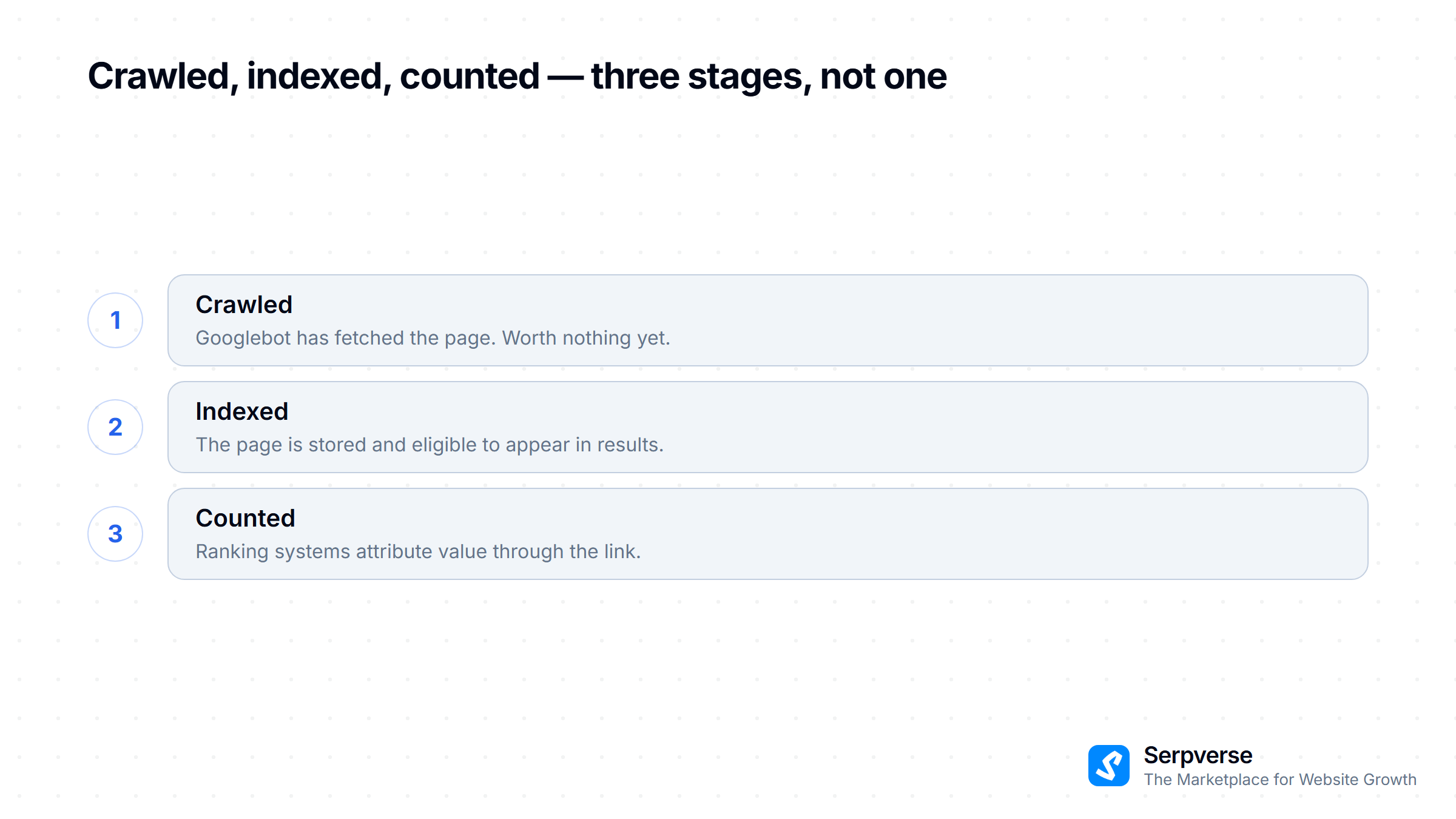
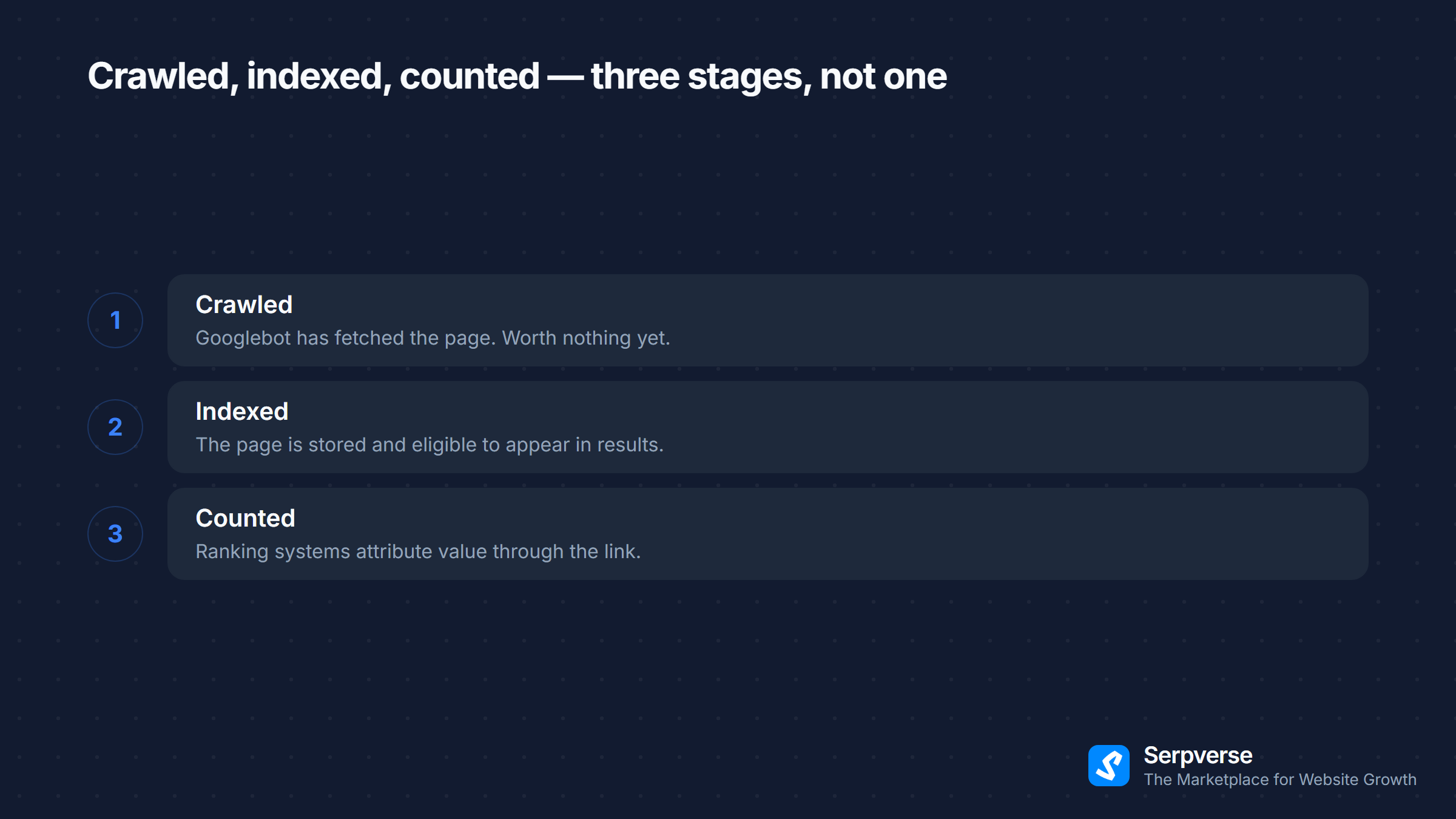
Most confusion here comes from collapsing three separate stages into one. They happen in order, and a link can stall at any of them.
| Stage | What it means | What it's worth to you |
|---|---|---|
| Crawled | Googlebot has fetched the page | Nothing yet |
| Indexed | The page is stored and eligible to appear in results | The link can now be counted |
| Counted | Ranking systems attribute value through the link | The actual benefit |
A page can be crawled and not indexed — Google fetched it, evaluated it, and declined to store it. A page can be indexed and the link still not counted, because of a rel attribute or because ranking systems discounted it.
"Not indexed" is the stage you can most easily diagnose and most often influence, so start there.
How to Check in Thirty Seconds
Take the exact URL of the page your link sits on — not your own page, the publisher's article — and search Google for it directly:
site:publisher.com/the-exact-article-urlThree possible outcomes:
- The page returns. It's indexed. Your problem is elsewhere — likely a
relattribute, in which case dofollow versus nofollow covers what each value stops, or simply time. - Nothing returns. The page is not in the index. Nothing on it is passing anything.
- A different page returns. Check for a redirect or a URL change since publication — one of the four failure modes covered in what to do when a guest post link is removed.
For a more precise answer, the URL Inspection tool in Search Console reports indexing status directly — but only for properties you control, so it works for your own pages rather than a publisher's. For third-party URLs, the site: check is what you have.
Why Most Unindexed Backlinks Are Unindexed
The instinctive explanation is that the link is bad. Usually it's more mundane than that: Googlebot never found the page, or found it and judged it not worth storing.
Nobody links to the page. This is the big one. Googlebot discovers URLs by following links. A guest post published to a site's blog, never linked from the homepage, never included in a sitemap, never shared anywhere — has no discovery path. It exists at a URL nobody references.
The site's crawl budget is spent elsewhere. Google allocates finite crawling attention per site, and low-value sites get very little. Google's guidance on managing crawl budget(opens in new tab) explains how demand and site health govern how much crawling a site attracts. A publisher pumping out several sponsored posts a week on a site with no audience is spreading a tiny budget across a growing pile of pages.
The page is thin or duplicative. Google indexes selectively. A 400-word post assembled to hold a link, on a site full of similar posts, is a page it may fetch and then decline to keep.
The source domain is weak, new, or already deindexed. If the site itself has indexing problems, your page inherits them.
Notice how much of this is about the publisher, not your link. Which is the real lesson: indexing problems are usually a symptom of having bought on a site Google doesn't care about.
What You Can Actually Fix
Ranked by how much difference they make relative to effort:
- Ask the publisher to link to it internally. The single most effective fix. A link from the site's own homepage, category page, or a related article gives Googlebot a discovery path and signals the page matters. Publishers are usually happy to do this — it costs them nothing and improves their own site structure.
- Check the article is in the site's sitemap. Some publishers exclude sponsored content from their sitemap, deliberately or through a misconfigured plugin. Worth asking directly.
- Get the page linked from somewhere else. A mention in a newsletter, a relevant forum reply, a social post that gets picked up. Any genuine external reference creates a crawl path.
- Confirm it isn't blocked. Occasionally a publisher's
robots.txtor anoindextag on their sponsored-post template is quietly excluding the entire section. Check the page source for anoindexmeta tag before assuming anything subtler — our free backlink checker reports it directly, including anoindexset in theX-Robots-Tagheader, which leaves nothing in the markup to find.
That fourth one is worth checking early, because it converts an inexplicable problem into an obvious one. A noindex tag on a paid placement means the publisher is selling something that structurally cannot work.
What You Can't Fix
Some causes are outside your reach, and recognising them saves wasted effort.
If the source domain has been deindexed for spam, nothing you do to one page will help. If the site has a chronically low crawl rate because Google has judged the whole property low-value, a single internal link won't reverse that. If the publisher won't respond, you have no lever at all.
In those cases the honest answer is that the placement was a bad buy, and the useful takeaway is diagnostic: check indexation on the publisher's existing posts before you purchase, not after.
Why Indexing Services Are Mostly Selling You Nothing
Search this problem and page one is dominated by services offering to index your backlinks for a fee. Be skeptical for a structural reason: none of them can make Google store a page it has evaluated and rejected.
What they can do is ping the URL and create some crawl paths. That addresses exactly one cause — discovery — which you can address yourself for free by asking the publisher for an internal link.
If the page was crawled and declined on quality grounds, no amount of submission changes the verdict. Google's request-recrawl guidance(opens in new tab) is explicit that submission is a request, not an instruction, and that crawling doesn't guarantee indexing.
How Long Before You Worry
Give a new placement four to six weeks before treating non-indexation as a problem. On a healthy site with normal internal linking, a new post is usually indexed within days. On a slower site it can genuinely take a month.
If the page is still absent after six weeks, it isn't running late — something is preventing it, and it's time to work through the checks above. Bear in mind that indexing is only the first hurdle; even once indexed, backlinks take time to affect rankings, so don't read early indexation as a promise of quick movement.
When to Write a Link Off
At some point, chasing costs more than the link is worth. A reasonable threshold: you've asked the publisher once, checked for a noindex, confirmed the site indexes its other content, and it's been two months.
Write it off, and record the domain. The genuinely valuable output of an unindexed placement is knowing not to buy there again — and if you bought several links on the same site, checking those too, because indexing problems cluster by domain rather than by page.
Buying in a Way That Avoids This Entirely
The reliable prevention is upstream. Before purchasing, check whether the publisher's recent posts are indexed — pick two or three at random and run the site: check. A site that can't get its own content indexed will not get yours indexed either.
Beyond that, the same qualities that make a site worth linking from make indexation likely: real traffic, genuine internal linking, a sitemap that includes everything, and content that isn't obviously assembled to hold links. Our guide to evaluating link quality covers what to look at, and the reasoning behind Google's link qualification attributes(opens in new tab) is worth understanding alongside it — an indexed page with a sponsored attribute has the same practical effect on rankings as an unindexed one.
Some marketplaces attach an indexing condition to placements, so a link that never gets indexed within a defined window becomes a resolvable issue rather than a sunk cost — on Serpverse an indexing guarantee is part of what a placement comes with. That's worth checking before you buy, because it moves the risk of this exact failure off you. Either way, indexation is the first thing to verify after any placement goes live — and the check takes less time than reading this sentence twice.