How Long Do Backlinks Take to Work? A Real Timeline
Most answers range from two weeks to six months. Here's how long backlinks actually take to work, what sets the pace, and when to start worrying.
- By
- Serpverse Team, SEO Experts
- Published
- Aug 26, 2026
- Read
- 8 min read
- backlink timeline
- link building
- seo timeline
- rankings
 Serpverse
Search this question and you'll get answers ranging from seven days to six months, stated with equal confidence. That spread isn't sloppiness — it's the honest consequence of a question that depends on variables nobody asking it has specified.
How long backlinks take to work depends on a chain of steps, each with its own delay, and on where your page currently sits in the results. Understanding the chain gets you a far better answer than any single number, and more usefully, it tells you which stage yours is stuck at.
Why Every Answer You Find Is Different
The people publishing these timelines are describing genuinely different situations. A link to a page already ranking eleventh for a low-competition term behaves nothing like a link to a brand-new page targeting a head term.
Both writers are being truthful about what they observed. Neither is describing your case. So rather than pick a number, work through the stages — you can identify which one you're in, and that's actionable in a way that "four to twelve weeks" never is.
The Chain a Backlink Has to Travel
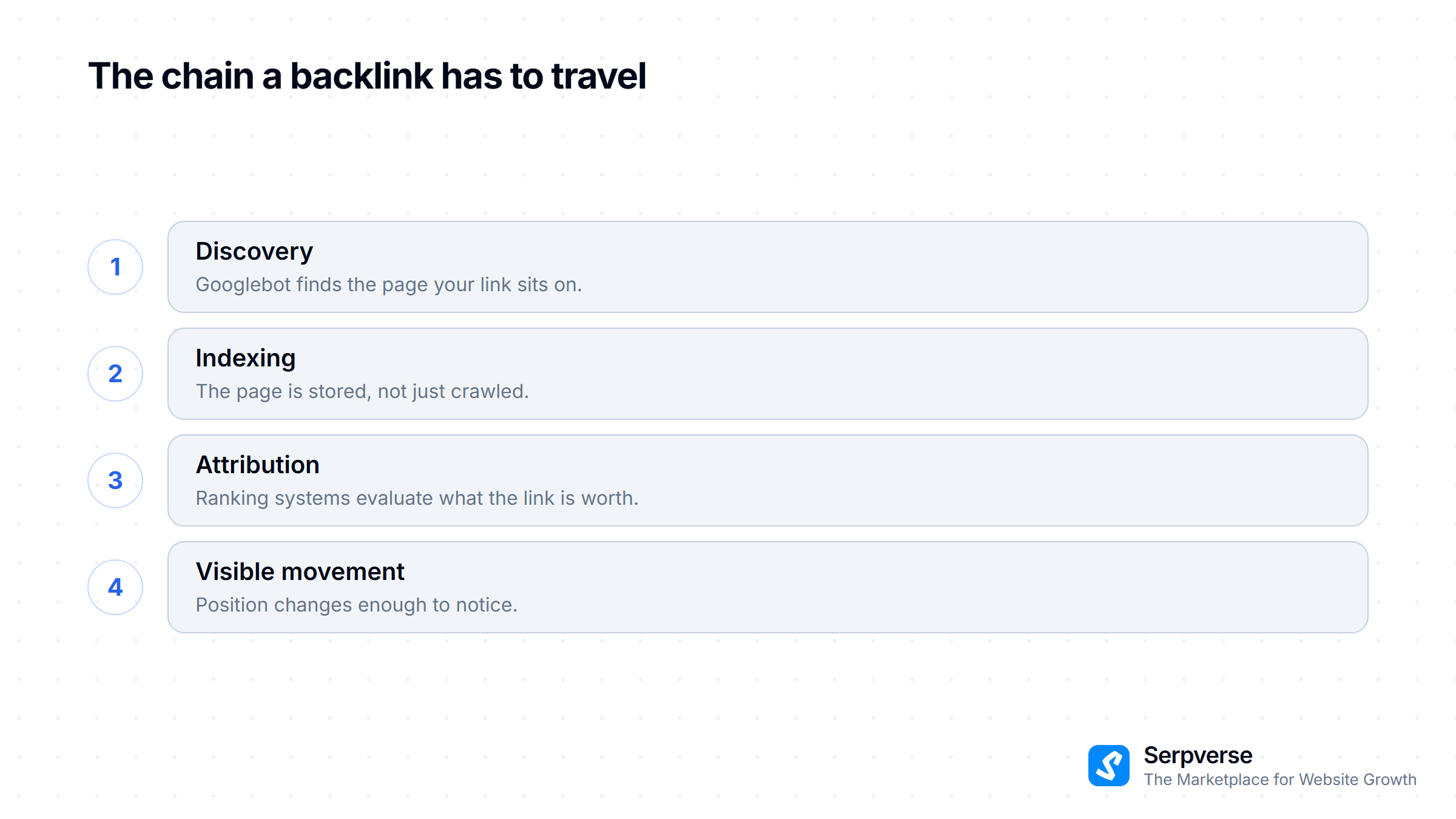
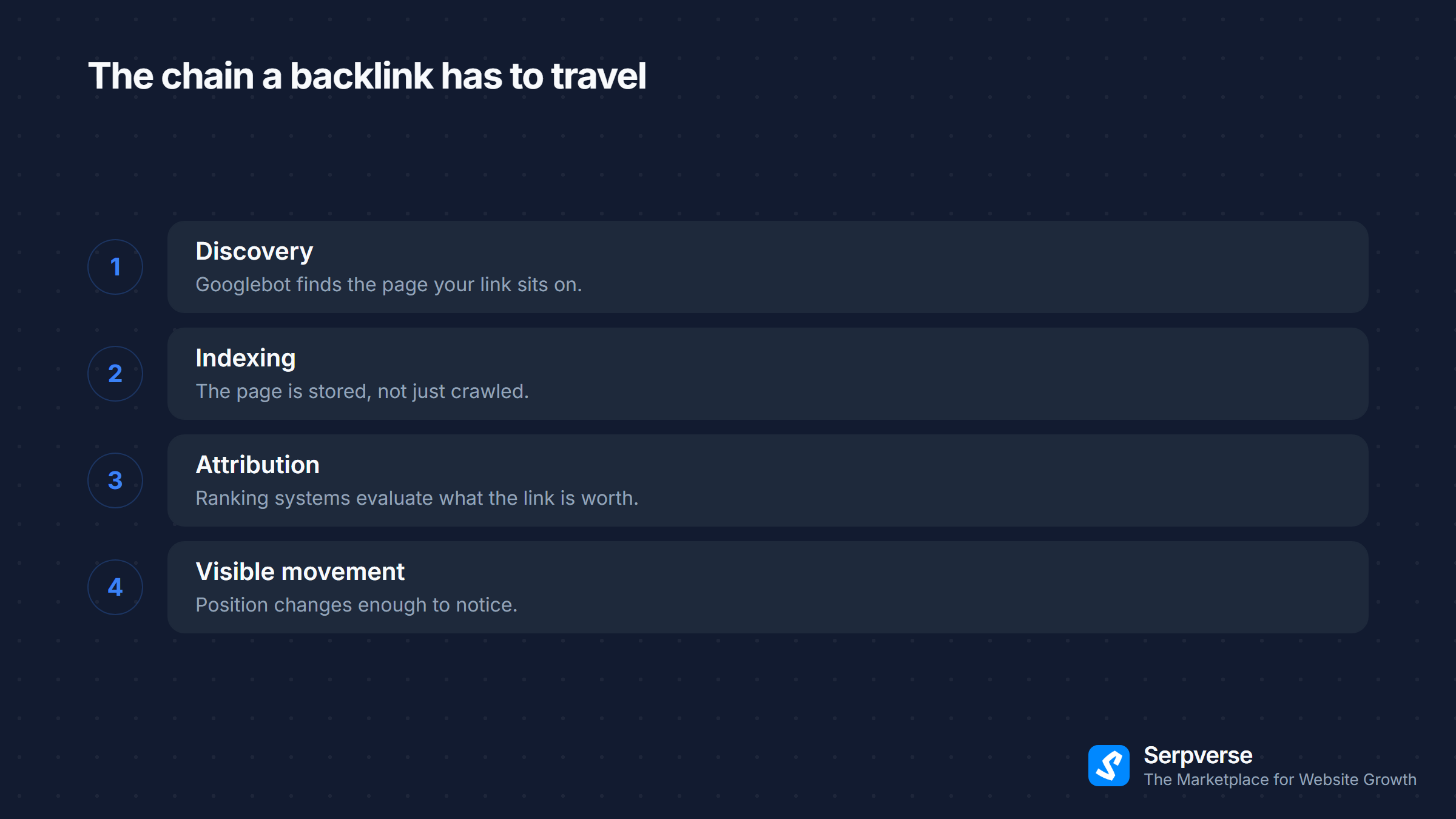
Four things have to happen in order. A link stalled at any stage produces the same visible symptom: nothing.
| Stage | Typical duration | What determines it |
|---|---|---|
| Discovery | Hours to weeks | Whether anything links to the page your link is on |
| Indexing | Days to weeks | The publisher's site quality and crawl rate |
| Attribution | Weeks | How ranking systems evaluate the link |
| Visible movement | Weeks to months | Competition for your target term |
The total is cumulative, which is why the honest range is so wide. A well-linked page on a healthy site can clear the first two stages in 48 hours. A sponsored post nobody links to, on a site Google crawls monthly, can sit unindexed indefinitely — and no amount of waiting fixes that, because it isn't a waiting problem.
A Realistic Timeline
Assuming the placement is on a reasonably healthy site, here's what the phases look like in practice.
Weeks 0–2 — Discovery and indexing. Googlebot finds the page and decides whether to store it. Nothing is measurable yet. If you check anything in this window, check indexation, not rankings.
Weeks 2–6 — First signals. If the link is going to do something, this is usually where the first traces appear: impressions ticking up, average position drifting by a place or two. Small movements, easily lost in noise, and often only visible in aggregate.
Weeks 6–16 — The bulk of the effect. Most of the ranking change attributable to a link tends to land here. Google's ranking systems(opens in new tab) are continuously refreshed rather than updated on a schedule, so change arrives gradually rather than on a single day.
Months 4–6+ — Compounding. Later movement usually reflects the accumulated profile rather than any individual link. Attributing a month-five change to one placement from January is generally a mistake.
Why Your Current Position Changes Everything
This is the variable that explains most of the disagreement between published timelines, and it's rarely mentioned.
A page sitting on page two or three of the results moves quickly when it gains authority. There's less competition at that depth, the gaps between positions are smaller, and a single good link can be enough to close them. Movement within a month is entirely normal.
A page already in the top ten is a different problem. The competition there is stronger, the incumbents have their own accumulating signals, and the marginal link has to overcome much more. Movement of two or three positions can take several months, and it takes proportionally more links to achieve.
The practical consequence: the same link produces very different timelines depending on where you started. If you're comparing your results against someone else's reported timeline without knowing their starting position, you're comparing nothing at all.
What Speeds It Up
- Internal linking on the publisher's side. A placement linked from the site's homepage or a related article gets discovered and indexed far faster than an orphaned one.
- Topical relevance. A link from a closely related page tends to be attributed more readily than one from an unrelated site.
- A page that's already competitive. Links accelerate a page that nearly ranks; they rarely rescue one that's far off.
- Existing crawl demand on your own site. If your site is crawled frequently, the target page is re-evaluated sooner after the link appears.
What Slows It Down
- A publisher with a poor crawl rate. Google allocates crawling by demand and site health, as its crawl budget guidance(opens in new tab) describes. A low-value site gets very little, and your placement waits in that queue.
- A
sponsoredornofollowattribute. This doesn't slow the link down; it stops it. Check the page source before you start counting weeks — or run the page through our free backlink checker, which reports therelattributes on every link to your domain. - Highly competitive target terms. More competition means more signal required before anything visibly shifts.
- A page with underlying quality problems. Links amplify a page that deserves to rank. They don't substitute for one that doesn't.
"Nothing Happened" Is Three Different Problems
Six weeks in with no movement, the useful next step is working out which failure you have — they need completely different responses.
The page isn't indexed. The most common cause and the most fixable. Nothing on an unindexed page passes anything, no matter how long you wait. We've covered why backlinks don't get indexed and what actually resolves it, and it's the first thing to rule out.
The link is indexed but discounted. The page is in the index, the link is live and followed, and ranking systems have declined to attribute value. Usually a signal about the site you bought on. There's no fix; there's a lesson about vetting.
Everything worked, the effect is just small. One link on a competitive term may produce a change too small to see against normal fluctuation. This isn't failure, it's scale — the question becomes how many links the term requires, which we've looked at in how many backlinks it takes to rank.
Distinguishing these takes about five minutes and saves months of misdirected effort.
How to Measure It Properly
Ranking checks on a single keyword are the worst available instrument. They fluctuate daily for reasons unconnected to anything you did, and they'll show you a change you caused as easily as one you didn't.
Better:
- Record the baseline before the link goes live. Impressions and average position for the target page over the preceding month. Without this you have nothing to compare against, and after the fact it's too late.
- Watch impressions before positions. Impressions move earlier and are less noisy — they're the leading indicator.
- Look at the page, not the keyword. Aggregate performance across every term the page ranks for. A link often lifts a spread of secondary terms before it moves the one you were watching.
- Compare month over month, never day over day. Daily variation will convince you of things that aren't happening.
What to Do While You Wait
Very little, and that's the correct answer. The most common mistake in this window is deciding at week three that a link failed, buying more, and losing the ability to attribute anything to anything.
Check indexation at week two. Check the rel attribute once. Then leave it alone until week six.
If you're planning a campaign rather than a single placement, the timeline argues for steady acquisition over batches — a consistent pace produces overlapping curves instead of one spike followed by a flat quarter, and it's far easier to reason about. Holding that pace is simpler when you can browse available placements and their metrics directly rather than waiting on outreach replies. For how link timelines fit the broader picture, how long SEO takes overall sets out the month-by-month view that individual placements sit inside.
The Short Answer
Four to twelve weeks for the first measurable signal, three to six months for the bulk of the effect, assuming the link is indexed, followed, on a site with genuine authority, and pointing at a page that was already close.
Change any one of those assumptions and the answer changes with it. Which is why, at six weeks with nothing visible, the productive question isn't "how much longer?" — it's "which stage is this stuck at?"