How to Make Money Selling Guest Posts on Your Blog
Turn your blog's authority into income. Learn how to sell guest posts, set fair prices, protect your site's SEO, and get paid reliably as a publisher.
- By
- Serpverse Team, SEO Experts
- Published
- Aug 2, 2026
- Read
- 12 min read
- sell guest posts
- monetize blog
- publisher
- guest posting
 Serpverse

Your blog took years to build. Real traffic, a niche audience, a domain Google has learned to trust — that authority is an asset, and other marketers will pay to borrow it. Selling guest posts is one of the most dependable ways to make money from a blog you already run: a buyer pays to publish an article on your site, and you keep the revenue. Done well, it is steady income on content you were going to host anyway. Done carelessly, it can quietly cost you the search rankings that made your space worth buying in the first place. This guide covers how to sell guest posts profitably — what you need first, how to price, how to protect your SEO, and how to get paid without chasing invoices.
How Selling Guest Posts Works
At its simplest, selling guest posts means charging another website owner to publish their article — almost always one containing a link back to their site — on your blog. They want exposure and a backlink; you have an audience and a domain with authority. Money changes hands, the post goes live, and both sides get something they wanted.
The demand is real and steady. Businesses building their search presence need links from relevant, credible sites, and buying a placement is faster than earning one. That is the opportunity. The catch is that the single thing most buyers want most — a followed link that passes ranking credit — is exactly the part Google regulates. Understand that early and you can monetize for years. Ignore it and you are trading a durable asset for short-term cash.
The rest of this guide is really about one question: how do you take the money without damaging the thing that makes the money possible?
What You Need Before You Sell a Single Post
Buyers pay for authority and reach. Before you list a price, be honest about whether your site actually offers them. A placement on a weak or spammy site isn't just cheap — it's a link most careful buyers will refuse, because it does nothing for their rankings.
Here is the baseline that makes a blog sellable:
| Requirement | Why buyers care | Rough floor |
|---|---|---|
| Real organic traffic | Proves Google trusts and ranks the site, and means the link sends actual visitors | A few thousand monthly organic visits |
| Domain authority | Higher authority passes more ranking value | Domain Rating (DR)(opens in new tab) or DA around 20+ |
| Clean link profile | A low spam score and no link-scheme footprint keep the site penalty-free | No PBN or link-farm history |
| A clear niche | Topical relevance is what makes a paid link look editorial | One coherent subject area |
| A real publishing history | Original, maintained content signals a genuine publication, not a link shop | Regular, substantive posts |
If your site doesn't clear this bar yet, the fastest path to selling guest posts profitably is to keep publishing genuinely good content until it does. Authority is the product. There is no shortcut that survives contact with Google.
How Much Should You Charge for Guest Posts?
Pricing is where publishers most often leave money on the table — or scare buyers off. Your price should track the value you pass to the buyer, and that value is driven by three things: your authority (DR/DA), your organic traffic, and your niche's commercial demand. Finance, SaaS, legal, and health command premiums; lifestyle and general blogging sit lower. The most profitable niches for guest posts breaks down why that ordering holds and which premium categories are worth accepting.
For a market reference point, Ahrefs — citing an Authority Hacker survey of 755 link builders — puts the average paid guest post(opens in new tab) around $78. Treat that as a midpoint, not a target: the average hides a huge spread, and authority moves the number far more than anything else. For the buyer's-eye view of what placements cost and why, see our guest post cost guide.
| Your site | Typical per-post range |
|---|---|
| DR 20–30, modest niche traffic | $40–$100 |
| DR 30–45, solid traffic | $100–$250 |
| DR 45–60, strong traffic or high-value niche | $250–$500 |
| DR 60+, established authority | $500–$1,000+ |
These ranges are approximations — traffic, niche, and turnaround shift them significantly. For the full method — pricing from organic traffic rather than DR, niche multipliers, what you can legitimately charge extra for, and how to test a rise — see how much to charge for guest posts. The workflow for researching comparable listings is in our guide to pricing your listings.
If you sell on Serpverse, one detail works in your favor: you keep 100% of the price you set. The platform's service fee is charged to the buyer on top of your price, not deducted from your earnings — so the number you list is the number you receive.
Protect Your SEO Before You Cash the Check
This is the section most "how to sell guest posts" guides skip, and it is the one that decides whether this income lasts. Selling a guest post is not against Google's rules. Selling a followed link that passes ranking credit in exchange for money is — unless that link is qualified with rel="sponsored" or rel="nofollow".
Google's spam policies(opens in new tab) are explicit that "exchanging money for links, or posts that contain links" is link spam when those links are meant to manipulate rankings. The fix is not to stop selling; it is to mark paid links correctly. Google's guidance on qualifying paid links(opens in new tab) recommends the sponsored value for any advertisement or paid placement. The older nofollow is still accepted, but sponsored is now preferred.
| Link type | rel attribute | Passes ranking credit? | Safe to sell? |
|---|---|---|---|
| Editorial link you'd give for free | none / dofollow | Yes | Yes — it's genuinely editorial |
| Paid placement, marked sponsored | rel="sponsored" | No | Yes — compliant |
| Paid placement, marked nofollow | rel="nofollow" | No | Yes — compliant |
| Paid placement passing PageRank, undisclosed | none / dofollow | Yes | No — policy violation |
Beyond marking the link, the practices that keep you defensible are the same ones that describe good publishing: only accept content you'd have been happy to commission, keep placements topically relevant, put the link in-content rather than in a sitewide footer, and keep sponsored posts a minority of your output. For a fuller breakdown of the line between safe and risky, read our honest take on whether selling guest posts is safe. The short version: risk isn't binary — it scales with the choices you make on every placement.
Set Clear Submission Rules
Published submission rules do two jobs at once: they filter out the low-quality, high-risk orders before they reach you, and they make every accepted placement look editorial. Write them down and enforce them.
A solid rule set covers:
- Niche fit. You only accept content relevant to your site's subject. Off-topic commercial links carry the most risk and the least value.
- Quality bar. Original, well-structured, genuinely useful writing — the same standard as the kind of guest post you'd publish if no money were involved. No spun or thin AI filler.
- Link rules. One contextual, in-content link as standard. Paid links are marked
rel="sponsored". No exact-match commercial anchors ("best cheap car insurance") stuffed to order. - Word count and formatting. A minimum length and a heading structure that matches your existing posts.
- A volume cap. Decide how many sponsored posts you'll run per month and hold the line. A real publication has a real editorial calendar, not a wall of paid inserts.
Publishing these rules up front also raises your acceptance-to-order ratio: serious buyers self-select, and you spend less time rejecting drafts that were never going to fit.
Finding Buyers: Direct Outreach vs a Marketplace
Once your site is ready and priced, buyers have to find you. There are two routes, and most publishers eventually use both.
Direct inbound means advertising that you accept contributions — a "Write for Us" page, outreach replies, industry networking — and negotiating each deal yourself. You keep the full margin, but you also do all the work: vetting whether the buyer's content and target page are safe to link to, agreeing terms, and, critically, collecting payment.
A marketplace puts your listing in front of buyers who are already looking to place content, and standardizes the parts that usually go wrong. You set your price and your rules once; buyers browsing your niche find the listing and order against it.
| Direct outreach | Marketplace | |
|---|---|---|
| Buyer discovery | You market and wait | Buyers browse to you |
| Price negotiation | Per deal | Set once, listed |
| Buyer vetting | Entirely on you | Screened before they transact |
| Payment risk | You chase invoices | Handled by the platform |
| Your margin | Full | Full price; buyer pays the fee |
Neither is "better" in the abstract. Direct outreach can win premium one-off deals; a marketplace wins on predictability and volume with far less overhead.
Getting Paid Reliably
The unglamorous truth about direct deals is that the placement is the easy part — getting paid is the risk. Once your link is live, your leverage is gone. Chasing net-30 invoices, absorbing a chargeback weeks later, or eating an outright non-payment are all common, and each one erases the profit on several honest orders.
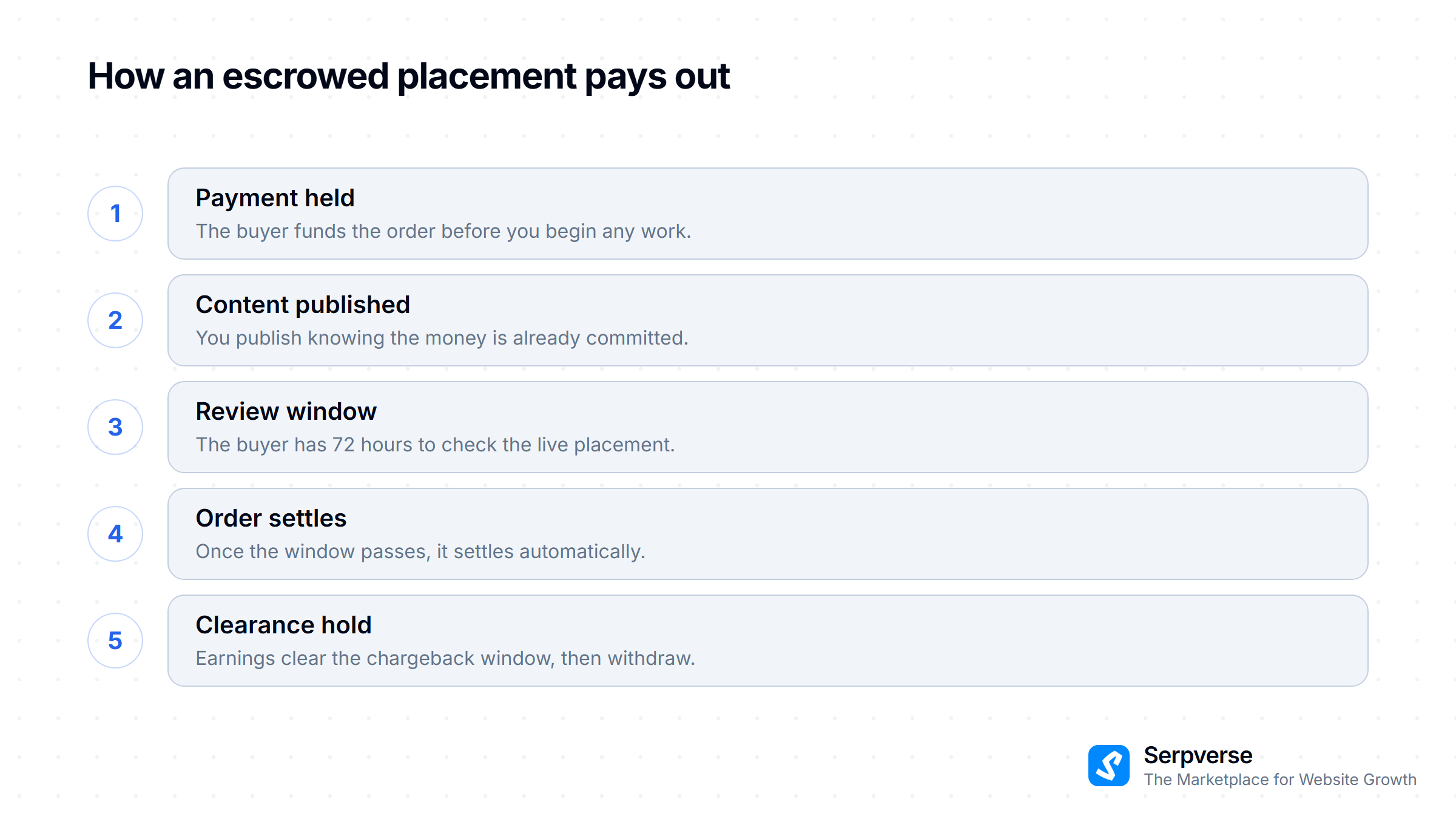
This is the specific problem escrow solves, and it's the core of the Serpverse model for publishers. The buyer's payment is committed up front and held before you begin — so you never publish on a promise. Once your content goes live and the buyer's 72-hour review window passes, the order settles in your favor automatically. Earnings then clear a standard 14-day hold (the chargeback-dispute window) before landing in your withdrawable balance, which you can cash out once it clears the $50 minimum.
You can also keep your listing visible only to buyers who have funded their account, which filters out tire-kickers and points your inventory at people who are ready to actually transact.
Listing Your Site on Serpverse
Serpverse is a guest-post marketplace built supply-first — it opens to buyers shortly, and it is recruiting quality publishers now. The publisher side is deliberately simple:
- List your website and set your own price and submission rules. The listing walkthrough covers exactly what each field does.
- Pass verification. Every site is reviewed by hand against real quality standards — confirmed ownership, genuine editorial content, legitimate organic traffic, technical health, and a clean link profile. Sites that exist only to sell links are rejected. That bar is what makes buyers trust the listings, and it's spelled out in how we verify publishers.
- Get matched with vetted buyers, keep 100% of your listed price, and get paid through escrow so you're never stiffed.
Because verification screens out link farms and penalty-risk sites before anyone transacts, being listed is itself a credibility signal — you're competing on the strength of your site, not racing unvetted sellers to the bottom. If your blog has real traffic and real standards, Serpverse is built to turn that into reliable income.
Key Takeaways
Selling guest posts is one of the most durable ways to monetize a blog with real authority — as long as you treat the search rankings that create that authority as the asset worth protecting.
- Qualify before you list. Real traffic, DR/DA around 20+, a clean link profile, and a clear niche are what make a placement worth buying.
- Price to value, not to the floor. Track authority, traffic, and niche demand; the market average is a midpoint, not a ceiling.
- Mark paid links
rel="sponsored"orrel="nofollow". Selling undisclosed followed links for ranking credit is a Google policy violation that puts both sites at risk. - Publish and enforce submission rules. Relevance, a quality bar, one in-content link, and a volume cap keep every placement editorial.
- Protect your payment. Escrow removes the single biggest risk of direct deals — delivering a permanent link and then chasing the money.
The publishers who earn from guest posts for years are the ones who sell like a real publication: selective about what they run, honest about how links are marked, and never willing to trade a durable asset for a one-time check.