How Much to Charge for Guest Posts: A Publisher's Guide
Most publishers underprice guest posts. Learn how to set rates from traffic and niche demand, what to charge extra for, and when to raise your prices.
- By
- Serpverse Team, SEO Experts
- Published
- Aug 15, 2026
- Read
- 11 min read
- guest post rates
- publisher pricing
- blog monetization
- publisher
 Serpverse

Ask ten publishers how they set their guest post price and nine will describe the same process: they looked at what a couple of other sites charged, picked something similar, and never touched it again.
That method reliably produces one outcome — a price too low, held for too long, on a site whose value has grown since. Buyers don't correct you. A buyer who thinks your rate is cheap simply pays it. This guide covers how to set a rate that reflects what you actually deliver, what you can legitimately charge extra for, and how to raise it without losing the buyers you have.
If you're earlier in the process and still deciding whether to sell placements at all, start with our guide to making money selling guest posts — it covers qualifying your site, submission rules, and the SEO protections that make this income durable. This article picks up at the pricing question and goes deeper.
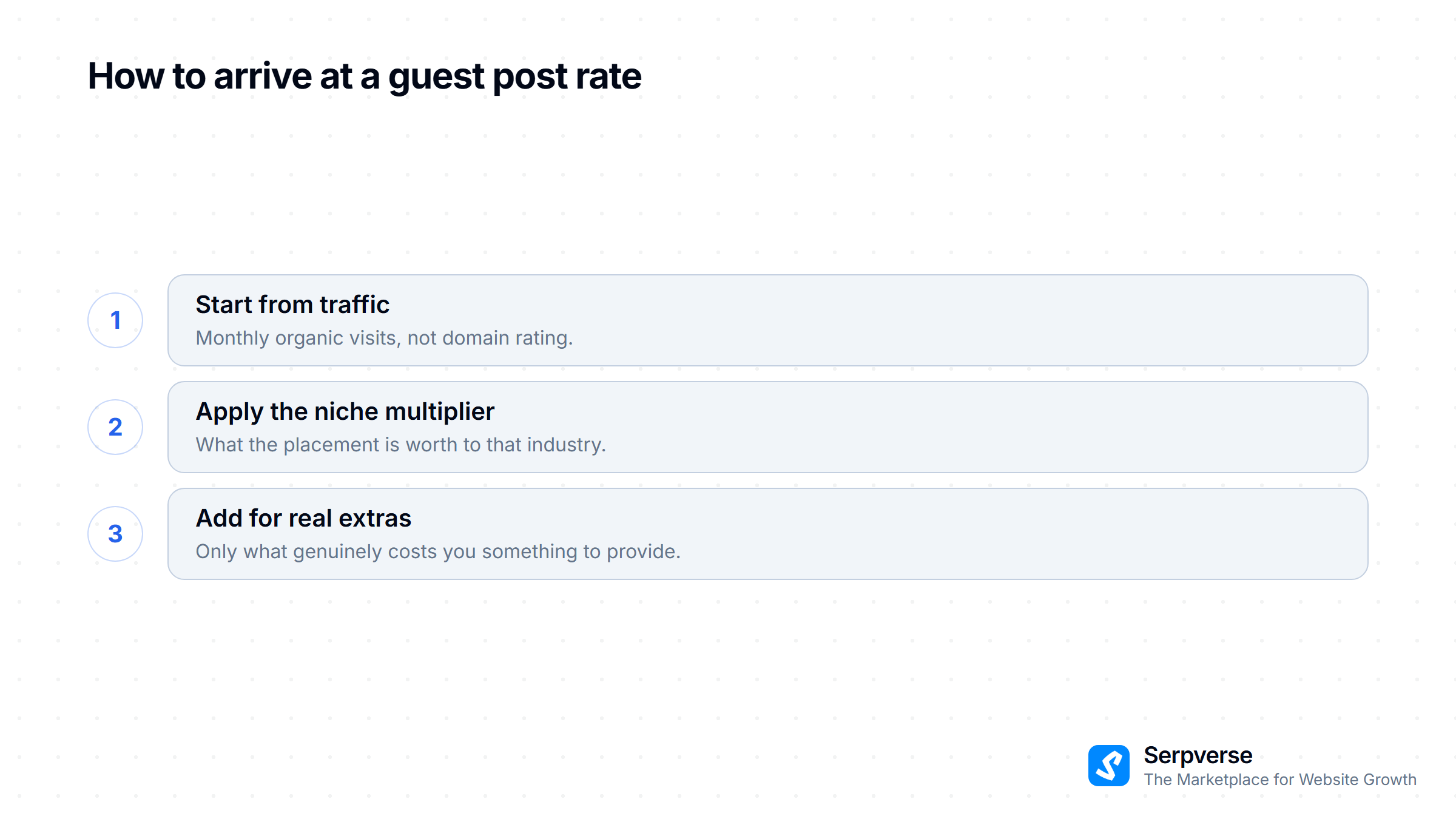
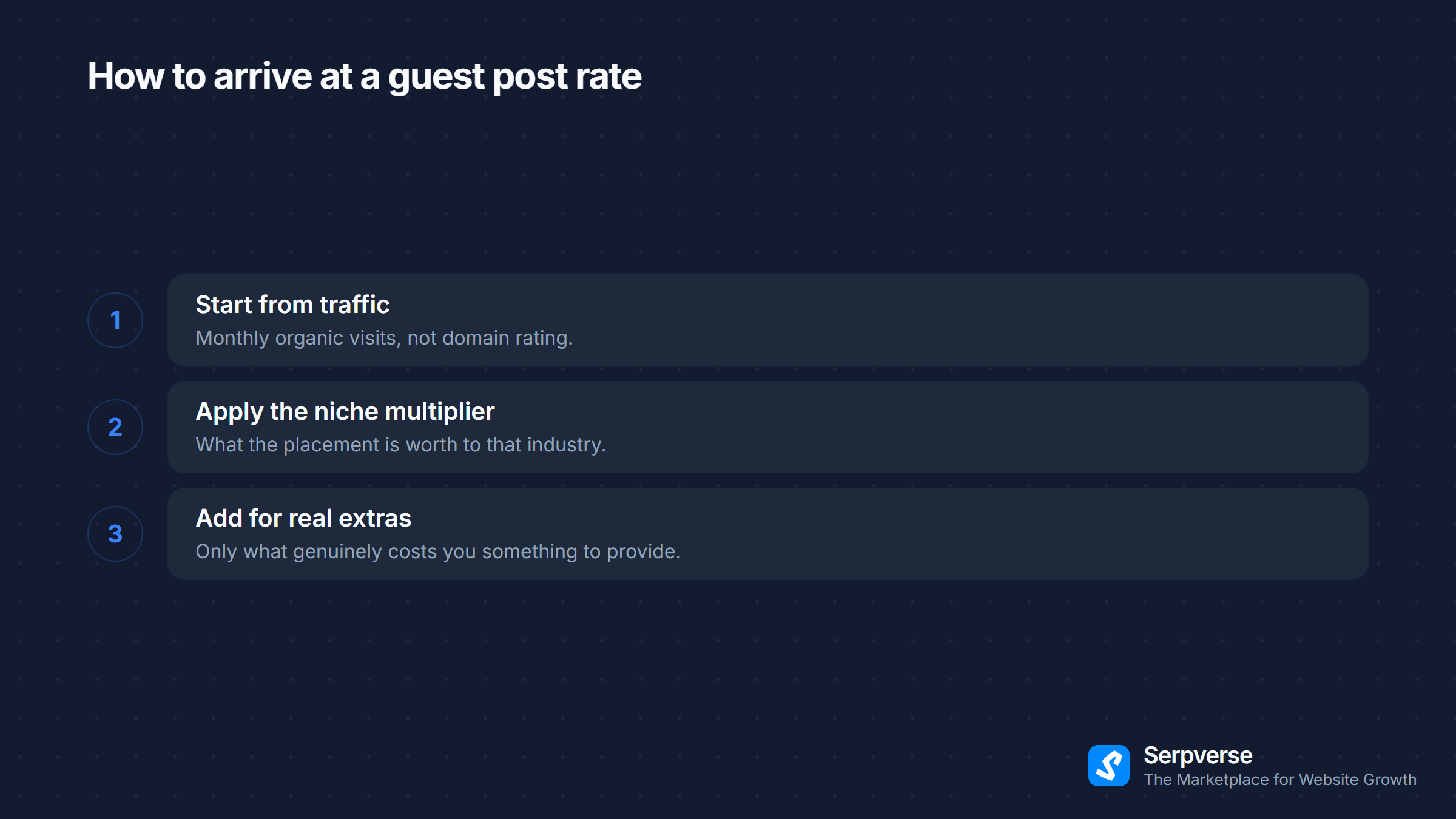
Start With Traffic, Not Domain Rating
Most publishers price off Domain Rating because it's a single visible number. Buyers who know what they're doing price off organic traffic, and the gap between those two habits is where publishers lose money in both directions.
Traffic is the better anchor for three reasons:
- It's the hardest metric to fake. DR can be inflated by a site's own link building. Real monthly visitors from search cannot be manufactured cheaply.
- It's what a careful buyer actually checks. Experienced buyers cross-reference DR against traffic precisely to catch inflated authority. Leading with traffic signals you're the real thing.
- It correlates with the outcome the buyer wants. A page on a site with real readers passes referral visits alongside ranking value.
The practical consequence: if your DR is modest but your traffic is strong, you are almost certainly underpriced. If your DR is high and your traffic is thin, you'll struggle to hold a high price with buyers who check — and the ones who don't check are usually the buyers you least want.
Guest Post Rates by Monthly Organic Traffic
Use this as your starting band, then adjust with the multipliers below. These are market-observed ranges for a publisher selling directly, not vendor prices.
| Monthly organic traffic | Typical rate | Notes |
|---|---|---|
| Under 1,000 | $30–$75 | Hard to sell to careful buyers; build traffic first |
| 1,000–5,000 | $75–$150 | Viable once the niche is clear and content is genuine |
| 5,000–20,000 | $150–$300 | The volume band — most steady publisher income sits here |
| 20,000–75,000 | $300–$600 | Real leverage; buyers will pay for demonstrated reach |
| 75,000+ | $600–$1,500+ | Priced as a publication, not a placement |
For calibration against the wider market: BuzzStream's analysis of roughly 500,000 sites(opens in new tab) puts the average guest post at $295 bought directly from a site and $461 through a vendor. Ahrefs, citing a survey of 755 link builders, puts the average paid link nearer $83(opens in new tab).
Those two numbers look contradictory and aren't. The $83 figure reflects what the market buys on average, and the market is dominated by cheap, low-quality inventory. The $295 figure reflects what real placements cost. If your site is genuinely good, the second number is your reference point and the first is a description of the bottom of the market you're not competing in.
Apply Your Niche Multiplier
Two sites with identical traffic can justify very different prices, because the buyer's economics differ enormously by category. Treat your traffic band as a base and multiply:
| Niche | Multiplier | Why |
|---|---|---|
| General, lifestyle, hobby | 1.0× | Low commercial intent; broad supply of alternatives |
| B2B, SaaS, marketing, tech | 1.3–1.5× | High customer value; buyers have real budgets |
| Health, finance, legal, insurance | 1.5–2.0× | High value per ranking and a higher quality bar to clear |
| iGaming, crypto, CBD, adult | 2.0–4.0× | Restricted categories; few reputable publishers will accept them |
The multiplier at the bottom of that table is compensation for risk, not a windfall. Accepting restricted-category content changes what your site is associated with, and the premium exists because most publishers correctly decline. Charge it or decline it — don't accept that content at general-interest rates.
What You Can Legitimately Charge Extra For
Your base rate buys a standard placement: one relevant article, one contextual link, published to your normal timeline. Everything beyond that is a priced add-on.
- Rush turnaround. Publishing within 48 hours instead of your normal two weeks is worth 25–50% on top. You're reordering your editorial calendar.
- Additional in-content links. A second or third link in the same article carries real value for the buyer. Price each at roughly 30–50% of the base rate.
- Writing the article yourself. Producing the content rather than reviewing a submission is a separate service. Price it at your actual writing cost plus margin — commonly $75–$200 on top.
- Newsletter or homepage feature. Genuine additional distribution to a real audience, priced against what that audience is worth.
- Longer or research-heavy content. If the buyer wants 2,500 words with original formatting, that's more editorial work than a standard 900-word post.
- A longer link commitment. If you're willing to guarantee the placement stays live for a defined period, that's a real assurance most sellers won't give.
Each of these is defensible because each represents something you actually do or genuinely give up. That's the test for any add-on.
What You Should Never Sell at Any Price
One add-on is offered constantly and should always be refused: a premium for an undisclosed followed link.
Buyers will ask for it and pay well above your rate, because a followed link is the one that passes ranking value. That demand is exactly the trap. Google's spam policies(opens in new tab) treat links exchanged for money as spam unless they carry rel="sponsored" or rel="nofollow", and Google's guidance on qualifying outbound links(opens in new tab) names sponsored as the right value for paid placements.
Selling that premium means accepting a recurring payment in exchange for the asset that generates all your other revenue. The full risk picture is in our honest assessment of whether selling guest posts is safe.
Three more to decline regardless of price:
- Sitewide or footer links. Priced as one link, valued as considerably less, and a clear footprint.
- Unlimited link packages. Any offer that decouples your price from your editorial capacity turns your site into inventory.
- Anchor text you'd never write. If the requested anchor reads like an ad, it looks like one to a reviewer too.
How to Test a Price Increase
Publishers avoid raising prices because they fear losing volume. The arithmetic is more forgiving than instinct suggests.
If you raise your price by 20%, you can lose up to 17% of your orders and still earn exactly the same revenue — on fewer placements, which means less editorial work and a lower sponsored-content ratio. Anything better than that is a straight win.
A disciplined test:
- Raise by 15–20%. Large enough to matter, small enough not to reset your positioning.
- Hold it for 60 days or the next 10 enquiries, whichever comes first. A week of quiet is noise, not a signal.
- Measure enquiry-to-order conversion, not enquiry volume. Fewer, better-qualified buyers is the intended outcome.
- Compare revenue, not order count. The number that matters is what you earned, not how busy you were.
- If conversion holds, raise again. Most underpriced publishers discover they were two increases below the market, not one.
Handling Discounts and Bulk Requests
Bulk requests arrive constantly, usually phrased as an opportunity. Most are worth declining.
A buyer asking for ten placements at half price is asking you to concentrate your sponsored-content ratio in one campaign, from one buyer, at your worst margin — the exact profile that damages a site. If you offer bulk terms at all, keep the discount modest (10–15%), spread delivery over months rather than weeks, and apply your normal editorial standards to every piece.
The one discount that's usually worth giving is for content you'd have been happy to publish anyway. A genuinely strong article from a credible contributor in your niche costs you nothing in editorial risk, and rewarding that quality attracts more of it.
Never discount to win a first order from a buyer who's negotiating hard on price alone. That buyer sets an anchor you'll spend the relationship trying to escape.
Pricing Mistakes That Cost Publishers Money
- Setting it once and forgetting. Your traffic and authority grow; a static price silently becomes a bigger discount every year.
- Pricing off DR alone. It's the metric most detached from what a buyer receives, and the easiest to have inflated without realising.
- Copying the cheapest listing in your niche. You're benchmarking against the site with the least to offer.
- One flat rate across every category. A restricted-niche placement and a hobby post are not the same product and shouldn't cost the same.
- Competing on price. In a market where cheap inventory is the norm and quality is scarce, the low-price position attracts exactly the buyers who create risk.
- Forgetting your own costs. Reviewing submissions, formatting, handling revisions, and maintaining the post are real work. A price that ignores them isn't profit.
When to Reprice
Review your rate quarterly, and immediately whenever one of these changes:
- Organic traffic moves by more than 25% in either direction
- You move up a traffic band in the table above
- You start accepting a higher-multiplier niche
- Your rejection rate climbs — a signal that demand exceeds your capacity at the current price
- Nobody has questioned your price in months, which usually means it's below market
The last one is the most reliable and the most ignored. A price that never meets resistance isn't well calibrated; it's low.
Getting Paid What You List
Setting the right number matters less if collecting it is unreliable. In direct deals the placement is the easy part — once your link is live, your leverage is gone, and chasing invoices or absorbing a chargeback weeks later erases the margin on several honest orders.
On Serpverse the buyer's payment is committed before you begin, so you never publish on a promise. You set your own price and keep 100% of it — the platform's service fee is charged to the buyer on top of your rate, not deducted from your earnings, so the number you list is the number you receive. You can also restrict your listing to buyers who have already funded their account, which filters out the enquiries that were never going to convert.
For the practical mechanics of researching comparable listings and adjusting rates over time, our knowledge base guide to pricing your listings covers the workflow, and guest post cost shows the same market from the buyer's side — useful context for understanding what your buyers are comparing you against.
Key Takeaways
- Anchor to organic traffic, not Domain Rating. Traffic is harder to fake, and it's what careful buyers actually check.
- Apply a niche multiplier — 1.0× for general interest up to 4× for restricted categories, where the premium compensates for real risk.
- Charge separately for rush turnaround, extra links, writing the content, and longer commitments. Each is genuine additional work.
- Never sell an undisclosed followed link at a premium. It trades the asset that generates all your revenue for a single payment.
- A 20% rise can lose 17% of orders and break even — on less work. Test deliberately and measure revenue, not order count.
- If nobody ever questions your price, it's too low. Review quarterly and after any material change in traffic.