How Many Sponsored Posts Is Too Many for Your Blog?
There's no fixed limit, but there is a ratio. How many sponsored posts is too many, what actually causes problems, and how to stay on the safe side.
- By
- Serpverse Team, SEO Experts
- Published
- Aug 27, 2026
- Read
- 7 min read
- sponsored posts
- blog monetization
- publisher
- paid links
 Serpverse

Once your blog starts earning from sponsored content, the same worry arrives: at what point does this start hurting the site that made it possible?
Most of the advice you'll find is either a moral position dressed as guidance ("your readers deserve better") or a number pulled from nowhere ("two a month"). Neither helps, because how many sponsored posts is too many isn't a fixed figure. It's a ratio, and it's governed by things you can actually check.
Here's what genuinely matters, and what doesn't.
The Count Isn't the Problem — The Proportion Is
Four sponsored posts a month on a blog publishing twenty pieces is a fifth of output. Four on a blog publishing five is nearly everything.
The first site looks like a publication that takes sponsorship. The second looks like a placement service with a blog attached. Same absolute number, completely different risk — and it's the second pattern that draws scrutiny, from search engines and readers alike.
So stop counting posts and start counting proportion. That single reframing resolves most of the anxiety around this question.
What Actually Causes Problems
Google's spam policies(opens in new tab) treat links that pass ranking signals in exchange for payment as a link scheme — and this applies to the site selling as well as the site buying. Publishers can receive a manual action for unnatural outbound links, which appears in the manual actions report(opens in new tab) alongside a description of what was found.
The practical trigger is a pattern rather than a count. Sites get flagged when they display several of these at once:
| Signal | What it looks like |
|---|---|
| Outbound-link density | Every post carrying two or three followed commercial links |
| Topical incoherence | Casino, insurance, and dog grooming content on one site |
| No genuine audience | No direct traffic, no returning readers, no comments or shares |
| Template uniformity | Every sponsored post the same length and structure |
| No original content | Nothing published that nobody paid for |
A site with all five is unmistakable. A site with none, publishing occasional sponsored pieces among genuine work, looks like most of the web.
A Working Ratio
If you want a starting point rather than a principle:
- Up to 20% of published output — comfortable for most sites. Sponsorship is visible but the site is clearly something else first.
- 20–40% — workable, but the supporting signals need to be strong: real traffic, real audience, coherent topic, genuinely useful sponsored content.
- Above 40% — you are running a placement site. That may be a deliberate and profitable choice, but be clear that's the business you're in, and expect the scrutiny that comes with it.
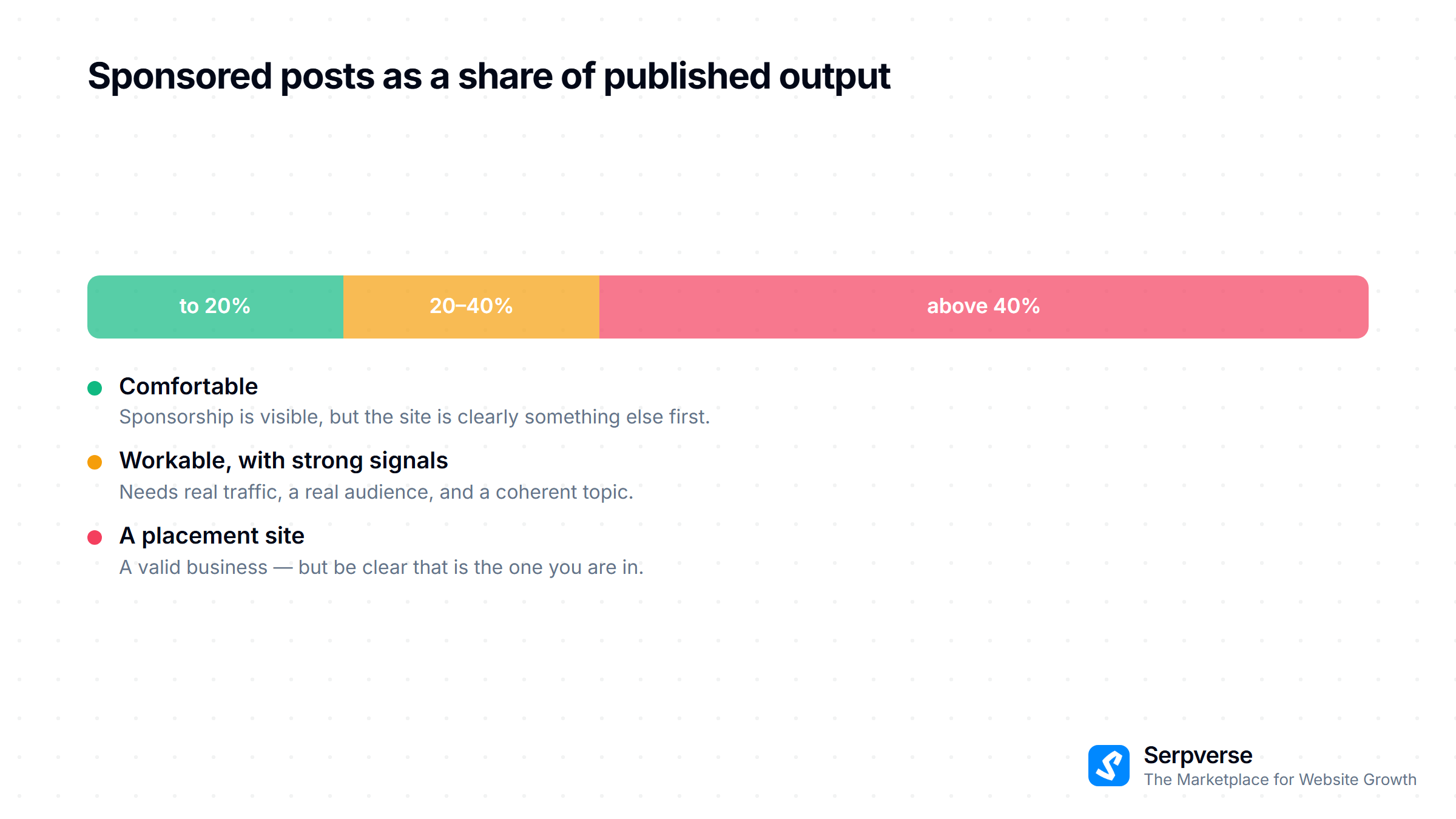
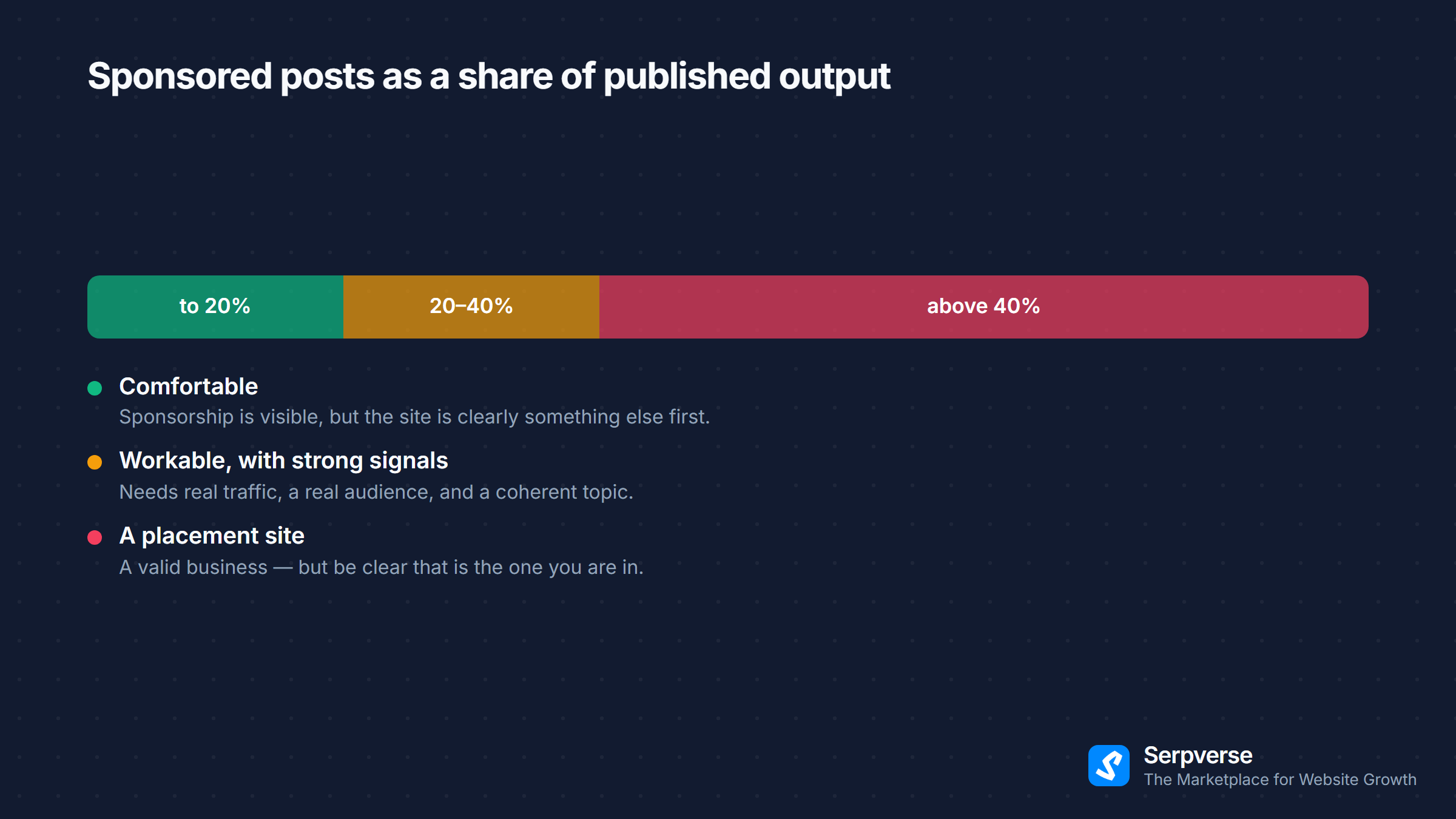
The percentage is a guide, not a threshold with a cliff at the far side. A site at 45% with strong traffic and a tight niche is in better shape than one at 25% with no audience and five unrelated industries in its archive.
Outbound Links Matter More Than Post Count
Here's the detail most publishers miss. The reviewable signal isn't how many sponsored posts you published — it's how many followed commercial links leave your domain.
One sponsored post carrying four followed links to four unrelated businesses contributes more to a risky pattern than four sponsored posts carrying one contextual link each.
This is worth writing into your guidelines explicitly. Capping links per post, and being firm about it, does more for your site's profile than reducing how many posts you accept. Our guide to content guidelines that filter out junk submissions covers how to set those limits so buyers see them before they order rather than arguing after.
What Disclosure Changes
Applying rel="sponsored" to paid links resolves the search-engine question almost entirely. Google's link qualification guidance(opens in new tab) sets out exactly this: the attribute tells crawlers the link was paid for, and a properly attributed paid link is compliant.
The complication is commercial rather than technical. Most buyers are paying specifically for a followed link, and a publisher who nofollows everything will find demand drops sharply. That's the real trade, and it's worth naming plainly rather than pretending it doesn't exist.
Where it lands in practice: publishers who attribute their paid links properly can accept a considerably higher volume without accumulating risk, because the pattern that draws scrutiny is followed commercial links specifically. If you'd rather run volume than rates, disclosure is what makes that viable. The mechanics of dofollow versus nofollow are worth understanding before you set your policy either way.
The Reader Test
Search engines aren't the only constraint, and arguably not the binding one.
Your rates depend on your traffic, and your traffic depends on people finding the site worth returning to. A blog that visibly reorients around whatever pays most loses the readers who made it valuable — and then loses the rates, because the metrics that justified them decay.
This failure mode is slower and quieter than a manual action, and considerably more common. Nobody notices it happening. The site simply becomes less interesting, traffic drifts down over a year, and the placements that used to command a premium stop being worth one.
A blunt check: if you dropped every sponsored post from your archive, would what remains still be a site worth reading? If not, you've crossed a line that has nothing to do with Google.
Warning Signs You've Gone Too Far
Practical indicators, roughly in order of seriousness:
- Direct and returning traffic falling while total pageviews hold up. Your audience is leaving; search is masking it.
- You've started accepting topics you can't defend. The clearest early signal, and the easiest to ignore.
- Your last unpaid post was months ago.
- Buyers negotiating downward and finding you accept. Falling rates usually mean the market has noticed something about your site.
- Outbound followed links outnumber your posts.
Any one is worth attention. Three together mean the mix has shifted and it's time to pull back.
If You're Already Over the Line
It's recoverable, and it doesn't require abandoning the income.
Start publishing genuine content again — that alone shifts the ratio without turning away a single buyer. Tighten the guidelines for new work: fewer links per post, stricter relevance, higher minimum quality. Raise your rates, which reduces volume and improves the mix simultaneously — listing on a marketplace where you set your own price and buyers see it before ordering makes that far easier than renegotiating with existing buyers one at a time.
For the archive, converting the worst historical placements to sponsored is defensible, though be aware buyers may notice and object. Weigh that against how exposed the pattern currently looks.
The mistake to avoid is the abrupt purge — mass-nofollowing everything overnight, or deleting the archive. That looks like exactly what it is, damages relationships with publishers who dealt with you honestly, and isn't necessary. Gradual correction works.
The Short Answer
There is no number. There's a proportion — keep sponsored content meaningfully below half your output — and there's a set of patterns that matter far more than the count: how many followed commercial links leave your site, whether your topics cohere, whether you have a real audience, and whether anything gets published that nobody paid for.
Get those right and the exact figure stops mattering. Get them wrong and no amount of restraint on volume will save you. If you're setting your rates alongside your limits, what to charge for guest posts covers the pricing side, and whether selling guest posts is safe covers the underlying question this one builds on.