How Many Backlinks Disappear? We Rechecked 3,107 to Find Out
We fetched every page behind 3,107 backlinks first seen 12 to 24 months ago. On article pages 31% to 43% were gone, most still listed as live.
- By
- Serpverse Team, SEO Experts
- Published
- Nov 28, 2026
- Read
- 9 min read
- backlinks
- link removal
- research
- link monitoring
- paid links
 Serpverse


A backlink isn't something you own. It sits on someone else's page, and that page can be rewritten, deleted or moved without anyone telling you. Everyone in link building knows backlinks disappear. Far fewer people know how often.
The wider web gives a hint: Pew Research Center(opens in new tab) found that 38% of webpages that existed in 2013 were no longer accessible a decade later. We wanted the figure for the links people actually build, over the stretch they care about. So we took backlinks first seen between November 2024 and October 2025, fetched every page they sat on, and checked whether each link was still there, and how it was marked.
The Short Version
- 31% to 43% of links on article pages were gone 12 to 24 months after they first appeared, depending on how you count.
- Losing the whole page was more common than losing just the link. Deleted pages took 24% of article links; links stripped from pages that were still up took 19%.
- The backlink index was slow to notice. It still listed most of the lost links as live, and 34% of the article links it called live were gone.
- Quiet downgrades happen, but rarely. 4% of links that started out followed had been switched to nofollow or sponsored.
How We Ran the Study
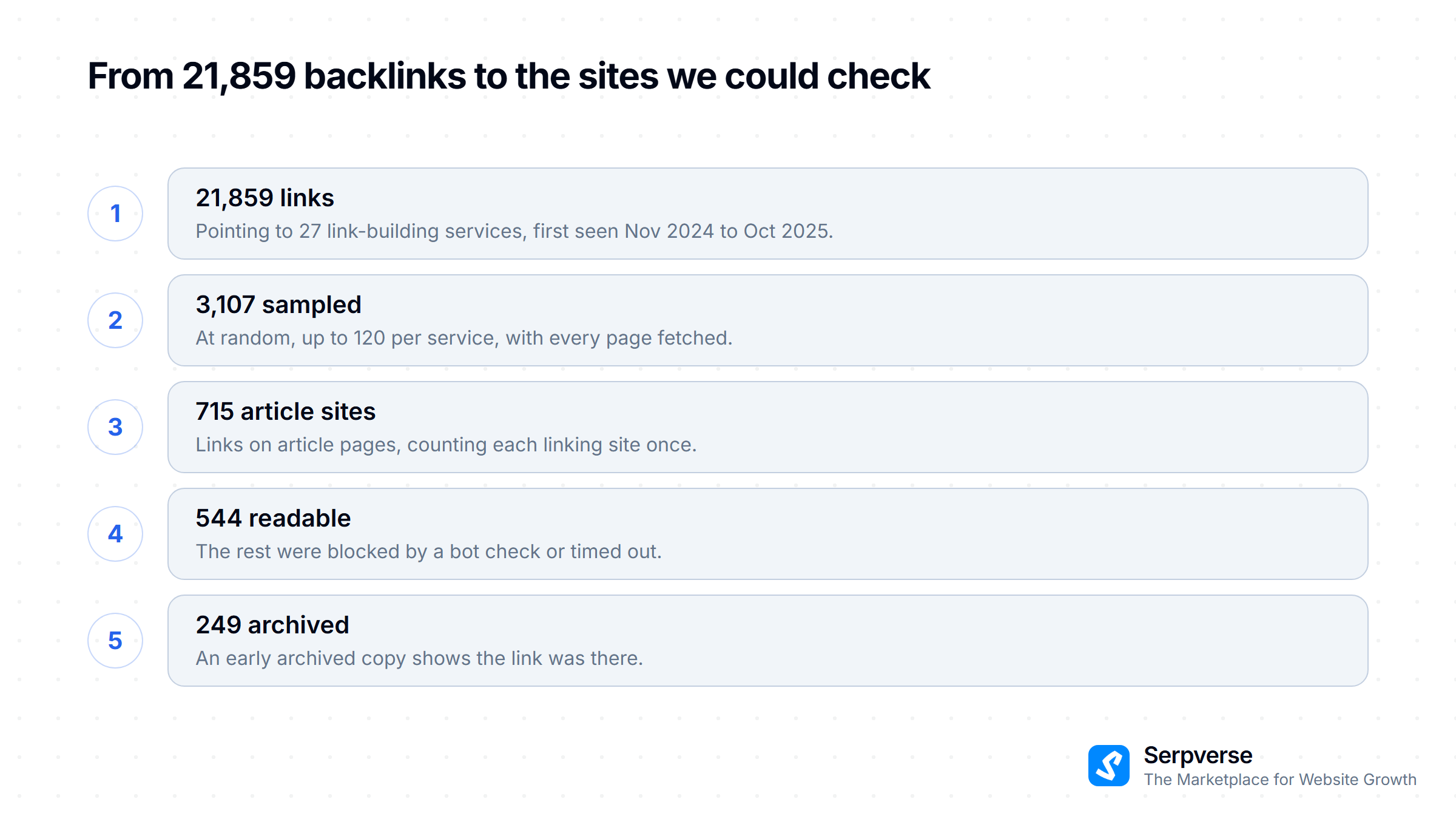
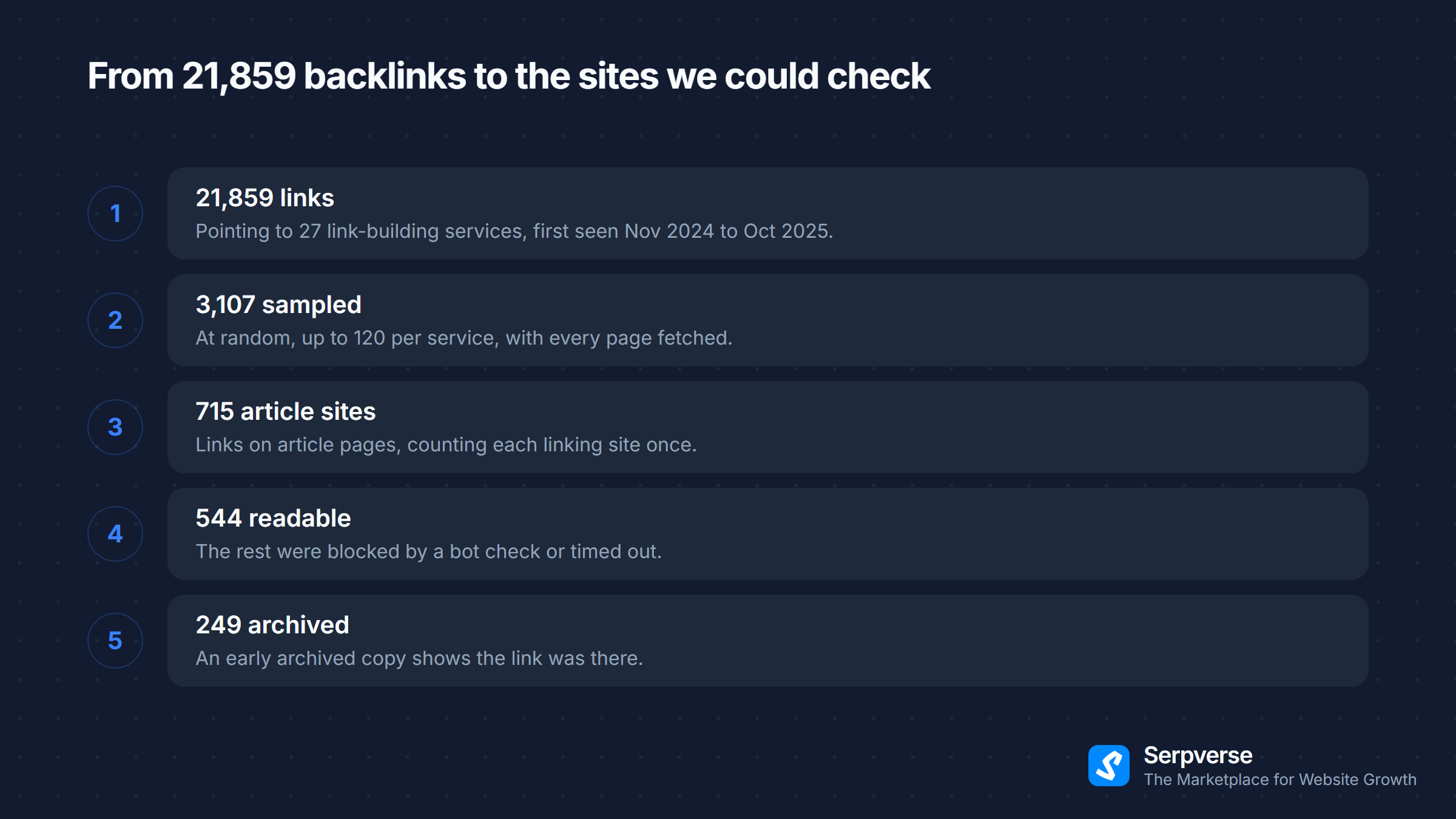
We started from 21,859 links pointing to 27 link-building marketplaces and services, taken from a commercial backlink index, DataForSEO. All of them were first seen between 1 November 2024 and 1 November 2025, and the set included links the index had already marked as lost. From those we drew a random sample of 3,107, up to 120 per service, and on 21 November 2026 we fetched every page.
We run a guest post marketplace ourselves, so we have an interest in the answer. Serpverse wasn't one of the 27, and we don't report results by service: the links point to those services, but weren't necessarily bought through them.
For each link we recorded one of three outcomes:
| Outcome | What it means |
|---|---|
| Page gone | The page returned an error (almost all 404 or 410), or redirected to the site's home page |
| Link removed | The page was still up, but the link was no longer in it |
| Still there | The link was on the page, recorded with its rel value: followed, nofollow, sponsored or ugc |
Google's guide to qualifying outbound links(opens in new tab) explains what each rel value tells it. Pages we couldn't read, blocked by a bot check or timing out, were counted as unreadable rather than gone.
Two choices shape the headline figures:
- Article pages only. Directory listings, profiles, tag pages, forums and Q&A pages behave very differently from articles, and articles are what most link buyers pay for.
- One link per site. A single site can carry many links: one accounted for 108 of the sampled article links on its own. Counting each linking site once stops a few sites from deciding the result.
That left 715 sites with a link on an article page, and we could read 544 of them. For 249 of those, an archived copy from near the start shows the link was there, which gives us a second, stricter estimate below.
How Many Backlinks Disappeared?
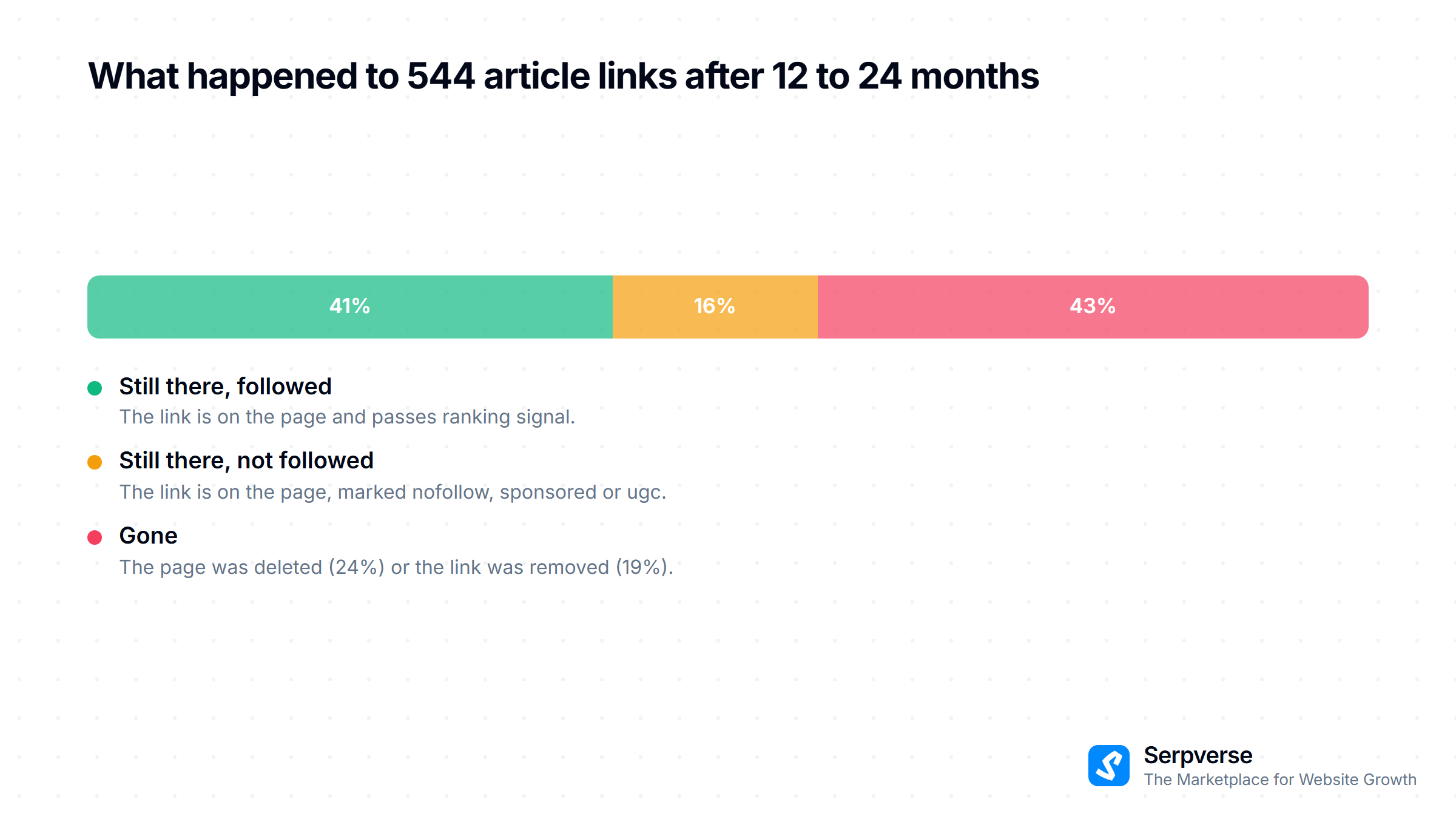
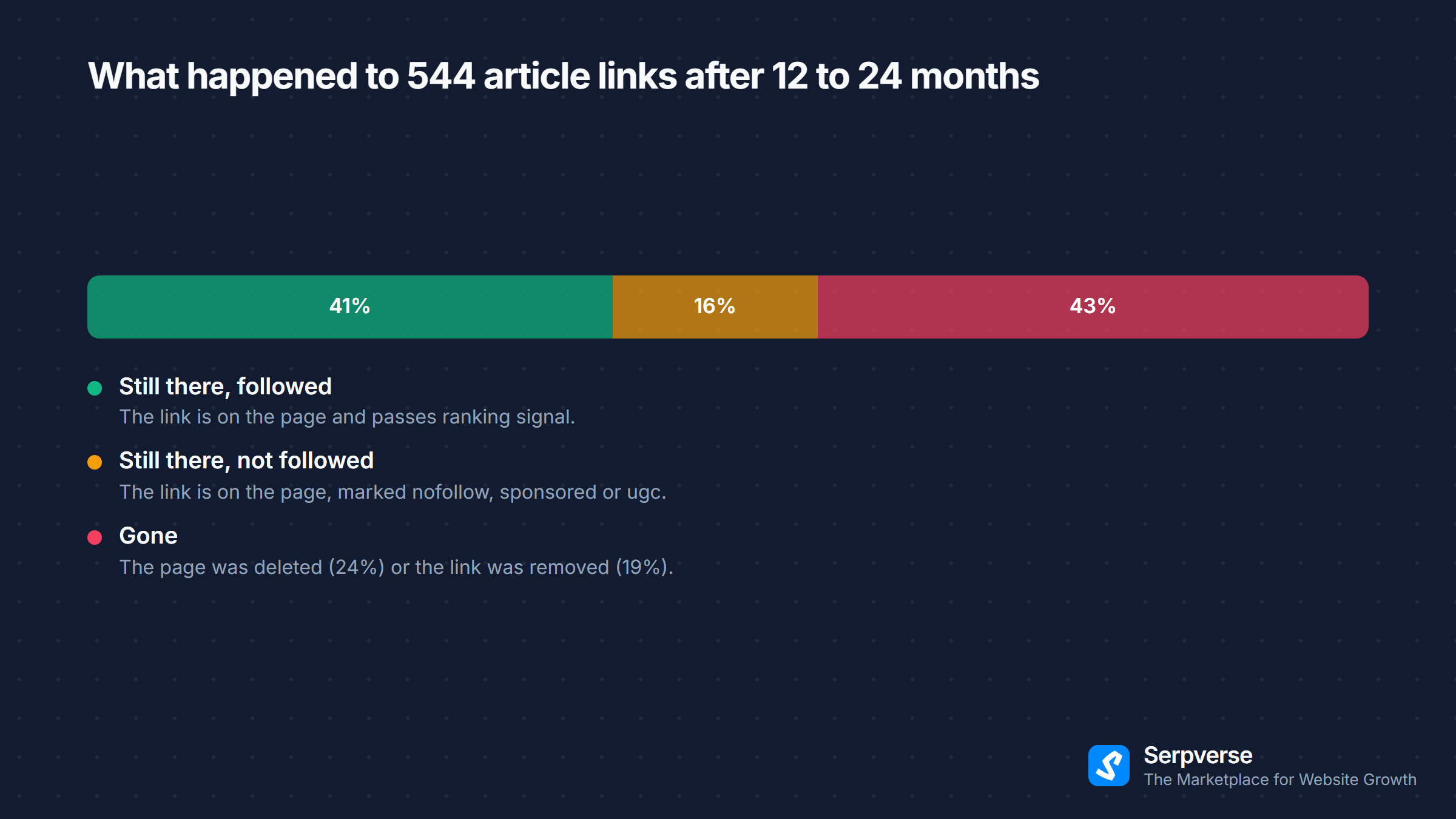
| Article pages, one link per site (544 read) | Share |
|---|---|
| Gone | 43% |
| Page gone | 24% |
| Link removed, page still up | 19% |
| Still there, followed | 41% |
| Still there, nofollow, sponsored or ugc | 16% |
Put another way, fewer than half the article links in the sample were still on the page and passing ranking signal 12 to 24 months on.
Checking Against an Archived Copy
A link the index marked as lost could, in principle, never have been on the page at all. So for a second estimate we went to the Wayback Machine(opens in new tab). We found an archived copy from within 120 days of the link's first appearance for 288 of the 544 pages, and the link was in 249 of those copies.
Of those 249 links, 31% were gone: 44 because the page had been deleted, 32 because the link had been removed.
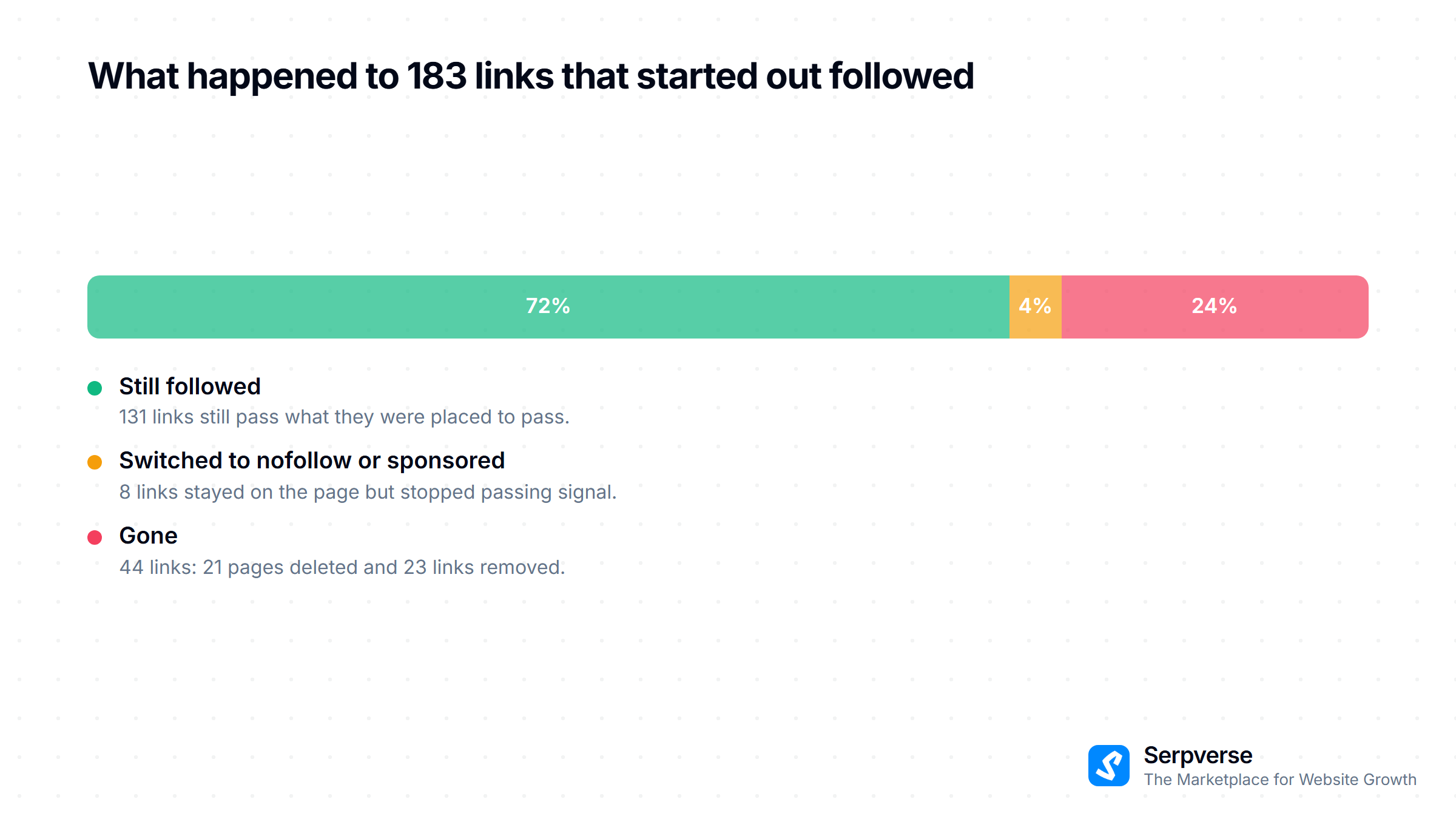
Of the 183 that started out followed:
- 131 (72%) were still followed.
- 44 (24%) were gone.
- 8 (4%) had been changed to nofollow or sponsored.
So 28% of followed links no longer passed what they were placed to pass.
Links that started out nofollow fared worse: 29 of the 61 were gone. That subset is small, so we don't read much into the gap.
The two estimates differ. Pages the Wayback Machine keeps copies of are likely to come from better-kept sites, which would pull the archived subset's loss rate down. That's why we give the result as a range: 31% to 43% of article links gone within two years.
The Index Still Listed Most Lost Links as Live
The most practical finding for anyone who buys or builds links: the backlink index we used was slow to notice a loss.
Of the 233 article links that were gone, the index still listed 145 as live. Put the other way, 34% of the article links it called live were actually gone when we fetched the page. Across every readable link in the sample, including non-article pages, the figure was 46%.
It was wrong in the other direction too, though less often: 27 of the 115 article links it had marked as lost were still on the page.
That isn't a criticism of one provider. An index recrawls billions of pages on its own schedule, and a removed link stays in its data until the next crawl catches it. We tested one index, but every index learns of a removal the same way. A backlink report showing a link as live is not proof that it is; the only reliable check is to load the page.
What to Do About It
- Check the page, not the report. Load the page, find the link and look at its rel. Our backlink checker does this in one step: it reports whether the link is on the page, its anchor text and rel, and whether the page returns an error or carries a noindex.
- Check on a schedule. With losses on this scale, a check every few months on the links you paid for is worth the time. Most of the loss here was invisible until someone looked. For a whole profile rather than a handful of placements, our guide to a backlink profile audit covers the full process.
- Keep a record of what was agreed. The page, the target URL, the anchor and the rel. When something changes, you'll want to describe it exactly.
- Know what happens if a paid link breaks. Before paying for a placement, find out what you can do if it disappears later. Our guide to a removed guest post link covers confirming what broke and getting it put back.
On Serpverse, every listing shows the placement guarantee its publisher sets, and a removed or altered link on a completed order can be disputed afterwards with no deadline to report. When the breach is confirmed, the refund is recovered from the publisher's balance. That's why we think checking matters as much as protection: the sooner a broken placement is spotted, the easier it is to put right.
How Far to Trust These Numbers
We'd rather you knew the limits than took the headline on trust.
- They're a minimum. The index held no lost link last seen before November 2025, a year before our check. It appears to drop lost links after about a year, so links that disappeared before then aren't in the data at all.
- A few errors may be temporary. Of the 132 pages counted as gone, 115 returned a 404 or 410 and 7 redirected to the home page. The other 10 were nine server errors and one login page, and some of those may come back.
- The links point to link-building services. That makes them a mix of paid placements, editorial mentions and spam, not a register of known sold posts. Only 20 pages in the headline set carried a sponsored label, too few to report on their own.
- A quarter of sites couldn't be read. 171 of the 715 article sites were blocked or didn't respond. If those sites behave differently, the rates would shift.
- We read the page's HTML. A link added by JavaScript after the page loads would look removed to us. We expect few links in articles to work this way, but some may.
- Dates come from a crawler. "First seen" is when the index first found a link, which can be later than when it was published, so link ages are approximate.
- No age trend. Links first seen 12 to 18 months before our check showed more loss than those first seen 18 to 24 months before it. That is almost certainly the index dropping older losses, not links getting safer with age, so we haven't drawn a conclusion from it.
Method in Brief
- Source: DataForSEO's backlink index, links to 27 link-building marketplaces and services, first seen 1 November 2024 to 1 November 2025, live and lost. 21,859 links.
- Sample: 3,107 links, random, up to 120 per service.
- Fetch: every linking page loaded on 21 November 2026, with outcomes as in the table above.
- Article pages: classed by URL, a post slug of three or more words, excluding directory, profile, tag, forum, Q&A and review pages.
- Headline set: one link per linking site. 715 sites, 544 readable.
- Baseline: the Wayback Machine copy nearest each link's first-seen date, within 120 days. 288 found, 249 containing the link.