Ecommerce Link Building: Strategies That Work in 2026
Ecommerce link building is hard — product and category pages rarely attract links. Learn tactics that build authority, rankings, and sales for online stores.
Why Ecommerce Link Building Is Uniquely Hard
Ecommerce link building is one of the hardest jobs in SEO — not because the tactics are exotic, but because the pages you most need to rank are the pages nobody wants to link to. Think about the last time you linked to a product page or a category listing. You probably never have. People link to ideas, data, tools, and stories. They rarely link to a "Men's Running Shoes" category or a checkout-ready product page.
That is the structural problem at the heart of ecommerce SEO. Your money pages earn revenue precisely because they are commercial — and that commercial nature is exactly what makes them un-linkable:
- They are transactional, not editorial. A category page exists to sell, not to inform. There's nothing to cite.
- They are thin and templated. Product pages often share a layout, boilerplate copy, and manufacturer-supplied descriptions — near-duplicates at scale.
- They churn. Products get discontinued and categories get restructured, so any links you do earn rot as URLs change.
- Someone else owns the linkable surface. Manufacturers, review sites, and marketplaces frequently outrank you for your own products.
Ahrefs puts the same reality plainly in its guide to ecommerce link building tactics(opens in new tab): "There just aren't that many obvious opportunities to get links to product and category pages." The tactics that actually work, then, are the ones that stop trying to link directly to money pages and instead build authority elsewhere — then route it inward.
The Core Framework: Earn Authority, Then Route It to Money Pages
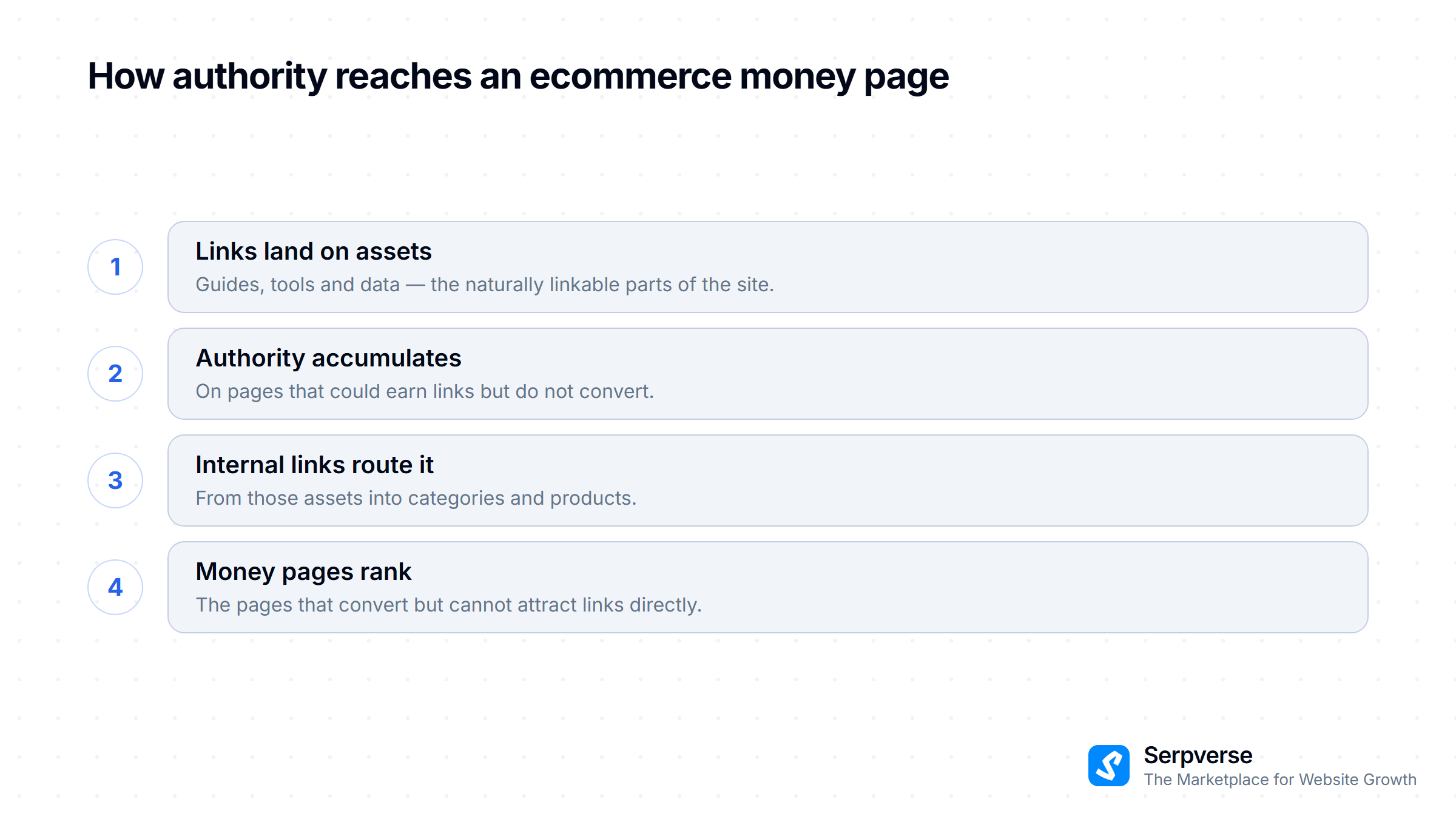
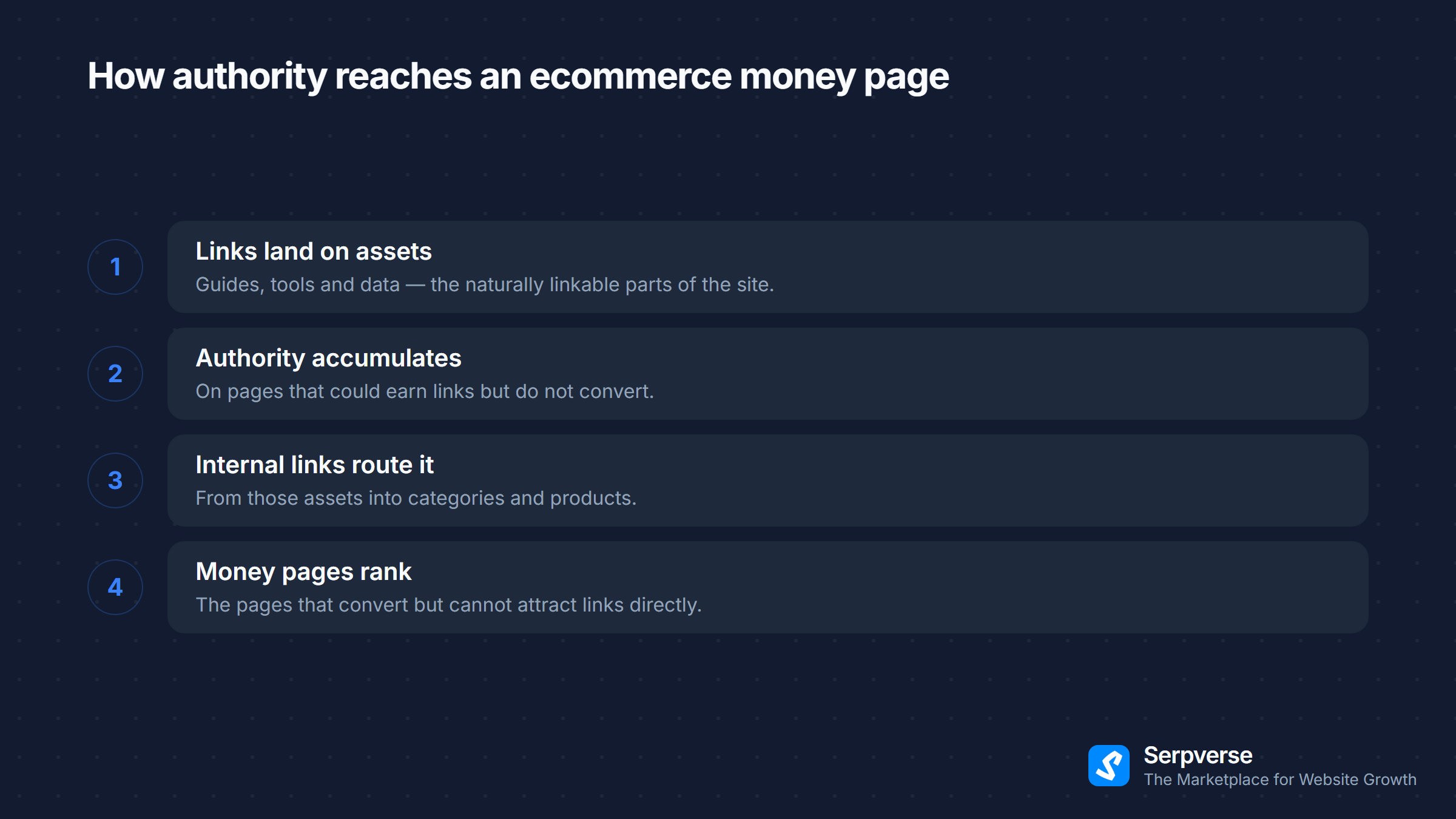
Every durable ecommerce link building program does two distinct jobs. Confusing them is why so many campaigns stall.
| Job | What it looks like | Where the links point |
|---|---|---|
| Earn domain authority | Linkable assets, digital PR, guest posts, brand-mention reclamation | Your homepage, blog, tools, and data — the naturally linkable parts of your site |
| Route authority inward | Internal linking from those assets to categories and products | Your money pages — the ones that convert but can't attract links directly |
Skip the first job and you have nothing to distribute. Skip the second and you build authority that pools in your blog and never reaches the pages that pay the bills.
Build Linkable Assets Your Money Pages Never Could
A linkable asset is a page built to earn links rather than sales. For an online store, the best assets sit adjacent to what you sell — close enough to attract your buyers, useful enough that other sites cite them.
| Asset type | Why it earns links | Example for a store |
|---|---|---|
| Buying & how-to guides | Answer the research questions buyers ask before purchase | "How to choose a road bike" for a cycling retailer |
| Original data & research | Journalists and bloggers cite primary sources | An annual pricing or trend report built from your own sales data |
| Free tools & calculators | Utility earns repeat links and embeds | A "tire size calculator" or "ring size finder" |
| Gift guides & curated roundups | Seasonal, shareable, endlessly referenced | "Best gifts for coffee lovers under $50" |
| Definitive resource pages | Become the reference for a topic | A materials glossary or care-instructions hub |
The discipline is to build assets that sit in your niche, not generic viral bait. A skincare brand's ingredient dictionary attracts links from beauty writers who also buy — and every one of those links can be routed toward product pages. For a deeper look at formats that reliably attract citations, see our guide to content that earns backlinks.
Use Digital PR to Land High-Authority Links
Linkable assets earn links passively; digital PR earns them on purpose. The highest-authority links most stores ever get — national publications, industry press, high-DR blogs — come from giving writers something worth covering.
The formats that work for ecommerce:
- Data studies. You're sitting on first-party data most publishers would envy: pricing trends, buying patterns, seasonal demand. Package it into a report and pitch it.
- Expert commentary. Offer a spokesperson to comment on trends in your category — journalists need sources on deadline.
- Product-led stories. A genuinely novel product, a sustainability milestone, or a surprising use case can be newsworthy on its own.
Digital PR is the highest-ceiling tactic in this list, but also the most effort-intensive. Our full walkthrough of digital PR for link building covers pitching, timing, and turning a single dataset into dozens of placements.
Internal Linking: The Multiplier Most Stores Ignore
This is the step that separates ecommerce link building from generic link building — and the one most stores skip. Every link you earn to a guide, tool, or homepage builds authority that you can deliberately pass to product and category pages through internal links.
Google's own link best practices(opens in new tab) confirm the two things that make internal links count: the link must be a crawlable <a href>, and the anchor text must describe the destination. Apply that inside your store:
- Link from assets to money pages. Every buying guide should link to the relevant category and top products with descriptive anchors — "trail running shoes," not "click here."
- Route homepage authority down. Your homepage is usually your strongest page. Feature key categories in the navigation and body so its equity flows to them.
- Turn categories into hubs. Give thin category pages unique intro copy, curated subcategories, and links to related guides so they become destinations, not dead ends.
- Use breadcrumbs and related products. Structured internal links spread equity across the catalog and help every page get discovered.
Done well, internal linking turns a handful of hard-won external links into ranking power across hundreds of products. Our internal linking strategy guide covers the site-architecture patterns that make this compound.
Broken Link Building for Product and Category Pages
Broken link building is a natural fit for ecommerce because product catalogs churn constantly — which means the web is full of dead links to discontinued products and defunct competitors.
The play is simple: find a resource page or article linking to a product that no longer exists, then offer your equivalent page as the replacement. Discontinued competitor SKUs, shuttered brands, and outdated "best of" roundups are all opportunities. Because you're helping a site owner fix a genuine error, acceptance rates beat cold outreach. Our step-by-step guide to broken link building covers how to find dead links at scale and pitch the swap.
Reclaim Unlinked Brand and Product Mentions
Online stores get mentioned far more often than they get linked. Reviewers, gift-guide writers, and forum users name your brand and products without linking — and every unlinked mention is a link you've already earned but not collected.
Search for your brand name, flagship products, and founders, then filter for pages that mention you without a link. A short, friendly outreach note — "thanks for the mention, would you add a link so readers can find us?" — converts a meaningful share of them. For ecommerce specifically, watch for product roundups and "where we bought it" posts, which name products constantly and link inconsistently.
Tap Supplier, Manufacturer, and Partner Links
Some of the easiest, most relevant links for a store come from the businesses you already work with. These links are on-topic by definition and rarely require any content creation.
- "Where to buy" and stockist pages. If you retail other brands, ask to be listed on their official stockist or store-locator pages.
- Manufacturer and distributor directories. Suppliers often maintain authorized-reseller lists — get on them.
- Partners and integrations. Payment providers, shipping partners, and complementary brands frequently keep partner directories.
- Trade associations and local listings. Industry bodies and local business directories offer relevant, durable links.
None of these move rankings alone, but together they form a relevant, natural-looking foundation that most competitors never bother to claim.
Guest Posting to Build Store-Wide Authority
Because you can rarely earn editorial links straight to a product page, guest posting is one of the most reliable ways to build the domain authority you then route inward. A well-placed article on a respected publication in your niche earns a contextual link — and you control the anchor, the target, and the surrounding context.
The key is relevance and editorial quality. Google's link spam policies(opens in new tab) target "large-scale article marketing or guest posting campaigns" with over-optimized anchors — but an individual, genuinely useful guest post on a relevant site is exactly the kind of editorial endorsement the algorithm rewards. Point the link at a linkable asset or category hub, then let your internal linking carry the equity to products.
This is where a guest-post marketplace like Serpverse removes the hardest part — finding relevant, vetted publishers. You can filter verified publishers by niche, domain metrics, traffic, and price; see transparent pricing before you commit; and keep your payment in escrow until the placement is live and you've approved it. Revision rounds and campaign tools let you run placements across dozens of publishers without the cold-outreach overhead.
An Ecommerce Link Building Roadmap
Tactics land better in sequence than all at once. A practical order for most stores:
| Phase | Focus | Tactics |
|---|---|---|
| Foundation | Claim what you've already earned | Unlinked mentions, supplier & stockist links, directory listings |
| Assets | Build things worth linking to | Buying guides, a data study, one useful free tool |
| Outreach | Earn and reclaim links actively | Broken link building, digital PR, guest posting |
| Distribution | Route authority to money pages | Internal linking from every asset to categories and products |
Work top to bottom, but treat distribution as continuous — every new link you earn should be paired with internal links that carry its equity toward the pages that convert. Consistency compounds: a store that earns and routes even a few quality links a month pulls away from competitors chasing one-off wins.
Key Takeaways
- Ecommerce link building is hard because money pages aren't linkable — product and category pages are transactional, thin, and constantly changing. Stop trying to link to them directly.
- Earn authority elsewhere, then route it inward. Linkable assets, digital PR, and guest posts build domain authority; internal linking carries it to the pages that convert.
- Linkable assets should sit in your niche — buying guides, original data, free tools, and gift guides attract links from the same people who buy from you.
- Internal linking is the multiplier — it turns a handful of external links into ranking power across the whole catalog, and most stores ignore it.
- Claim the easy links first — unlinked mentions and supplier or stockist pages are relevant, durable, and often uncontested.
- Use guest posting for controllable authority — relevant, editorial placements build the domain strength you funnel to money pages, and a vetted marketplace removes the publisher-discovery bottleneck.
The stores that win at ecommerce link building treat it as two disciplines working together — earning authority and distributing it — not as a scramble for links to pages that were never meant to attract them.